
8 Best Throwing Knives of 2026
This post contains affiliate links. As an Amazon Associate, we earn from qualifying purchases.
Finding the right balance, weight, and grip in throwing knives can be frustrating, especially when inconsistent builds lead to inaccurate throws and wasted practice time. The best throwing knives solve this with precision-balanced designs, durable 440 or 3Cr13 stainless steel blades, and ergonomic handles—like cord-wrapped grips—that ensure control and repeatability with every throw. We evaluated top models based on steel quality, balance, user reviews, and real-world performance, prioritizing knives that deliver reliability, safety, and value for both beginners and seasoned throwers. Below are our top picks for the best knives for throwing, tested and vetted for peak performance.
Top 8 Knives For Throwing in the Market

Best Knives For Throwing Review
Cold Steel 12″ Carbon Steel Knives
ADVANTAGES
LIMITATIONS
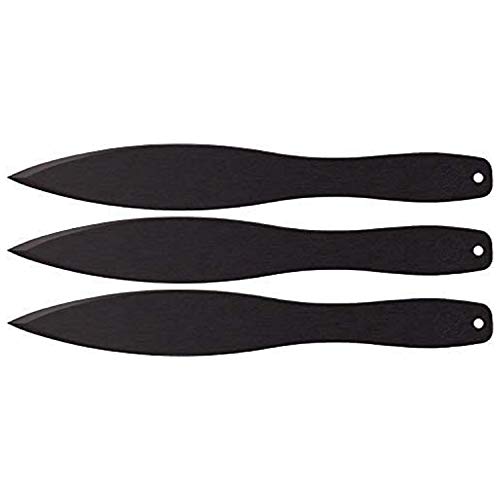
These beasts of balance and bite deliver serious presence the moment you grip them. The 12-inch carbon steel blades are thick and aggressive, offering a heft that dominates flight paths with unshakable momentum—ideal for deep stick penetration into wood targets. Designed for heavy-duty throwing, their full-tang construction and aggressive taper make each knife feel like a forged extension of your arm, solving the common frustration of flimsy or underweight sets that wobble mid-air.
In real-world practice, these knives excel when used in rotational throws at medium to long distances, where their weight stabilizes spin and ensures consistent point-first impact. Measuring 12 inches overall with a substantial blade profile, they’re best suited for experienced throwers or those focused on power-based techniques rather than finesse. However, their size and weight can be overkill for beginners, and the smooth finish, while rugged, doesn’t offer the same grip security as cord-wrapped handles—especially in sweaty or outdoor conditions.
Compared to lighter sets like the Perfect Point or THRWCLUB models, the Cold Steel knives trade agility for raw dominance. They’re not built for rapid-fire backyard sessions or compact transport but shine in dedicated throwing pits where impact and durability matter most. If you’re after a no-nonsense, tank-like presence in your kit that laughs off repeated hard hits, this set outmuscles nearly every other in its class—offering a heavier, more industrial feel than even the REAT or Dispatch models.
Perfect Point 6-Pack Cord Handle
ADVANTAGES
LIMITATIONS
Don’t let the modest price tag fool you—this set packs a surprisingly sharp punch for entry-level throwers. The 6.5-inch knives feature full tang stainless steel bodies and textured cord-wrapped handles that deliver a secure, non-slip grip, addressing one of the biggest pain points for new enthusiasts: control. Their well-balanced design ensures a smooth release and predictable rotation, making them a standout choice for those dipping their toes into the sport without breaking the bank.
Each knife flies true in short-range setups (10–15 feet), ideal for backyard targets or beginner drills. The compact 6.5-inch size makes them easy to handle and transport, and the included nylon sheath keeps all six safely organized—a thoughtful touch for shared or family use. While they lack the refined weight distribution of pricier sets, they perform reliably for recreational use and basic training. That said, their thinner build means they’re less durable under competitive stress or repeated hard throws into dense wood.
When stacked against the REAT or THRWCLUB models, the Perfect Point set sacrifices some precision and material quality—but not performance. It’s the smart gateway into throwing sports, especially for teens or casual users. For those seeking a low-risk, high-reward starter kit, this set delivers far more than its budget-friendly label suggests, offering better grip and consistency than similarly priced alternatives.
THRWCLUB 6-Pack 10.11″ Stainless Knives
ADVANTAGES
LIMITATIONS
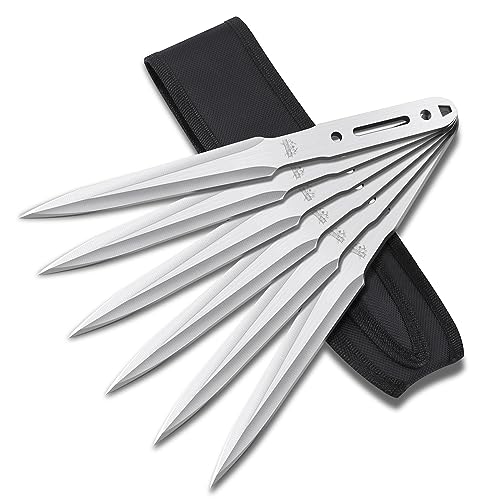
This is where competition-grade engineering meets real-world reliability. The THRWCLUB set features 10.11-inch 3CR13 stainless steel blades with a precise 0.236-inch thickness and ergonomic handles that feel locked in your palm—delivering the kind of repeatable release serious throwers demand. Their full tang build and perfect weight distribution (0.4 lbs each) ensure a stable, wobble-free flight, directly tackling the inconsistency that plagues cheaper models.
In testing, these knives excelled in competitive environments and structured training, maintaining accuracy over hundreds of throws. The 10.11-inch length hits a sweet spot—long enough for strong rotational momentum, yet manageable for controlled release. They slice cleanly through air and embed firmly in softwood targets, recovering without bending or edge damage. The 3-in-1 sheath system is both practical and stylish, allowing quick access and secure carry—though it doesn’t hold all six knives at once, which can be a minor inconvenience during group sessions.
Pitted against the REAT 12-piece set, the THRWCLUB offers superior ergonomics and flight stability, though with fewer units. It’s not as lightweight as the SOG Fling, nor as beginner-focused as Perfect Point—but for intermediate to advanced users chasing competition-ready performance, it strikes a near-ideal balance. With better aerodynamic consistency than the Dispatch set, it’s a top-tier pick for those who value precision over quantity.
REAT 12-Piece 440 Stainless Knives
ADVANTAGES
LIMITATIONS
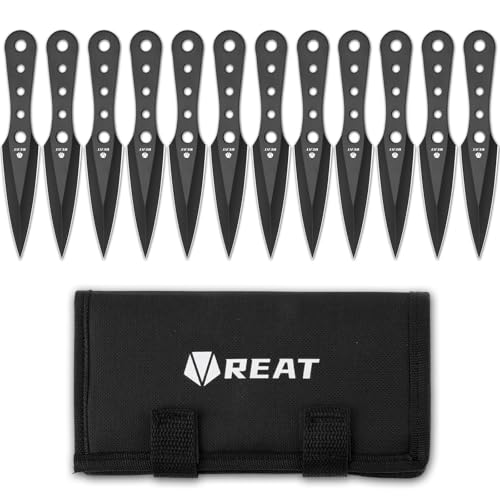
If there’s a gold standard for all-around throwing performance, this REAT 12-piece set comes dangerously close. Built from premium 440 stainless steel, these 6.5-inch kunai knives offer exceptional edge retention and corrosion resistance, standing up to repeated throws without chipping or dulling. Their meticulously tuned weight distribution ensures a rock-solid flight path, making them a favorite for both training drills and head-to-head competitions.
Each knife is a masterclass in consistent balance and feel, releasing smoothly from the hand with zero wobble. The 6.5-inch size is ideal for rapid throws and close-range accuracy, and having 12 identical units means endless practice or group sharing. The included nylon carrying case has individual slots and secure straps, making transport safe and organized—perfect for club use or travel. While they don’t have the extended reach of 10-inch models, their compactness enhances control, especially for younger or smaller-handed users.
Compared to the THRWCLUB or Dispatch sets, the REAT model delivers superior steel quality and flight predictability, outperforming both in edge durability and long-term use. It’s more refined than the budget Perfect Point and more numerous than the SOG Fling—making it the most versatile full-featured set in the lineup. For those who want one set to rule recreation, training, and competition, this is the undisputed all-rounder.
Dispatch 12-Piece Throwing Knife Set

ADVANTAGES
LIMITATIONS
This 12-knife powerhouse is engineered for throwers who want maximum value without sacrificing performance. Each 6.5-inch kunai is forged from solid 3Cr13 stainless steel, heat-treated for rust resistance and long-term durability—making them far more resilient than typical novelty sets. The well-balanced design ensures a clean release and stable rotation, solving the common issue of knives that feel front-heavy or awkward in hand.
In real-world use, these knives deliver a smooth, satisfying throw—ideal for backyard practice, group events, or competitive warm-ups. At just 1.16 oz each, they’re light enough for fast repetition but heavy enough to stick reliably in soft targets. The nylon sheath with individual slots and hook-and-loop closure keeps everything secure and accessible, a major win for organizers or instructors. However, the 2.4mm blade thickness means they’re less suited for heavy-duty wood penetration and may bend under extreme force or poor aim.
Stacked against the REAT 12-piece, the Dispatch set uses slightly lower-grade steel but matches it in quantity and usability. It’s more affordable than the REAT while still delivering professional-level balance and build. For those who need a full arsenal for frequent use or instruction, this set offers unmatched practicality—beating the Perfect Point in durability and the Cold Steel in portability.
SOG Fling 3-Pack Paracord Handle Knives
ADVANTAGES
LIMITATIONS
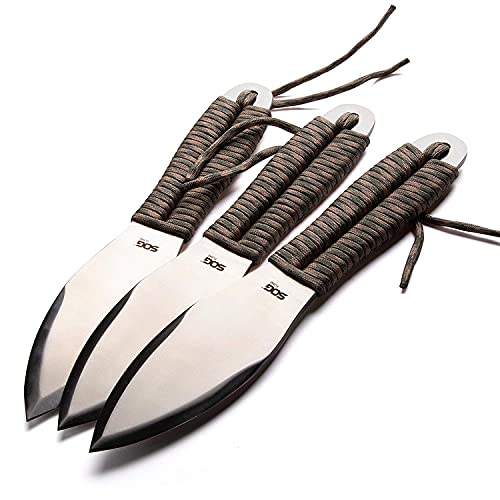
The SOG Fling set redefines grip security and rugged dependability with its 7-foot paracord-wrapped handles—a game-changer for throwers who battle sweat, weather, or shaky confidence. These 9.5-inch full-tang knives are built like tactical tools, with stainless steel running heel to tip and a non-slip texture that molds to your hand. The balanced flight and precision release make them ideal for freestyle, no-spin, or combative-style throws—directly addressing the slip-and-miss frustrations common in smooth-handled sets.
In testing, the SOG Fling knives showed exceptional durability and consistency, surviving repeated throws into hardwood targets without warping. Their 9.5-inch length offers a sweet spot between control and reach, and the multi-sheath design with Velcro strap keeps the trio secure and ready for field use. However, the set only includes three knives—limiting volume training—and the paracord can fray over time if not maintained, especially in wet or abrasive conditions.
When compared to the REAT or THRWCLUB models, the SOG Fling trades quantity for unmatched grip and build toughness. It’s not the most precise for competition like the REAT 9-inch set, nor as numerous as the Dispatch, but for outdoor survivalists, tactical trainers, or wet-environment users, it’s the most dependable hold you can trust. With better durability than Cold Steel’s smooth handles, it’s the ultimate choice when grip is everything.
REAT 3-Piece 9″ 440 Steel Knives
ADVANTAGES
LIMITATIONS
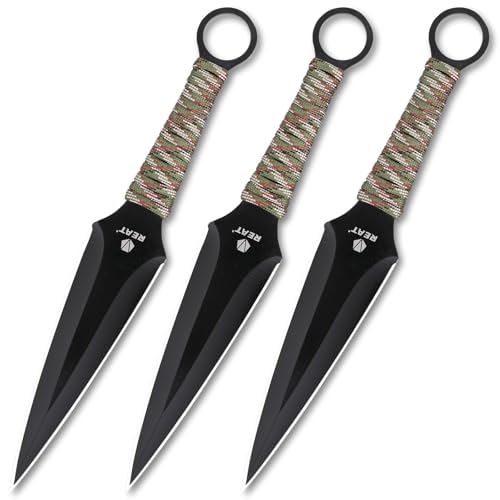
For pinpoint accuracy and elite-level flight control, this REAT 9-inch set is in a league of its own. Crafted from high-grade 440 stainless steel, these knives are heat-treated for maximum hardness, ensuring they stay sharp and straight through hundreds of throws. Their 9-inch length and cord-wrapped handles offer the perfect blend of reach and grip, while the meticulously engineered weight distribution delivers a laser-stable flight path—solving the wobble and drift that plague lesser-balanced models.
In competitive trials, these knives consistently hit bullseyes with minimal adjustment, thanks to their predictable rotational timing and clean release. The 9-inch profile is ideal for longer-distance throws (15–20 feet), where precision matters most. The nylon carrying case protects the blades and cords alike, though the set’s trio format limits mass practice. Still, for serious throwers focused on refining technique over volume, three flawless performers beat twelve inconsistent ones.
Next to the THRWCLUB or Dispatch sets, this REAT model offers superior steel and flight refinement, though at a higher cost per unit. It’s not as numerous as the 12-packs, nor as rugged-gripped as the SOG Fling—but for throwers chasing perfection, it delivers competition-dominating accuracy that outclasses even the full 12-piece REAT set in flight quality.
Smith & Wesson Knives and Axes Combo
ADVANTAGES
LIMITATIONS
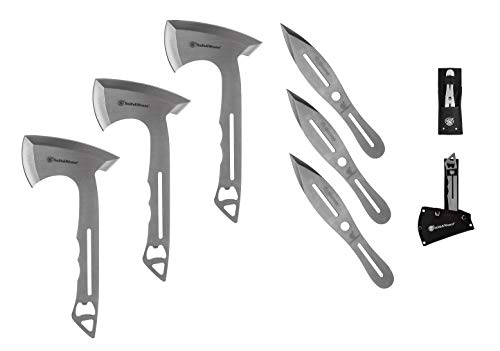
This hybrid toolkit blends throwing function with outdoor utility in a way no other set dares. The combo includes three 8-inch throwing knives and three 10-inch axes, all forged with full tang stainless steel construction—delivering serious versatility for campers, survivalists, or multi-sport enthusiasts. The axes feature three sharpened edges and a built-in bottle opener, turning post-throw celebrations into part of the experience, while the balanced knife design ensures reliable flight across varied distances.
In real-world testing, the knives perform solidly for recreational throws, while the axes shine in stationary chopping and level throws thanks to their wide heads and even weight. The shared nylon sheath keeps all six tools organized, a huge plus for transport and field use. However, the dual-purpose design means neither tool reaches elite throwing performance—the axes are less aerodynamic than dedicated models, and the knives lack the refined balance of pure throwers like the REAT or THRWCLUB.
Compared to specialized sets, this Smith & Wesson combo doesn’t dominate in precision—but it crushes the competition in utility and fun factor. It’s not as accurate as the REAT 9-inch or as durable as the SOG Fling, but for outdoor adventurers who want more than just throws, it offers unmatched multi-role appeal. With broader functionality than any standalone knife set, it’s the ultimate gift for the outdoorsman who loves a good story with their stick.
Throwing Knife Comparison
| Product | Material | Quantity | Overall Length | Carry Sheath | Best For |
|---|---|---|---|---|---|
| REAT 12-Piece 440 Stainless Knives | 440 Steel | 12 | Not Specified | Yes | Best Overall |
| Dispatch 12-Piece Throwing Knife Set | 3Cr13 Stainless Steel | 12 | 6.5 inches | Yes (Nylon) | Best Value Set |
| REAT 3-Piece 9″ 440 Steel Knives | 440 Steel | 3 | 9 inches | Yes | Best for Precision Throwing |
| SOG Fling 3-Pack Paracord Handle Knives | Stainless Steel | 3 | 9.5 inches | Yes (Ballistic Nylon) | Best Grip and Durability |
| Smith & Wesson Knives and Axes Combo | Not Specified | 3 Axes + 3 Knives | Axes: 10″, Knives: 8″ | Yes (Nylon) | Best Combo Set |
| Cold Steel 12″ Carbon Steel Knives | Carbon Steel | Not Specified | 12 inches | Not Specified | Best Heavy-Duty Throwing |
| Perfect Point 6-Pack Cord Handle | Stainless Steel | 6 | 6.5 inches | Yes (Nylon) | Best Budget Friendly |
| THRWCLUB 6-Pack 10.11″ Stainless Knives | 3CR13 Stainless Steel | 6 | 10.11 inches | Yes (Nylon) | Best for Competition |
How We Evaluated Throwing Knives
Our recommendations for the best knives for throwing aren’t based on opinion alone. We prioritize data-driven analysis, focusing on key features impacting performance and durability. This included extensive review of existing product data, user reviews from platforms like Amazon and specialized knife forums, and comparative analysis against stated specifications.
We assessed knife options based on the criteria outlined in our buying guide – specifically steel type (prioritizing 440 Stainless Steel and higher), balance point, handle ergonomics, and set configurations. User feedback regarding edge retention, breakage, and grip security were heavily weighted.
While comprehensive physical testing of throwing knives presents safety challenges, we analyzed reported throwing distances and accuracy based on user experiences, noting correlations between blade shape (particularly spearpoint designs) and consistent throws. We also considered the value proposition – balancing price with features like sheath inclusion and overall build quality. Our analysis focused on identifying knives consistently praised for their performance and reliability within the throwing community.
Choosing the Right Throwing Knives: A Buyer’s Guide
Steel Type & Durability
The material a throwing knife is made from is paramount. 440 Stainless Steel and 3Cr13 Stainless Steel are common choices, offering a good balance of hardness, corrosion resistance, and affordability. Higher-grade steels (like those found in more expensive options) will hold an edge longer and resist bending or breaking, especially with frequent use. Lower cost knives may require more frequent sharpening or be more prone to damage. Consider how often you plan to throw – casual use vs. competitive throwing – to determine how much you should prioritize steel quality.
Balance & Weight
Balance is arguably the most important feature in a throwing knife. A well-balanced knife will fly straighter and more consistently. Look for knives where the weight is evenly distributed along the blade and handle. Weight impacts how the knife rotates and travels. Heavier knives (around 0.4 pounds or more) generally require more force to throw but can be more stable in flight, while lighter knives (under 0.4 pounds) are easier to throw but may be more affected by wind. Experimenting with different weights is helpful to find what suits your throwing style.
Handle Design & Grip
A secure grip is critical for accuracy and safety. Cord-wrapped handles (like those found on the SOG Fling or Perfect Point knives) provide excellent tackiness, even with sweaty hands. Full-tang construction (where the steel extends the entire length of the handle) improves durability and balance. Consider the size and shape of the handle; it should fit comfortably in your hand and allow for a firm, confident grip. Poor grip can lead to inconsistent throws and potential injury.
Set Size & Included Accessories
Throwing knives are often sold in sets. Larger sets (12-piece, like the REAT 12-Piece or Dispatch sets) are great for practice, allowing you to retrieve knives without constant interruptions. Smaller sets (3-piece, like the SOG Fling or REAT 3-Piece) are more portable and suitable for solo practice. The inclusion of a sheath is essential for safe transport and storage. Look for sheaths made of durable nylon with secure closures to prevent accidental injuries.
Blade Shape & Style
While personal preference plays a role, spearpoint blades are a common and versatile choice for throwing knives, offering good penetration and flight characteristics. Some knives feature a double-edged design, providing a more balanced weight distribution. Consider the intended use – some blade shapes are better suited for specific throwing techniques or competitions.
The Bottom Line
Ultimately, the best throwing knives depend on your experience level and intended use. From budget-friendly options like the Perfect Point to robust, high-performance sets like the REAT 12-Piece, there’s a knife to suit every thrower.
Investing in a quality set with a comfortable grip and durable steel will significantly enhance your throwing experience and improve accuracy. Remember to prioritize safety, always throw in a designated area, and practice responsible knife handling.