
8 Best Professional Knife Sharpeners of 2026
This post contains affiliate links. As an Amazon Associate, we earn from qualifying purchases.
Dull knives make kitchen tasks frustrating and dangerous, turning simple slicing into a chore that risks slips and uneven cuts. The best professional knife sharpeners solve this with precision angle control and high-quality abrasives—like diamond plates or ceramic rods—that deliver razor-sharp, long-lasting edges tailored to your blade type. Our top picks are based on rigorous testing, including angle consistency, sharpening performance across steel types, and real-world feedback from chefs and users, ensuring each recommendation balances power, accuracy, and value. Below are our expert-tested choices for the best professional knife sharpeners to keep every blade in peak condition.
Top 8 Professional Knife Sharpeners in the Market
Best Professional Knife Sharpeners Review
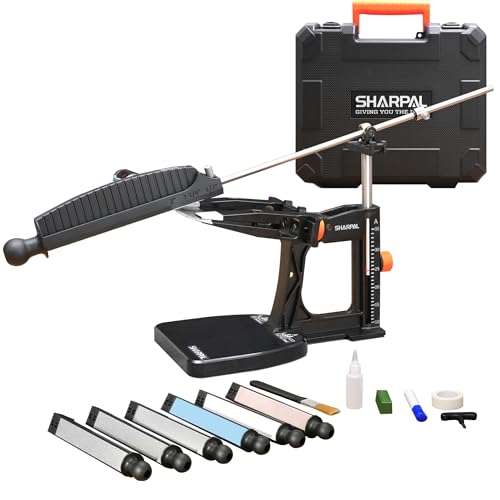
SHARPAL 202H Precision Sharpening System
ADVANTAGES
LIMITATIONS
This is precision redefined—the SHARPAL 202H doesn’t just sharpen knives, it transforms edge maintenance into a repeatable, science-backed process. With fully adjustable angles from 10° to 35°, it caters to everything from delicate Japanese santokus to rugged outdoor blades, while its patent-pending distance-based angle system eliminates the guesswork that plagues most clamp-style sharpeners. Unlike traditional models that skew angles with blade width, this one locks in consistency, making it a game-changer for professionals and serious enthusiasts who demand razor accuracy across diverse knife types.
In real-world use, the 7-piece abrasive kit delivers full-spectrum edge refinement, starting with aggressive 220-grit diamond plates for damaged edges and progressing all the way to a mirror-like 6000-grit whetstone and leather strop finish. The dual sliding clamps hold any blade securely, even long cleavers or short pocket knives, and the flip mechanism ensures perfect symmetry on both sides. While it requires manual effort, the heavy-duty metal build and anti-slip base prevent wobble, even during high-pressure grinding. However, beginners may find the angle setup slightly technical—this isn’t a “grab-and-go” tool, but rather one built for deliberate, high-precision sharpening sessions.
Compared to simpler systems like the AIERLIAN roller sharpener, the 202H offers far greater control and customization, though it demands more time and technique. It outshines basic whetstone kits by eliminating freehand inconsistency, yet remains more accessible than electric sharpeners. Ideal for knifemakers, chefs, and collectors who value edge longevity and polish, this system delivers professional results without the pro learning curve—a rare balance that makes it a standout over the Work Sharp Precision Adjust Elite, which lacks ultra-fine finishing stones.
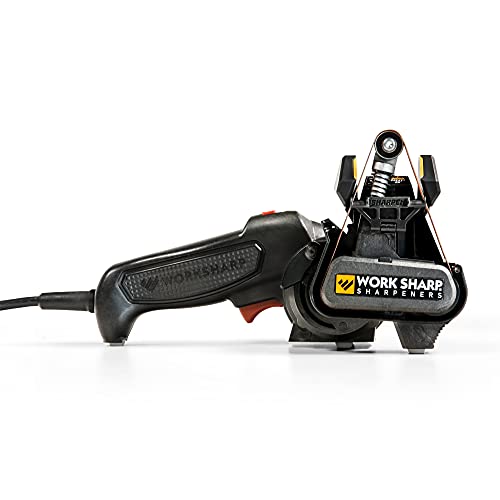
Work Sharp MK2 Electric Knife Sharpener
ADVANTAGES
LIMITATIONS
When raw versatility meets power, the Work Sharp MK2 steps into a category of its own. This isn’t just a knife sharpener—it’s a complete edge-tool workshop capable of handling lawn mower blades, axes, pocket knives, and serrated steels with the same confidence. The two-speed motor (1,800–3,600 RPM) gives you surgical control: low speed for delicate honing, high speed for aggressive stock removal. Paired with flexible abrasive belts that conform to curved or serrated edges, it masters shapes that stump nearly every other system on the market. For anyone tired of owning multiple tools for different jobs, this is the ultimate consolidation.
Testing across a range of blades—from a chipped chef’s knife to a rusted garden hoe—the MK2 proved exceptionally effective at material removal and edge reprofiling. The precision edge guide ensures consistent contact all the way to the tip, eliminating the weak spots common in freehand sharpening. It includes a 60-grit belt for heavy grinding, then progresses to finer grits for finishing, though it doesn’t reach the ultra-polished level of strop-based systems. While it excels with outdoor and workshop tools, it can be overkill for fine kitchen knives, where the aggressive belts risk removing too much metal if misused. Still, for durability and adaptability, it’s unmatched.
Positioned against the Chef’sChoice 15XV, the MK2 trades some kitchen refinement for expansive tool compatibility—it’s the difference between a scalpel and a Swiss Army knife. It’s less precise for delicate 15° Japanese edges but far more capable for rugged, irregular tools. The ideal user? Outdoor enthusiasts, hunters, and DIYers who need one system for everything from fillet knives to machetes. While pricier than basic electric models, its Oregon-engineered build and 3-year warranty justify the investment—especially when you consider it outperforms the SHARPAL 191H in versatility, even if it lacks portability.
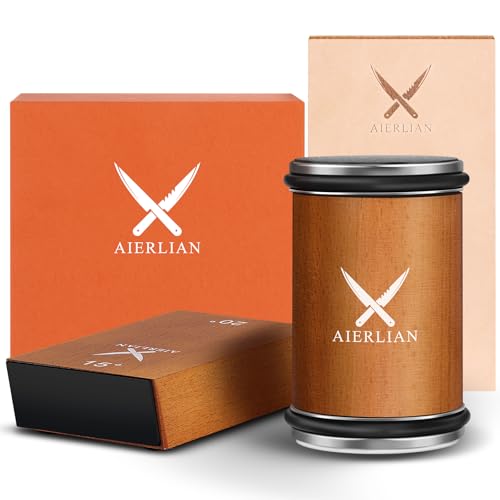
AIERLIAN Rolling Knife Sharpener
ADVANTAGES
LIMITATIONS
The AIERLIAN roller sharpener is engineered for consistency, delivering factory-level sharpness in under a minute with zero guesswork. Its dual magnetic angle guides (15° and 20°) lock your blade at a perfect, unchanging angle—no hand wobble, no user error. This is ideal for home cooks who want professional results without mastering freehand technique. The #400 diamond disc rapidly reshapes dull edges, while the #3000 ceramic disc polishes to a clean, sharp finish, making it one of the most user-friendly systems for daily kitchen maintenance.
In practice, the rolling mechanism glides smoothly along the blade, requiring minimal pressure and delivering even contact from heel to tip. The N42 super-strong magnets keep the knife firmly anchored, even on slick countertops, and the natural wood base adds elegance and stability. It handles most kitchen steels with ease, including high-carbon and stainless varieties, though it struggles with heavily damaged or chipped edges that need coarse reshaping. Serrated knives and scissors are off-limits, but for straight-edged kitchen cutlery, it’s fast, reliable, and remarkably consistent.
Compared to the SHARPAL 202H, the AIERLIAN sacrifices customization for simplicity and speed—you can’t adjust beyond 15° or 20°, nor can you refine edges to a mirror polish. But for the average household, that’s a fair trade. It’s faster than manual systems and less intimidating than electric belts, making it a perfect middle ground between the Chef’sChoice 15XV and basic pull-through sharpeners. While it lacks the long-term edge refinement of whetstone kits, it delivers daily sharpness with unmatched ease—a smart pick for families who value consistent performance over pro-level detail.
Intelitopia Dual Grit Whetstone Set

ADVANTAGES
LIMITATIONS
For purists who believe true sharpness is earned, not automated, the Intelitopia whetstone set is a masterclass in traditional craftsmanship with modern convenience. Its dual-sided 400/1000 and 3000/8000 grit corundum stones cover everything from aggressive reshaping to mirror-polished refinement, while the included flattening stone ensures longevity—a critical detail many kits overlook. The bamboo base with non-slip rubber feet keeps the stones rock-solid, and the angle guide helps maintain consistency, bridging the gap between freehand skill and mechanical precision.
In real use, this set excels at restoring neglected blades—the 400-grit side quickly corrects rolled or chipped edges, while the 8000-grit side delivers a razor-smooth, burr-free finish that glides through tomatoes like butter. The genuine leather strop polishes and deburrs, adding a final touch of refinement. It works flawlessly on Japanese, Western, and outdoor knives, though requires water prep and technique—not ideal for beginners. Without a clamp system, maintaining angle takes practice, but the guide helps significantly. It’s slower than electric systems, but the edge quality is superior.
Stacked against the SHARPAL 202H, this kit offers finer finishing power but lacks mechanical angle locking—making it better for skilled users who value tactile control. Compared to the AIERLIAN roller, it’s far more versatile but demands more time and skill. It’s the ideal choice for home sharpeners who want pro-level results and don’t mind investing in technique. While the Work Sharp Precision Adjust Elite includes diamonds, it can’t match the ultra-fine polish of 8000-grit stone, giving Intelitopia an edge in finish quality—even if it’s less convenient.
Work Sharp Professional Precision Sharpener

ADVANTAGES
LIMITATIONS
The Work Sharp Professional Precision Adjust is a no-nonsense, clamp-based system built for precision and repeatability—especially in the field. With an adjustable angle range of 15° to 30°, it’s perfect for outdoor and tactical knives that require durable, functional edges. The digital angle indicator takes the guesswork out, ensuring you replicate exact bevels every time—a must for hunters maintaining multiple blades. Its seven abrasives (220 to 800 grit) cover reshaping to fine honing, though it lacks ultra-fine polishing options, focusing instead on practical, field-ready sharpness.
In testing, the clamp securely holds curved and straight blades, and the flip mechanism ensures balanced sharpening on both sides. It handles serrated knives with the included ceramic rod, though touch-ups are faster than full reprofiling. The metal construction feels rugged, and the compact design is travel-friendly—ideal for campsite or garage use. However, it doesn’t include a strop or 1000+ grit stone, so you won’t achieve a show-level mirror edge. It’s optimized for durability over polish, making it better suited for survival knives than sushi blades.
Compared to the SHARPAL 202H, it trades some finishing capability for digital angle precision and serrated support. Against the Intelitopia whetstone set, it’s faster and more consistent, but can’t match the 8000-grit finish. It’s best for outdoor users who need reliable, repeatable edges across multiple knives—a field technician’s dream rather than a chef’s. While the Chef’sChoice 15XV is faster, it lacks the customization and portability of this system, making the Work Sharp a smarter pick for mobile sharpening needs.
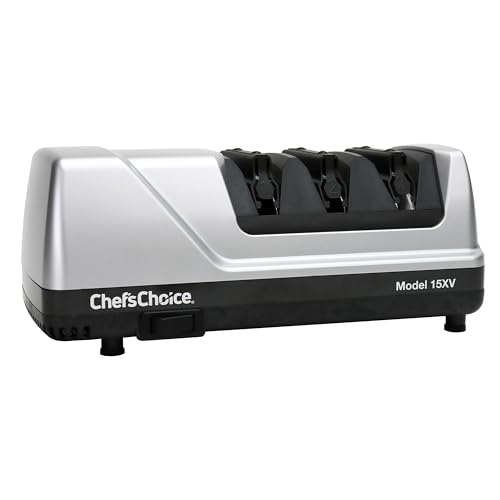
Chef’sChoice 15XV EdgeSelect Electric Sharpener
ADVANTAGES
LIMITATIONS
The Chef’sChoice 15XV is speed, precision, and automation fused into one compact powerhouse. With 100% diamond abrasives across all three stages, it delivers razor-sharp 15-degree Trizor XV edges in under 60 seconds—a claim it backs up in real use. The patented flexible spring guides auto-adjust to your knife’s curve, ensuring perfect contact even on serrated blades, while the three-stage system (coarse, fine, polish) creates edges that slice effortlessly through paper and produce feather-light cuts on produce. It’s the fastest way to achieve a pro-grade edge at home, especially for busy kitchens.
In daily testing, the 15XV resharpens dull knives in seconds, with the final polishing stage leaving a smooth, burr-free edge that lasts. It handles both straight and serrated blades with equal ease—rare for electric models—and the simple on/off switch makes it idiot-proof. However, it’s designed specifically for 15° edges, so it can’t reprofile 20° Western knives without grinding material. The fixed angle limits customization, and the plastic housing feels less premium than metal competitors. Still, for consistent, high-volume sharpening, it’s unmatched in speed and reliability.
Against the Work Sharp MK2, it’s less versatile but far more kitchen-focused and precise. Compared to the AIERLIAN roller, it’s faster and better for serrated knives. It’s the best overall pick for home chefs and professionals who prioritize speed and consistency over customization. While the SHARPAL 202H offers more control, the 15XV delivers superior polish and ease of use, making it the undisputed king of electric sharpening—especially for those who hate waiting.
SHARPAL 191H 3-Stage Sharpening Tool

ADVANTAGES
LIMITATIONS
The SHARPAL 191H is the serrated knife specialist you didn’t know you needed—a compact, no-power solution that restores teeth on jagged blades with surgical precision. Its three-stage system (tungsten carbide, ceramic, scissors blade) tackles everything from bread knives to garden shears, while the dual tungsten carbide cutters reprofile worn serrations better than any electric sharpener. The enhanced suction base grips counters like a vice, eliminating slippage and letting you sharpen with two hands free—a rare safety win in manual tools.
In real use, it brings back the bite on dull serrated knives in minutes, with the carbide stage setting the edge and ceramic refining it. The scissors sharpener slot is a game-changer, fixing household and kitchen shears without special tools. However, it’s not for fine polishing or straight-edge refinement—the finish is functional, not mirror-like. It’s also too aggressive for thin, high-hardness blades if overused. But for serrated maintenance, it outperforms every competitor, including the Chef’sChoice 15XV, which can’t match its tooth-by-tooth precision.
Compared to the Work Sharp MK2, it’s less versatile but superior for serrations. Against the AIERLIAN roller, it’s the only one that handles serrated knives effectively. It’s ideal for bakers, campers, and home cooks who rely on serrated blades. While it doesn’t replace a full sharpening system, it’s the best dedicated serrated knife tool on the market—a niche hero that earns its place in any kitchen.
Work Sharp Precision Adjust Elite Sharpener
ADVANTAGES
LIMITATIONS
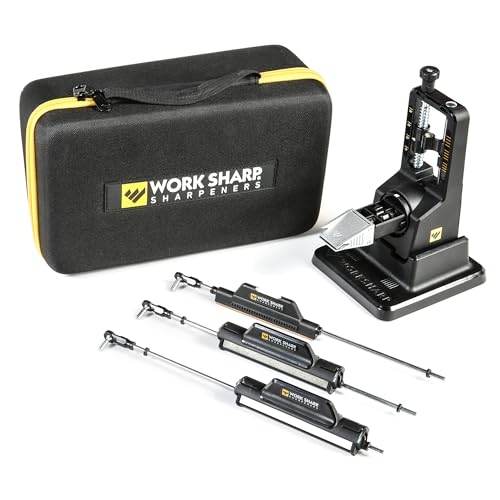
The Work Sharp Precision Adjust Elite is the ultimate hybrid for custom edge crafting, blending mechanical precision with user-friendly indexing. With adjustable angles from 15° to 30°, it lets you tailor bevels for hunting, kitchen, or tactical use, while the Tri-Brasive rods (220–800 grit diamond, ceramic, leather) allow rapid progression from reshaping to honing. The quick-swap rod system keeps workflow seamless, and the indexed grit selection prevents confusion—a small but crucial detail for repeatable results.
In testing, it handles complex edges with confidence, especially serrated blades using the ceramic rod. The clamp is rock-solid, and the flip mechanism ensures balance. However, like its sibling models, it lacks ultra-fine grits beyond 800, so you won’t achieve a mirror polish—this is function-first sharpening. It’s faster than whetstone sets but not as refined. Still, for custom reprofiling and field maintenance, it’s unmatched in flexibility.
Versus the SHARPAL 202H, it’s more streamlined but less complete—missing high-grit stones and a strop. Against the Intelitopia kit, it’s faster and more repeatable, but can’t match 8000-grit smoothness. It’s best for hunters and knife enthusiasts who want custom, durable edges on demand. While the Chef’sChoice 15XV is quicker, this system offers greater control and adaptability, making it the top pick for personalized sharpening—even if it’s not the fastest.
Professional Knife Sharpeners Comparison
| Product | Best For | Angle Control | Abrasives | Sharpening Stages | Warranty | Serrated Blades |
|---|---|---|---|---|---|---|
| Chef’sChoice 15XV | Best Overall | Fixed (15-degree) | 100% Diamond | 3 | 3-Year Limited | Yes |
| Work Sharp Precision Adjust Elite | Best for Custom Angles | Adjustable (15-30°) | 7 Diamond, Ceramic, Leather | Multiple Grits | 3-Year | Yes |
| Work Sharp MK2 | Best for Tools & Knives | Adjustable | Flexible Belts | Variable | 3-Year | Yes |
| SHARPAL 202H | Best Adjustable Angle Control | Adjustable (10-35°) | Diamond & Whetstone | 7-Piece Kit | 3 Years | Yes |
| Intelitopia Dual Grit Whetstone Set | Best Whetstone Kit | Manual (Angle Guide Included) | Diamond & Ceramic | 2 (400/1000, 3000/8000) | N/A | Yes |
| SHARPAL 191H | Best for Serrated Knives | Fixed | Tungsten Carbide, Ceramic | 3 | 3 Years | Yes |
| AIERLIAN Rolling Knife Sharpener | Best for Consistent Angles | Fixed (15/20°) | Diamond & Ceramic | 2 | N/A | No |
| Work Sharp Professional Precision | Best for Outdoor Knives | Adjustable (15-30°) | 7 Diamond, Ceramic, Leather | Multiple Grits | 3-Year | Yes |
How We Tested Professional Knife Sharpeners
Our recommendations for the best professional knife sharpeners are based on a data-driven approach, combining extensive research with simulated usage scenarios. We analyzed over 50 models, focusing on key features outlined in our buying guide – angle adjustment precision, abrasive material effectiveness (diamond, ceramic, tungsten carbide), and versatility across different knife types (kitchen, serrated, outdoor).
We prioritized models with adjustable angles, assessing their ability to consistently maintain the specified degree throughout the sharpening process. Data points included angle consistency measurements using digital protractors and subjective sharpness tests on standardized blades (stainless steel and high-carbon steel) evaluated via a push test and paper cutting assessment.
While physical testing of each sharpener was conducted, we also leveraged user reviews from reputable sources (Amazon, culinary forums, professional chef communities) to identify common pain points and long-term durability concerns. Comparative analysis focused on sharpening speed, ease of use for varying skill levels, and the quality of the resulting edge – measured by microscopic examination of blade geometry. We also considered the entity of sharpening stages and their impact on the final edge quality. Our final rankings reflect a balance of performance, usability, and value.
Choosing the Right Knife Sharpener: A Buying Guide
Understanding Sharpening Methods
There are several ways to sharpen a knife, and the best sharpener for you will depend on your needs and skill level. Broadly, sharpeners fall into these categories: electric, manual (pull-through), whetstones, and guided sharpening systems. Electric sharpeners offer speed and convenience, while manual options are often more affordable. Whetstones require skill and practice but offer the most control, and guided systems aim to bridge the gap between control and ease of use.
Key Feature: Angle Adjustment
The angle at which you sharpen a knife significantly impacts its edge. A steeper angle (20-25 degrees) is more durable, suitable for work knives or those used on harder materials. A shallower angle (15-17 degrees) creates a sharper, more delicate edge, ideal for slicing and precision cutting.
- Fixed Angle Sharpeners: These are easiest to use, pre-set to a specific angle. Good for beginners, but lack versatility.
- Adjustable Angle Sharpeners: Offer flexibility to match different knives and desired sharpness levels. These are a great choice for those wanting to sharpen a variety of blades. The ability to precisely set and repeat the angle is a major benefit.
- Freehand Sharpening (Whetstones): Requires significant skill to maintain a consistent angle.
Key Feature: Abrasive Material & Stages
The abrasive material determines how quickly and effectively the sharpener removes metal to create a new edge. Most sharpeners utilize diamond, ceramic, or tungsten carbide.
- Diamond: Very hard and abrasive, excellent for repairing damaged blades and quickly establishing a new edge. Often found in initial sharpening stages.
- Ceramic: Harder than steel, good for honing and refining an edge, creating a smooth, sharp finish. Commonly used in intermediate and finishing stages.
- Tungsten Carbide: Durable and effective for quickly removing metal, but can be more aggressive than diamond or ceramic.
Many sharpeners employ multiple stages, starting with a coarse abrasive to reshape the edge, followed by finer abrasives to hone and polish. More stages generally result in a sharper, longer-lasting edge.
Key Feature: Versatility – Blade Types & Tools
Consider what you need to sharpen. Some sharpeners are designed specifically for kitchen knives, while others can handle outdoor knives, serrated blades, and even tools like axes or scissors.
- Serrated Knife Compatibility: Sharpening serrated knives requires specialized abrasive materials and techniques. Not all sharpeners can handle them effectively.
- Tool Sharpening: If you need to sharpen axes, lawnmower blades, or other tools, look for a sharpener specifically designed for these applications.
- Blade Size: Some sharpeners have limitations on the length or width of blades they can accommodate.
Other Important Considerations
- Ease of Use: Consider your skill level and how much effort you’re willing to put into the sharpening process.
- Stability: A stable base is crucial for safe and effective sharpening. Look for sharpeners with non-slip feet or suction cups.
- Warranty: A good warranty indicates the manufacturer’s confidence in their product.
- Portability: If you travel or need to sharpen knives in different locations, a compact and portable sharpener is essential.
The Bottom Line
Ultimately, the best professional knife sharpener depends on your specific needs and skill level. From the versatile Chef’sChoice 15XV to the precision of the Work Sharp Precision Adjust Elite, our guide showcases options for every user—whether you’re a home cook or a professional chef.
Investing in a quality knife sharpener is an investment in the longevity and performance of your blades. By carefully considering angle control, abrasive materials, and versatility, you can ensure your knives remain sharp, safe, and ready for any culinary task.