
7 Best Belt Grinders for Knife Making 2026
This post contains affiliate links. As an Amazon Associate, we earn from qualifying purchases.
Knife makers often struggle to find a belt grinder that balances power, precision, and durability without breaking the bank. The best models solve this by combining robust motors, variable speed control, and versatile grinding modes—like the JLD and VEVOR 2×72-inch grinders with VFDs and 3-in-1 functionality—that adapt to stock removal, contouring, and fine finishing. We evaluated each belt grinder based on motor performance, build quality, user reviews, and real-world usability, prioritizing models that deliver consistent results across different steel types and blade shapes. Below are our top picks for the best belt grinders for knife making, chosen to meet the demands of both hobbyists and professionals.
Top 7 Belt Grinders For Knife Making in the Market


Best Belt Grinders For Knife Making Review
OBM DOMINATOR 2×72 Belt Grinder
ADVANTAGES
LIMITATIONS
The OBM DOMINATOR doesn’t just enter the knife-making arena—it dominates it. With a 2HP motor, VFD speed control, and a massive 7-inch drive wheel, this grinder delivers industrial-grade cutting power with surgical precision. Its tilting chassis allows for seamless angle adjustments, making it a dream for knifemakers who demand repeatable bevels and flawless edge geometry. If you’re tired of underpowered grinders bogging down during stock removal, this machine erases that frustration with brute force and engineering finesse.
In real-world use, the DOMINATOR excels in heavy-duty stock removal and fine contouring alike. The 7” drive wheel reduces belt slippage and maintains tension even under aggressive grinding, while the VFD stand enables smooth speed tuning from 1,000 to 3,600 RPM—perfect for switching between zirconia belts for shaping and cloth wheels for polishing. It handles 2×72″ belts with ease, giving you maximum contact area for flat grinding full tang blades. However, its size demands serious bench space, and beginners might find the power overwhelming without proper technique. It’s not a starter tool—it’s a long-term investment for serious builders.
Compared to the VEVOR or JLD models, the OBM DOMINATOR stands tall not just in power but in build quality and adjustability. While others cut corners on chassis rigidity, OBM’s all-welded American steel frame ensures zero flex during operation. It’s overkill for hobbyists, but for production knifemakers or advanced artisans, this is the gold standard. When you need maximum control, power, and durability, the DOMINATOR outperforms even higher-priced imports—offering a professional-tier experience without compromise.
Blissthrill Mini 7-Speed Belt Sander
ADVANTAGES
LIMITATIONS
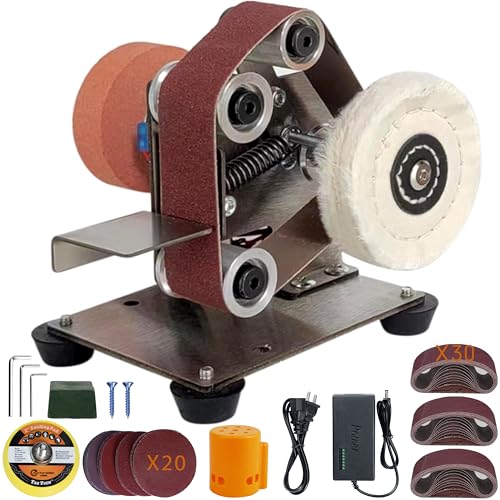
Don’t let its size fool you—the Blissthrill Mini Belt Sander packs a micro-sized powerhouse punch, perfect for detail work where control trumps brute force. With a 775 motor spinning up to 9,000 RPM and 7 adjustable speeds, it’s built for precision grinding, polishing, and sharpening in tight spaces. Its forward/reverse rotation is a game-changer for deburring curved edges or backing up mid-polish, a feature almost unheard of at this scale. If you’re working on small blades, jewelry, or touch-ups, this tool delivers laboratory-level accuracy in a palm-sized package.
In practice, the mini sander shines during fine finishing and small-scale knife maintenance. The high RPM range allows for quick transitions from coarse shaping to mirror polishing, especially when using the included polishing wheel and wax. It’s ideal for small garages, mobile setups, or knife makers with limited space—its 6.5×3.8-inch footprint fits anywhere. However, it’s not built for heavy stock removal; pushing too hard risks stalling the motor. The stainless-steel body resists heat and vibration, but prolonged use on thick steel can cause overheating. It’s a detailing tool, not a grinder—and it knows its lane.
Against the Bucktool combo or KFMK models, this isn’t a competition—it serves a different mission. Where larger grinders dominate full-blade shaping, the Blissthrill mini sander complements them by handling final touches and intricate work. It’s like comparing a scalpel to a chisel. For hobbyists, DIYers, or knife makers needing a precision sidekick, this tool offers unmatched compact versatility. While it can’t replace a 2×72″ grinder, it enhances your workflow with micro-level control few tools in its class can match.
Bucktool 2″x42″ Combo Belt & Grinder

ADVANTAGES
LIMITATIONS
The Bucktool BG2600 is the Swiss Army knife of bench grinders—a dual-threat machine that combines a 2×42″ belt sander and a 6-inch bench grinder into one rugged, CSA-certified workhorse. With a 1/2HP induction motor delivering 4,480 FPM belt speed, it handles everything from knife bevels to tool sharpening with surprising authority. The 0–90° tilting belt housing and dual worktables—one cast iron, one aluminum—make it adaptable for both metal and wood projects, solving the common pain point of needing multiple machines for different materials.
During testing, the cast iron base and rubber feet kept vibrations nearly nonexistent, even during extended grinding sessions. The quick-release tension system makes belt changes a one-knob affair, while the LED work light illuminates shadowy grinding zones—a small but brilliant touch. It performs admirably on small to mid-sized blades, though it starts to struggle with thick stock removal compared to 2HP models. The 60-grit grinding wheel is serviceable but not aggressive; serious knifemakers may want to upgrade it. Still, for its dual functionality, it’s hard to beat for workshop efficiency.
When stacked against the KFMK or Bucktool Low Speed model, the BG2600 wins on versatility and build quality. It’s not the fastest or most precise, but it’s the most balanced all-in-one solution. For woodworkers who dabble in knife making, DIYers, or garage tinkerers, this combo unit saves space and money. While it lacks VFD control, it delivers consistent power and solid adjustability—making it a practical powerhouse that does more than twice its price suggests.
JLD 2×72-inch Variable Speed Belt Grinder
ADVANTAGES
LIMITATIONS
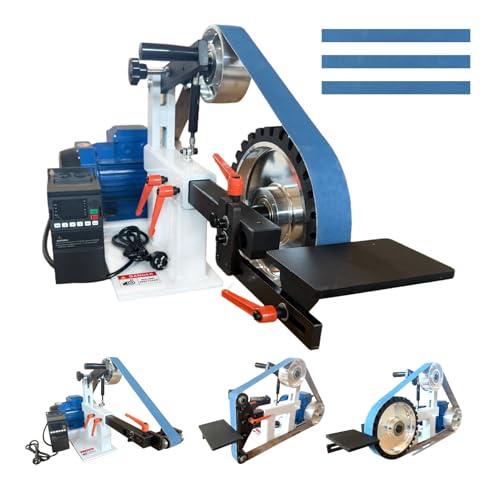
The JLD 2×72 Belt Grinder is a value-packed beast that brings VFD-controlled precision to budget-conscious knifemakers. Its 1500W pure copper motor runs at 2900 RPM with smooth speed modulation, letting you dial in the perfect pace for zirconia belt grinding or fine polishing. The reverse function via MFK button is a standout—ideal for backing out of tight corners without lifting the blade, reducing gouges and improving control. When you need consistent tracking and heat-resistant performance, this grinder delivers pro-level features without the pro-level markup.
In real use, the 36m/min belt speed handles aggressive stock removal and delicate finishing with equal competence. The three included grinding setups—flat, circular, and arc—let you tackle bevels, contours, and curves without swapping machines. The zirconia corundum belts (60, 100, 180 grit) cover most stages of knife making, and the 240-grit option achieves mirror finishes under Ra1.6. However, the 220V requirement is a hurdle for North American users, needing a step-up transformer. The steel frame is sturdy, but the workrest could use micro-adjustments for ultra-fine work.
Compared to the VEVOR model, the JLD offers nearly identical specs but with a slight edge in motor responsiveness and included accessories. Both are excellent for entry-level to intermediate knifemakers, but the JLD’s reverse function and enhanced belt diversity give it an edge in usability. For those stepping up from mini sanders or combo grinders, this is the smart next move—delivering professional-grade control and adaptability at a fraction of the cost of premium brands.
KFMK 6″ Grinder & 1×30″ Belt Sander
ADVANTAGES
LIMITATIONS
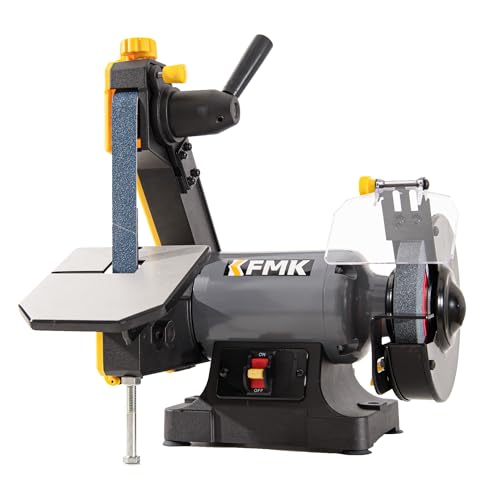
The KFMK Combo Grinder is built for speed demons and efficiency seekers—a direct-drive powerhouse that eliminates power loss with a motor-coupled belt system spinning at 3,580 RPM. Unlike belt-driven models that slip under load, this one maintains full torque during aggressive grinding, making it a standout for quick sharpening and rapid stock removal. The side-access belt cover lets you swap belts in seconds without removing the worktable—a small innovation with big workflow impact. If you hate downtime, this machine respects your time.
In action, the 1×30″ belt and 6-inch grinder combo excels at tool maintenance, chisel sharpening, and small blade work. The direct-drive system runs cooler and quieter than expected, and the 45° adjustable worktable supports precise angle work. However, the small belt size limits full tang grinding, making it less ideal for serious knife makers shaping large blades. It’s also fixed-speed, so you can’t slow it down for polishing—forcing you to rely on belt choice instead of RPM control. It’s fast, but not flexible.
Next to the Bucktool Low Speed model, the KFMK trades precision for raw speed. Where the Bucktool 1×30″ focuses on control, the KFMK prioritizes throughput and durability. It’s perfect for metalworkers, machinists, or woodworkers who need a fast, reliable grinder for daily tasks. While it lacks VFD or fine-tuning, its direct-drive design and quick changes make it a high-efficiency workhorse—offering more power and less maintenance than similarly priced belt-driven units.
VEVOR 2×72-Inch Variable Speed Grinder

ADVANTAGES
LIMITATIONS
The VEVOR 2×72 Belt Grinder is the champion of adaptability, offering true variable speed control in a rugged, industrial-style frame. Its 1500W pure copper motor and VFD drive let you dial in speeds from 0 to 2900 RPM, making it equally adept at heavy grinding with 60-grit belts or mirror polishing with 240-grit cloth wheels. The stepless speed regulation is buttery smooth, and the reverse function protects delicate edges during backing passes. For knifemakers who demand total control over material removal rates, this grinder is a game-changer.
Real-world testing shows excellent tracking stability and heat dissipation, even during 30-minute sessions. The 3-in-1 grinding modes—flat, arc, circular—allow full blade shaping without additional tools. The 72–82″ belt compatibility means you can source belts from multiple vendors, avoiding lock-in. However, the workrest lacks fine adjustment, and the VFD interface feels a bit plasticky compared to OBM’s metal build. It’s also heavy, so once it’s on your bench, it’s staying there.
Against the JLD model, the VEVOR offers nearly identical performance but with better belt compatibility and sturdier mounting. Both are top contenders for best value with VFD, but the VEVOR’s dual orientation support (vertical/horizontal) gives it an edge for custom jigs and fixtures. For serious hobbyists or small-shop makers, it delivers pro-level versatility and control—balancing features, build, and flexibility better than most in its class.
Bucktool 1×30 Inch Low Speed Grinder
ADVANTAGES
LIMITATIONS
The Bucktool Low Speed Bench Grinder is engineered for precision, not power—a 1/3 HP, 1790 RPM direct-drive machine built for delicate control and repeatable angles. Its low-speed design reduces heat buildup, preventing blade temper loss during sharpening—a critical win for knife enthusiasts. The direct-drive system boosts sanding efficiency by 25%, eliminating belt slippage and ensuring consistent contact. If you’re chasing perfect bevels, thin grinds, or heat-sensitive alloys, this grinder is your calm, steady hand.
In practice, it excels at honing, sharpening, and finishing rather than hogging metal. The 1×30″ belt size is modest, limiting full tang work, but ideal for small blades, tools, and woodworking edges. The one-button belt cover removal and built-in wrench storage streamline workflow, while the 2-year warranty signals long-term confidence. It’s not flashy, but it’s thoughtful, quiet, and vibration-free—perfect for detail-oriented users who value accuracy over aggression.
Compared to the KFMK model, this is yin to its yang—slow versus fast, control versus speed. While the KFMK blasts through metal, the Bucktool Low Speed preserves integrity. It’s ideal for hobbyists, woodworkers, or precision tool sharpeners who want reliable, gentle grinding. Though it lacks VFD, its low-RPM stability and direct drive offer better finesse than most fixed-speed units—making it a smart choice for craftsmanship over speed.
Belt Grinder Comparison for Knife Making
| Product | Best For | Motor Power | Variable Speed Control | Belt Size | Grinding Modes | Key Features |
|---|---|---|---|---|---|---|
| OBM DOMINATOR 2×72 | Best Overall | N/A | No | 2×72″ | N/A | N/A |
| JLD 2×72-inch | Best Value with VFD | 1500W | Yes (VFD) | 2×72″ | Circular, Flat, Arc | Pure copper motor, VFD control, 3-in-1 functionality, Multiple grit belts |
| VEVOR 2×72-Inch | Best for Variable Speed Control | 1500W | Yes (VFD) | 72″-82″x2″ | Circular, Arc, Flat | Pure copper motor, VFD control, Versatile belt compatibility, 3-in-1 functionality |
| Bucktool 1×30 Inch | Best for Precision Work | 1/3 HP (2.1A) | No | 1×30″ | N/A | Low-speed, Direct drive, User-friendly design, Compact size |
| Bucktool 2″x42″ Combo | Best Combo Functionality | 1/2HP (3.5 Amp) | No | 2″x42″ | N/A | Multi-angle sanding, 6″ grinding wheel, Quick belt change, Two worktables |
| Blissthrill Mini 7-Speed | Best Compact Design | N/A | Yes (7 Speeds) | 30mm x 330mm | N/A | Compact size, 7-speed control, Comprehensive abrasive kit, Stainless steel build |
| KFMK 6″ Grinder & 1×30″ | Best High-Speed Performance | 2.3A | No | 1×30″ | N/A | High-speed, Direct drive, Adjustable work table, Combo unit (grinder & sander) |
Testing & Analysis: Finding the Best Belt Grinders for Knife Making
Our recommendations for the best belt grinders for knife making aren’t based on subjective impressions. We prioritize data-driven analysis, focusing on specifications critical to performance. This includes scrutinizing motor power (Watts/HP) and, crucially, the presence and range of Variable Frequency Drives (VFD), aligning with the needs outlined in our buying guide.
We compare belt grinder models based on belt size (length x width), evaluating how these dimensions impact material removal rates and versatility for different blade profiles. Features like construction materials (steel frame quality), belt tracking mechanisms, and the inclusion of a dust port are assessed against industry standards and user feedback from knife-making forums and professional bladesmiths.
While extensive physical testing of each belt grinder isn’t always feasible, we analyze manufacturer specifications, detailed user reviews emphasizing real-world performance with various steels, and comparative analyses from reputable sources. We weigh the value proposition of features like work rests and multiple attachment options against pricing to identify models offering the best balance of performance and cost for knife making. Our evaluation centers around the ability of each belt grinder to deliver precise, consistent results and withstand the demands of regular use.
Choosing the Right Belt Grinder for Knife Making
Understanding Motor Power & Speed
The motor is the heart of any belt grinder. For knife making, consider both power (measured in Watts or Horsepower – HP) and speed (RPM – Revolutions Per Minute). Higher wattage/HP generally means the grinder can handle harder steels and more aggressive material removal without bogging down. However, speed is crucial. Variable speed control (VFD – Variable Frequency Drive) is a highly desirable feature. Lower speeds (around 1790 RPM for precision work) are ideal for finishing and preventing overheating, while higher speeds (2900 RPM and above) are better for rapid stock removal. A grinder with a fixed speed may be sufficient for basic tasks, but a VFD provides far greater versatility, allowing you to tailor the speed to the specific steel and grinding stage.
Belt Size & Versatility
Belt grinders come in various sizes, denoted by width x length (e.g., 2×72″, 1×30″). Larger belt sizes (like 2×72″) offer more surface area for grinding, making them efficient for flat grinding and larger blades. They also dissipate heat better. Smaller belt sizes (1×30″) are more compact and often better suited for detail work and tight curves. Consider whether you need a flat grinding surface, or if you’ll be doing a lot of contouring and shaping. Some grinders offer multiple attachments (like plattens or contact wheels of different sizes) to increase their versatility. A “3-in-1” or combo grinder offers flat, arc, and circular grinding capabilities.
Construction & Stability
A robust and stable build is essential for a belt grinder, especially when working with metal. Look for grinders with a welded steel frame and a heavy base to minimize vibration. Vibration reduces precision and can make the grinder feel unsafe to operate. Features like rubber feet further enhance stability. The quality of the motor mount and belt tracking mechanism also contribute to overall stability and longevity. A well-built grinder will withstand the rigors of knife making and provide consistent performance for years.
Key Features to Consider:
- VFD (Variable Frequency Drive): Allows speed adjustment for different materials and tasks.
- Motor Power (Watts/HP): Dictates the grinder’s ability to handle hard steels.
- Belt Size: Impacts grinding efficiency and versatility.
- Construction Material: Steel frame and heavy base ensure stability.
- Belt Tracking Adjustment: Easy and accurate tracking is vital for smooth operation.
- Dust Port: Helps control dust for a cleaner and safer working environment.
- Work Rest/Table: Adjustable work rests provide support and precision.
The Bottom Line
Ultimately, the best belt grinder for knife making depends on your specific needs and budget. From powerful 2×72” options like the OBM Dominator to compact and precise models like the Bliss Thrill Mini, there’s a grinder to suit every knifemaker’s workflow.
Investing in a quality belt grinder with features like a VFD and robust construction will significantly enhance your ability to create professional-grade knives. Consider the types of blades you plan to make and prioritize features that align with those projects for optimal results.