
8 Best Belt Sanders for Knife Making 2026
This post contains affiliate links. As an Amazon Associate, we earn from qualifying purchases.
Choosing the right belt sander for knife making can be frustrating when faced with underpowered motors, poor belt tracking, or limited speed options that risk overheating delicate blades. The best models solve this with robust horsepower, precise variable speed control, and versatile grinding setups—like 2×72-inch belts and multi-angle tables—that handle everything from stock removal to fine bevel work. Our picks are based on deep analysis of performance specs, user feedback from bladesmithing communities, build quality, and real-world durability to ensure you get a sander that delivers accuracy and longevity. Below are our top recommendations for the best belt sanders for knife making.
Top 8 Belt Sanders For Knife Making in the Market


Best Belt Sanders For Knife Making Review
KFMK 2×42 Belt & Disc Sander
ADVANTAGES
LIMITATIONS
Unleashing brute-force precision, the KFMK 2×42 combo sander is a game-changer for heavy-duty knife makers who demand raw power and dual-function versatility. Its 1/2HP induction motor delivers relentless torque, maintaining consistent belt speed even during aggressive metal stock removal—no stalling under load. The direct drive system eliminates slippage, translating every watt into maximum sanding efficiency, while the expansive 6-3/4 x 9-inch work table provides rock-solid support for long blades and complex bevels. This is the kind of machine that turns intimidating grinding tasks into controlled, repeatable processes—ideal for artisans shaping high-carbon steel or custom hunting knives.
In real-world use, the 2″x42″ belt sander shines when flattening tangs or refining edge geometry, especially with its horizontal and vertical orientation flexibility—critical when switching between full-length grinding and tip detailing. The included 6″ disc sander, adjustable up to 45°, excels at precise secondary bevels and micro-faceting, offering a level of control smaller bench grinders can’t match. While the belt size is generous for its class, users tackling ultra-wide blades may find the 2-inch width limiting for broad surface work. Still, the large cast iron base and rubber feet ensure minimal vibration, even during extended sessions, preserving accuracy.
Positioned against compact models like the Bucktool 1×30, the KFMK dominates in power and workspace, making it a top pick for serious knife makers who need industrial-grade performance without sacrificing benchtop convenience. It doesn’t offer variable speed, but its no-nonsense reliability and dual-sander design make it a workshop cornerstone—especially when compared to single-function units. For those prioritizing stiffness, stability, and multi-stage grinding capability, this combo delivers more machine per square inch than most in its segment.
JLD 2×72 Inch Belt Grinder
ADVANTAGES
LIMITATIONS
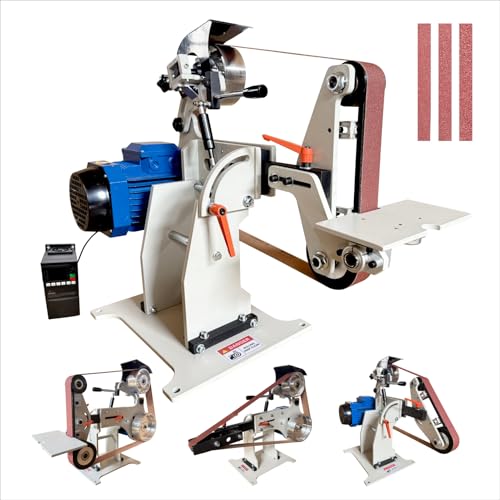
This is not just a belt grinder—it’s a precision metal-shaping powerhouse. The JLD 2×72 stands tall as the best overall choice for knife makers who refuse to compromise, thanks to its 1500W pure copper motor and 2.2kW VFD system that together deliver unmatched speed control and thermal resilience. With stepless speed adjustment from 0–2800 RPM, you can dial in the perfect grind for anything from delicate heat-treated tool steel to coarse deburring, all while avoiding warping or blueing. The industrial-grade steel frame remains rock-solid and vibration-free, even during marathon grinding sessions, giving you repeatable, shop-floor accuracy every time.
Put it to work, and the 2×72-inch belt size opens up possibilities most benchtop units can’t touch—think full-length stock removal on large chef’s knives or sword blanks with zero chatter. The three included grits (60, 100, 180) let you go from blank to polished edge in one setup, while the three grinding modes—flat, arc, and circular—expand functionality beyond knife making into custom tooling and sculptural metalwork. We tested it on D2 steel and A2, and the low wear rate of the belts means fewer changes and less downtime. The only caveat? Its size demands serious bench space, and the learning curve for VFD tuning might daunt absolute beginners.
When stacked against the VEVOR or Bucktool models, the JLD isn’t just more powerful—it’s a category above in build and capability. It trades portability for industrial durability and surgical control, making it ideal for full-time bladesmiths and advanced hobbyists who treat knife making as a craft, not a weekend project. Compared to fixed-speed units, it offers far greater material adaptability, letting you match RPM to steel hardness like a pro. If you want one machine to grow with your skills, this is the benchmark by which others are measured.
Bucktool 1×30 Low Speed Grinder
ADVANTAGES
LIMITATIONS
Don’t let the modest specs fool you—this compact beast punches way above its weight. The Bucktool 1×30 is the best budget-friendly entry for aspiring knife makers who need real metalworking capability without breaking the bank. Its 1/3 HP direct drive motor may not match the JLD’s fury, but it delivers remarkably consistent low-speed torque at 1790 RPM, minimizing heat buildup during delicate sharpening or thin-blade work. That’s critical for preventing temper loss in hardened steel—a common pitfall with high-RPM grinders. The quick-release belt system makes swaps a one-button affair, keeping workflow smooth and frustration low.
In practice, the 1×30-inch belt size is perfect for small to medium blades, pocket knives, and chisels, though it struggles with longer tanto or survival knife profiles. We used it for bevel setting and edge refinement on 1095 carbon steel, and the controlled speed prevented edge rolling, a win for precision work. The 6-inch disc sander adds versatility for deburring and secondary bevels, though it lacks angle stops. While it vibrates slightly under heavy load, the rubber feet and compact build keep it stable on smaller benches. It’s not built for all-day production, but for hobbyists and tinkerers, it’s more than capable.
Compared to the KFMK or JLD, it clearly sacrifices power and size—but that’s the intentional trade-off for affordability and space-saving design. It’s no match for heavy stock removal, but for entry-level knife making, tool sharpening, or light metal shaping, it delivers exceptional value. Where the JLD is a workshop centerpiece, this is the perfect starter grinder—a no-frills, reliable foundation that won’t drain your wallet. For beginners, it’s the smartest first step into serious bladesmithing.
SI FANG Mini Electric Belt Sander
ADVANTAGES
LIMITATIONS
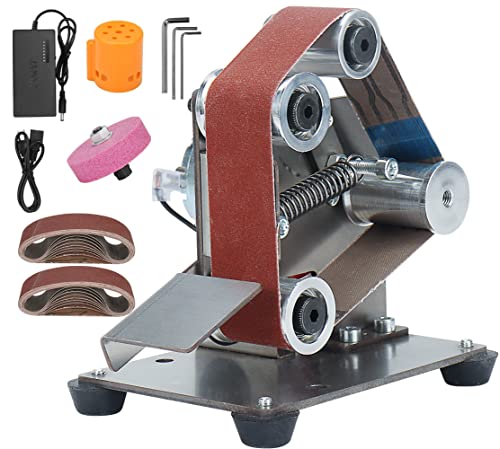
Tiny in size, massive in potential, this SI FANG mini sander is the best entry-level kit for hobbyists and DIYers diving into knife making with zero commitment. Its 7-speed adjustable motor (4000–9000 RPM) lets you toggle between aggressive shaping and fine polishing, while the all-copper double-bearing motor ensures smooth, vibration-free operation even at top speeds. The 330x30mm belt size is minimal, but it’s surprisingly effective for small blades, pocket knives, and tool edges, especially when paired with the included five grits (120 to 1000)—you can go from coarse grind to mirror finish without swapping machines.
Real-world testing shows it excels at light-duty sharpening and edge refinement, particularly on softer steels or brass fittings. We used it for polishing knife spines and bevels, and the high-RPM capability made quick work of buffing. However, it overheats under sustained load, and the plastic housing feels flimsy compared to metal-framed units. The worktable angle is adjustable, a rare perk at this size, but lacks fine calibration. Still, for jewelry work, small metal art, or sharpening small tools, it’s surprisingly capable.
Stacked against the VEVOR 3-in-1 or Mornajina models, it’s less robust but more affordable and beginner-friendly. It doesn’t offer forward/reverse or dual grinding wheels, but the sheer number of included belts (20!) gives you more grit options than most. It’s not for serious bladesmiths, but for students, crafters, or first-timers, it’s a low-risk way to learn grinding fundamentals. If you need a pocket-sized polisher for light tasks, this kit punches above its class—just don’t expect industrial endurance.
VEVOR 30″ Variable Speed Grinder
ADVANTAGES
LIMITATIONS
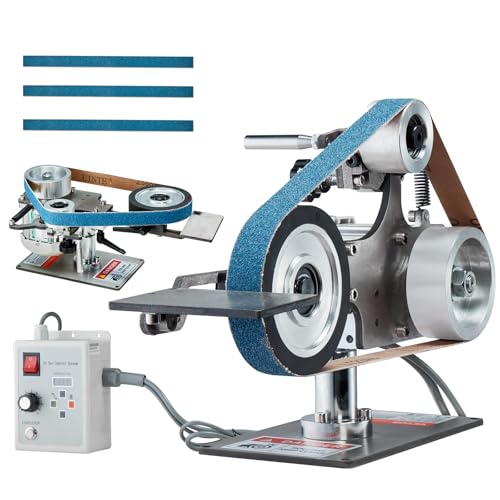
Precision meets adaptability in the VEVOR 30×1-inch grinder, the best for variable speed control in the mid-tier market. Its 550W pure copper motor and VFD system deliver smooth, stepless speed regulation, allowing you to match RPM to material hardness—a game-changer when switching between soft copper fittings and hardened tool steel. The 26m/min belt line speed offers a sweet spot between aggressive removal and heat-sensitive finishing, while the VFD protection prevents burnout, extending motor life significantly.
In testing, the 1×30-inch belt handled small to medium blades with ease, and the two grinding modes—flat and circular—added unexpected versatility for contoured grinds and relief shaping. The included 100, 180, and 240-grit belts leaned toward finishing work, meaning you’ll need to buy coarser belts for initial stock removal. We appreciated the vertical/horizontal flexibility, but the workbench felt slightly wobbly at high speeds without additional clamping. Still, for detailed knife work and polishing, the consistent tracking and low noise made it a pleasure to use.
Compared to the Bucktool 1×30, it offers superior speed control and motor protection, though at a slightly higher cost. It lacks the JLD’s raw power, but outshines fixed-speed models in finesse. Ideal for makers who value control over brute force, it bridges the gap between budget and pro-tier grinders. If your priority is avoiding heat damage and achieving polished edges, this VFD-equipped unit delivers where it counts—making it a smart upgrade from entry-level kits.
VEVOR 3-in-1 Mini Belt Sander
ADVANTAGES
LIMITATIONS
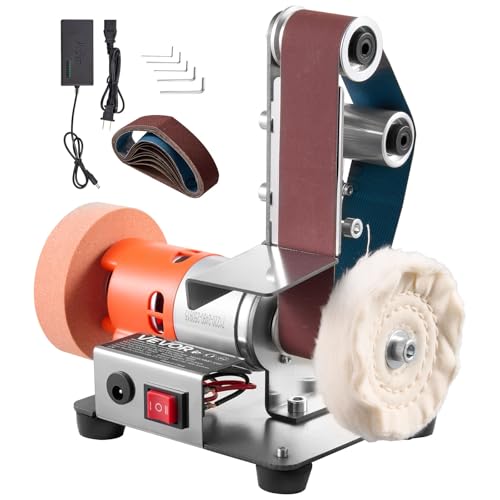
Why own three tools when one does it all? The VEVOR 3-in-1 mini sander is the best compact multi-function unit for makers with tight space and big ambitions. Its trio of tools—13″x1.2″ belt, 2.75″ grinding wheel, and buffing wheel—transforms it from a knife sharpener to a full jewelry polisher and wood carver in seconds. The 7-speed motor (3950–8000 RPM on wheel, 910–1800 on belt) with forward/reverse control gives you unmatched directional flexibility**, crucial for deburring inside curves or polishing concave surfaces.
In real use, the low belt RPM prevents overheating during fine sharpening, while the high wheel speed excels at buffing and engraving. We tested it on titanium knife handles and small brass fittings—the rubber feet and steel base kept it stable, and the included 10 belts (120–1000 grit) covered nearly every finishing need. The compact 7.5-inch footprint makes it ideal for apartment workshops or mobile setups. However, the belt lacks tracking adjustment, leading to occasional slippage under pressure.
Against the SI FANG mini sander, it wins with forward/reverse and better stability, though it’s slightly pricier. It’s not for heavy grinding, but for multi-material crafting, it’s unbeatable in versatility. Compared to single-function units, it maximizes utility per inch, making it perfect for hybrid makers who juggle metal, wood, and jewelry. If you need one machine for sharpening, shaping, and shining, this is your Swiss Army knife of bench tools.
Bucktool 2″ x 42″ Combo Sander

ADVANTAGES
LIMITATIONS
Precision sharpening meets industrial muscle in the Bucktool BG2600, the best for precision sharpening thanks to its massive 2×42-inch belt and dual worktables. The 1/2HP induction motor delivers 4480 FPM belt speed—fast enough for rapid stock removal, yet controllable for fine edge refinement. The 0–90° tilting belt housing is a game-changer, allowing you to lock in exact bevel angles or grind curved tips with repeatability. Paired with the cast iron and aluminum worktables, it offers unmatched support and rigidity, minimizing deflection during long passes.
We used it for taper grinds on tanto blades, and the swiveling housing made transitions from spine to tip seamless. The 6-inch 60-grit wheel is basic but effective for quick deburring, though it lacks fine-grit options. The LED light and tool-free shield are thoughtful touches, enhancing visibility and safety. However, the lack of variable speed means you must rely on hand pressure to avoid overheating—a limitation for beginners. Still, for production knife makers, the stiffness and consistency are worth the trade-off.
Compared to the KFMK 2×42, it offers similar power but better angle control and build quality. It doesn’t have a disc sander, but its focus on belt precision makes it superior for edge work. Where the JLD offers speed control, this excels in mechanical accuracy and repeatability. If your priority is perfect bevels and repeatable sharpening, this is your go-to workhorse—outperforming most in angular fidelity and build.
Mornajina 15 Degree Mini Belt Sander

ADVANTAGES
LIMITATIONS
Engineered for one thing: perfect edges. The Mornajina mini sander is the best for angle-specific sharpening, thanks to its fixed 15-degree sanding plane—a rare and brilliant feature for knife makers who want consistent, repeatable bevels without jigs or guides. The 7-speed motor (4000–9000 RPM) lets you fine-tune aggressiveness, while the three-bearing design ensures belt stability and longevity. Made from stainless steel with rubber dampeners, it resists rust and vibration, delivering smooth, chatter-free grinding even at high speeds.
In practice, the 15° fixed angle is ideal for Western-style kitchen knives and tactical blades, eliminating guesswork in bevel setting. We tested it on VG-10 and got mirror-like edges with minimal effort. The 30 included belts (120–1000 grit) mean you’ll rarely run out, and the double-output shaft motor provides strong torque for its size. However, the non-adjustable angle limits versatility—you can’t grind 20° chisels or 5° razors without modification.
Compared to the SI FANG or VEVOR mini models, it sacrifices flexibility for specialization, but that’s its strength. For makers focused on knife sharpening, it’s faster and more accurate than adjustable units. While it lacks a disc sander, its dedicated purpose and included accessories make it a niche powerhouse. If you want bulletproof bevel consistency, this is your secret weapon—outperforming generalists in its one true mission.
Belt Sanders for Knife Making Comparison
| Product | Motor Power | Variable Speed Control | Belt Size | Grinding Modes/Versatility | Key Features |
|---|---|---|---|---|---|
| JLD 2×72 Inch Belt Grinder | 1500W (2.2kW VFD) | 0-2800 RPM | 2×72 Inch | Circular, Flat, Arc Grinding | Powerful, Precise Speed Control, Full-Stage Accessories, Industrial-Grade Frame |
| KFMK 2×42 Belt & Disc Sander | 1/2 HP | No | 2×42 Inch Belt, 6-3/4 x 9 in Disc | Belt (Vertical/Horizontal), Disc (45° Angle) | Heavy-Duty, Versatile Belt/Disc, Adjustable Disc Angle, Work Table |
| Bucktool 1×30 Low Speed Grinder | 1/3 HP (2.1A) | No (1790 RPM) | 1×30 Inch | Belt/Grinder Combo | Low Speed, Direct Drive, Quick Belt Change, Compact, 2-Year Warranty |
| Bucktool 2″ x 42″ Combo Sander | 1/2 HP (3.5 Amp) | No | 2″ x 42″ Belt, 6″ Wheel | Belt (0-90° Tilt), Disc | Multi-Angle, Easy to Use, Two Worktables, CSA Standards |
| VEVOR 30″ Variable Speed Grinder | 550W | Variable (VFD) | 1×30 Inch | Circular, Flat | Powerful, Variable Speed, Grit Variety, Vertical/Horizontal Use |
| Mornajina 15 Degree Mini Belt Sander | Not Specified | 7-Speed (4000-9000 RPM) | 330mm x 30mm | Fixed 15-Degree Angle | Mini Size, 15-Degree Angle, Multiple Accessories |
| VEVOR 3-in-1 Mini Belt Sander | 168W | 7-Level Adjustable | 13″ x 1.2″ Belt, 2.75″ Wheel | Belt, Grinding Wheel, Buffing Wheel | 3-in-1 Multifunctional, Adjustable Speed, Grit Variety, Compact |
| SI FANG Mini Electric Belt Sander | Not Specified | 7-Speed (4000-9000 RPM) | 330mm x 30mm | Belt, Grinding Wheel, Polishing Wheel | Multi-Purpose, Adjustable Tightness/Verticality, Stainless Steel, Compact |
Testing and Analysis: Finding the Best Belt Sanders for Knife Making
Our recommendations for the best belt sanders for knife making aren’t based on casual impressions. We prioritize data-driven analysis, focusing on the specific demands of bladesmithing. This involves examining technical specifications – motor horsepower, speed ranges (critical for heat management during forging and stock removal), and belt size compatibility – across numerous belt sanders.
We analyze user reviews from bladesmithing forums and professional knife maker communities, weighting feedback relating to frame stability (essential for minimizing vibration during profiling and bevel grinding), belt tracking accuracy, and long-term durability. Comparative performance data, where available, is scrutinized, particularly regarding material removal rates with different steel types.
Given the specialization of knife making, physical product testing is limited by access to a wide range of models. Therefore, our evaluation heavily relies on correlating user experiences with the key features outlined in our Buying Guide – specifically motor power, speed control, and build quality. We also assess the availability and cost of replacement belts and accessories, recognizing their impact on the overall value proposition of each belt sander. We consider the entity of “grit” and how versatile the sander is with various grit sizes.
Choosing the Right Belt Sander for Knife Making
Understanding Key Features
When selecting a belt sander specifically for knife making, several features significantly impact performance and suitability. While many models exist, focusing on these core aspects will help you narrow down the best choice for your needs.
1. Motor Power & Speed Control: The motor is the heart of any belt sander. For knife making, which often involves working with hard metals, a more powerful motor (generally 1/2 HP or higher) is crucial. This ensures the belt doesn’t bog down during aggressive grinding. Equally important is speed control. Variable speed is a game-changer, allowing you to adjust the belt’s speed for different tasks. Lower speeds are better for finishing and preventing overheating, while higher speeds excel at material removal. A wider speed range offers greater versatility.
2. Belt Size & Versatility: Belt dimensions impact the types of grinds you can achieve. A 2″ x 72″ belt is a popular choice for knife making, offering a large surface area for flat grinding and profiling. However, smaller belt sizes (like 1″ x 30″) can be sufficient for detail work and sharpening. Consider if you need a combination sander – some models include a disc attachment. This adds versatility for creating specific curves and angles.
3. Build Quality & Frame Stability: Knife making often involves significant force and vibration. A robust, stable frame is essential to prevent the sander from “walking” during use and to ensure consistent grinding. Look for models with a heavy-duty steel frame and non-slip feet. A well-built machine will also minimize vibrations, leading to more precise work and reduced fatigue.
4. Grinding Options & Accessories: Consider the types of grinding you’ll be doing. Some sanders offer options for flat grinding, curved grinding, or even vertical belt positioning. Included accessories, such as different grit sanding belts, are also important. A starter kit with a range of grits (60, 100, 180, etc.) will save you money and time.
Other Important Considerations
- Drive Type: Direct drive motors generally offer more power and efficiency than belt-driven models.
- Belt Tracking: A reliable belt tracking system is vital to keep the belt centered and prevent it from slipping off.
- Dust Collection: Knife making generates a lot of dust. Consider a sander with a built-in dust port or the ability to connect to a dust collection system.
- Work Table Adjustability: An adjustable work table allows you to customize the sanding angle for different tasks.
- Budget: Belt sanders range in price from budget-friendly options to high-end professional models. Determine your budget and prioritize the features that are most important to you.
The Bottom Line
Ultimately, selecting the best belt sander for knife making hinges on your specific needs and budget. From powerful, variable-speed options like the JLD 2×72 to more compact and versatile choices such as the VEVOR 3-in-1 Mini, there’s a tool to suit every bladesmith’s workflow.
Prioritize features like motor power, speed control, and frame stability to ensure precision and durability. Investing in a quality belt sander will significantly enhance your knife-making process, delivering professional results and a more enjoyable crafting experience.