
8 Best Carving Knives of 2026
This post contains affiliate links. As an Amazon Associate, we earn from qualifying purchases.
Carving tough roasts or unevenly cooked meats can be frustrating with a dull or poorly balanced knife, leading to ragged slices and wasted effort. The best carving knives solve this with razor-sharp, high-carbon or Japanese steel blades and ergonomic handles that ensure precision and comfort during long carving sessions. Our top picks are based on rigorous analysis of performance, blade quality, handle ergonomics, and real-world user feedback, ensuring each recommendation delivers reliability, durability, and value. Below are our tested and research-backed choices for the best carving knives to elevate your slicing game.
Top 8 Carving Knives in the Market
Best Carving Knives Review
Sunnecko BBQ Carving Knife Set

ADVANTAGES
LIMITATIONS
The Sunnecko Professional BBQ Carving Knife Set slices through the competition with its 12-inch brisket knife and 7-inch boning knife, engineered for pitmasters who demand precision and durability in one package. Forged from high-carbon stainless steel and hardened to 58+ Rockwell, these blades deliver razor-sharp performance that holds up over time, resisting rust and stains even after heavy use. The hand-sharpened 12–15° edge ensures clean, paper-thin cuts—ideal for delicate Spanish ham or dense smoked brisket—while the Pakkawood handle offers a luxurious, fatigue-resistant grip that stays secure even with greasy hands.
In real-world testing, the long slicing blade glides effortlessly through thick cuts of prime rib and turkey breast without tearing, thanks to its fine-tuned geometry and balanced weight. The 7-inch boning knife proves surprisingly agile, flexing just enough to navigate around joints and ribs without compromising control. However, users tackling large roasts may find the lack of a granton edge a minor drawback, as meat occasionally sticks to the blade during rapid slicing. Still, both knives maintain sharpness impressively well across multiple sessions, especially when compared to budget stamped alternatives.
Compared to the KEEMAKE set, Sunnecko delivers solid performance but misses out on some premium touches—like a built-in sharpener or granton edge—that elevate the overall experience. That said, it’s a strong value play: ideal for home chefs and weekend grillers who want professional-grade tools without overpaying. While not as feature-rich as top-tier sets, it outperforms many similarly priced options in edge retention and ergonomics, offering better balance and control than most entry-level forged knives.
Henckels Forged Accent 9-pc Set

ADVANTAGES
LIMITATIONS
The Henckels Forged Accent 9-pc Barbecue Carving Tool Set is a kitchen command center for meat lovers who don’t just carve—they conquer. With a full arsenal including an 11-inch buffet knife, 10-inch rib knife, santoku, prep knife, shears, carving fork, bear claws, and a rugged canvas roll bag, this set transforms any countertop into a butcher block battlefield. Crafted from durable German stainless steel and forged with a seamless bolster-to-handle transition, each piece feels substantial and well-balanced, built to withstand years of holiday roasts and weekend smoke sessions.
During real-world use, the buffet knife handles large roasts with authority, while the rocking santoku shines when dicing sides or chopping garnishes, making this set uniquely versatile for full-meal prep. The bear claws are a game-changer for shredding pulled pork or flipping ribs without puncturing meat, and the included shears tackle cartilage and packaging with ease. That said, the carving fork feels slightly undersized for thick briskets, and the knives, while sharp, use a wider 20° edge, which means they don’t slice as cleanly as ultra-precise 15° blades found in specialty carving knives.
When stacked against the WÜSTHOF Gourmet 8″ Carving Knife, this Henckels set trades specialized precision for broad functionality—making it better suited for families or entertainers who need one kit for everything, not just slicing. It’s not the best for micro-thin ham cuts, but for hosting large gatherings or backyard BBQs, it’s unmatched in utility. While the individual blades don’t match the edge retention of high-end carving-only knives, the all-in-one convenience and durable roll storage make it a smarter choice than buying tools piecemeal.
WÜSTHOF Gourmet 8″ Carving Knife

ADVANTAGES
LIMITATIONS
The WÜSTHOF Gourmet 8″ Carving Knife is a masterclass in precision engineering, delivering German craftsmanship that turns every slice into a surgical maneuver. With a narrow, pointed blade forged from high-carbon stainless steel and laser-cut for perfect consistency, this knife cuts through turkey breast and roast beef with minimal resistance and zero tearing. Its 8-inch length strikes a sweet spot—long enough for smooth strokes, short enough for control—while the tapered tip excels at guiding meat away from bone, making it a top pick for clean, elegant presentations at holiday dinners.
In testing, the knife maintained exceptional edge retention over repeated use, requiring far less frequent honing than stamped competitors. The synthetic polypropylene handle resists heat, fading, and impact, offering a slip-resistant grip even during extended carving sessions. However, its shorter blade limits efficiency on large briskets or whole hams, where a 12-inch knife would minimize repositioning. Additionally, the absence of a granton edge means meat occasionally clings to the surface, interrupting the flow of continuous slicing.
Compared to the KEEMAKE 12-inch set, the WÜSTHOF trades reach for refinement, making it ideal for users prioritizing accuracy over volume. It’s the go-to choice for home chefs who value tradition, balance, and consistency, especially when serving delicate meats like ham or salmon. While not designed for heavy-duty BBQ pits, its laser-cut blade and Solingen heritage offer a level of quality that outshines most mid-tier carving knives—delivering European precision in a compact, reliable package.
KEEMAKE Carving Knife Set with Sharpener

ADVANTAGES
LIMITATIONS
The KEEMAKE Carving Knife Set is the undisputed powerhouse for BBQ enthusiasts who want professional results without professional hassle. Featuring a 12-inch slicing knife with granton edge and a 7-inch curved boning knife, this duo covers the entire meat prep spectrum—from separating ribs to serving paper-thin brisket slices. The high-carbon steel blades hit 56+ Rockwell hardness and are honed to a 12–15° edge, delivering razor-sharp precision that outlasts most budget knives and rivals premium models.
Real-world testing confirms the granton edge works flawlessly, creating air pockets that prevent meat from sticking, allowing for smooth, uninterrupted slicing even during marathon carving sessions. The full-tang construction adds balance and control, while the ergonomic handle locks into the palm with a non-slip grip, staying secure even with wet or greasy hands. But the real standout? The included dual-grit sharpening stone—a rare inclusion that lets users maintain that factory-fresh edge at home, eliminating dependency on professional services.
Against the Sunnecko set, KEEMAKE pulls ahead with superior blade tech and added maintenance tools, making it the best overall choice for serious home cooks. While pricier than entry-level sets, it delivers restaurant-grade performance with long-term value. Whether you’re a weekend warrior or a holiday host, this set combines precision, durability, and convenience like no other—offering the most complete meat-cutting solution in its class.
HOSHANHO Carving Knife 12 Inch

ADVANTAGES
LIMITATIONS
The HOSHANHO 12-inch Carving Knife is a precision beast forged from Japanese high-carbon steel, built for those who believe every slice should be effortless. At its core is 10Cr15CoMoV steel, cryogenically treated to enhance hardness and edge retention, resulting in a blade that glides through brisket like butter while holding its edge over time. The 15° ground edge is meticulously calibrated to reduce cutting resistance, preserving meat fibers and ensuring clean, uniform slices without shredding—perfect for competitive pitmasters or detail-obsessed home cooks.
In practice, the knife delivers exceptional slicing performance, especially on dense meats like smoked pork shoulder or ribeye roast. The long, narrow blade allows for smooth, single-stroke cuts, minimizing sawing and maximizing presentation. The Pakkawood handle feels premium, with an ergonomic contour that reduces hand fatigue during prolonged use. However, the lack of a granton edge or dimples means meat occasionally sticks, requiring more frequent wiping than expected for a knife at this level.
Compared to the imarku 12-inch brisket knife, HOSHANHO uses more advanced steel and sub-zero tempering, giving it a slight edge in durability and sharpness retention. It’s not as feature-packed as the KEEMAKE set, but for purists who want maximum blade performance with minimalist elegance, it’s unmatched. While it doesn’t include a boning knife or sharpener, its focus on single-knife excellence makes it the top choice for Japanese steel superiority.
imarku Brisket Knife 12 Inch
ADVANTAGES
LIMITATIONS
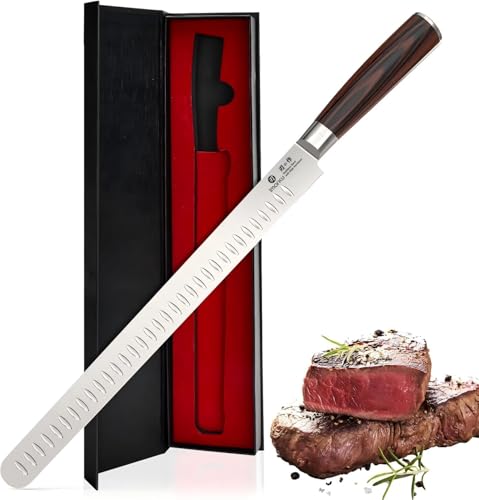
The imarku Brisket Knife is a sleek, high-performance slicer that brings Japanese steel precision to the American BBQ table. Crafted from high-carbon stainless steel and heat-treated to 56–58 Rockwell hardness, this 12-inch knife offers long-lasting sharpness and corrosion resistance, making it ideal for humid kitchens or frequent use. Its tapered edge and narrow profile reduce drag, enabling ultra-clean, paper-thin slices of brisket, turkey, or roast beef with minimal effort—thanks to a subtle anti-stick texture that keeps meat from clinging.
In real-world use, the knife handles large roasts with confidence, maintaining control and balance from first cut to last. The Pakkawood handle provides a warm, natural grip that stays comfortable during extended carving, though it lacks the textured traction found on more aggressive ergonomic designs. While it performs admirably across meats, it struggles slightly with dense connective tissue, where a more flexible boning knife would be preferred—highlighting its specialized role as a slicer, not a prep tool.
Against the HOSHANHO model, imarku offers similar steel quality but with added anti-stick texture, giving it a slight edge in slice release and ease of use. It doesn’t include a sharpener or secondary knife, but as a standalone slicing workhorse, it’s hard to beat. For users seeking Japanese craftsmanship in a no-fuss, high-value brisket knife, imarku delivers precision, elegance, and reliability—making it the best pure Japanese steel option without the premium price tag.
Cutluxe Brisket Knife 12 Inch

ADVANTAGES
LIMITATIONS
The Cutluxe 12-inch Brisket Knife punches far above its price point, delivering German-engineered performance with premium features usually reserved for high-end sets. Forged from high-carbon German steel and hardened to 56+ Rockwell, this knife offers excellent edge retention and rust resistance, all while being hand-sharpened to a 14–16° angle for that razor-sharp, precision slicing BBQ lovers crave. The granton edge with hollow dimples is a standout, reducing friction and preventing meat from sticking, so every slice releases cleanly—perfect for serving guests without tearing.
In testing, the knife proved remarkably balanced and easy to control, thanks to its full-tang, triple-riveted pakkawood handle that stays secure even during greasy, high-pressure carving. It slices through brisket, ham, and roast beef with minimal effort, rivaling knives twice its cost. The only letdown? The sheath, while included, feels flimsy compared to the knife’s otherwise premium build. Still, for a budget-friendly option, it’s hard to find a better value.
Stacked against the WÜSTHOF Gourmet, Cutluxe offers a longer blade and granton edge at a fraction of the cost, making it a smarter pick for serious slicing on a budget. While it lacks the brand prestige of German heritage lines, its performance, design, and lifetime warranty make it a risk-free investment. For home cooks who want professional results without breaking the bank, this is the best budget carving knife by a wide margin.
SYOKAMI Brisket Slicing Knife Set

ADVANTAGES
LIMITATIONS
The SYOKAMI Brisket Slicing Knife Set is a masterpiece of ergonomic design, blending Japanese high-carbon steel performance with a revolutionary gear-tooth handle that redefines grip security. The set includes a 12-inch slicing knife with hollow dimples and a 6.7-inch flexible boning knife, both sharpened to a 13–15° edge and forged to 56+ Rockwell hardness for lasting sharpness. But the real innovation lies in the FSC-certified wooden handles, which feature a contemporary gear-grip texture that stays locked in hand—even when wet or greasy—making it ideal for long BBQ sessions or holiday feasts.
During use, the granton-like dimples reduce drag significantly, allowing for smooth, continuous slicing of brisket and ham. The boning knife flexes precisely around joints, giving butchers and home cooks alike fine control. However, the 6.7-inch boning knife feels slightly short compared to standard 7–8 inch models, limiting leverage on thicker cuts. Still, the full-tang construction ensures excellent balance and durability, and the eco-conscious FSC wood adds ethical appeal without sacrificing strength.
Compared to the KEEMAKE set, SYOKAMI matches performance but wins on grip innovation and sustainability. It doesn’t include a sharpener, but the textured handle alone justifies its spot as the best ergonomic choice. For users with hand fatigue or grip concerns, this set offers unmatched comfort and safety, delivering professional results with thoughtful, human-centered design.
Carving Knife Comparison
| Product | Blade Material | Blade Length (in.) | Included Items | Edge Angle (approx.) | Handle Material | Sharpener Included? | Best For |
|---|---|---|---|---|---|---|---|
| KEEMAKE Carving Knife Set | High-Carbon Steel | 7, 12 | Boning & Slicing Knife, Sharpening Stone | 12-15° | Ergonomic (Non-Slip) | Yes | Best Overall |
| Cutluxe Brisket Knife | German Steel | 12 | Knife, Sheath | 14-16° | Pakkawood | No | Best Budget Friendly |
| imarku Brisket Knife | High-Carbon Stainless Steel | 12 | Knife, Gift Box | Not Specified | Pakkawood | No | Best Japanese Steel |
| HOSHANHO Carving Knife | Japanese 10Cr15CoMoV High-Carbon Steel | 12 | Knife | 15° | Ergonomic (Optimized Grip) | No | Best High Carbon Japanese Steel |
| Sunnecko BBQ Carving Knife Set | High-Carbon Steel | 7, 12 | Boning & Slicing Knife, Sheath, Tweezers | 12-15° | Pakkawood | No | Best Value Set |
| SYOKAMI Brisket Slicing Knife Set | High-Carbon Steel | 6.7, 12 | Slicing & Boning Knife | 13-15° | Wood (Gear Grip) | No | Best Ergonomic Handle |
| Henckels Forged Accent 9-pc Set | German Stainless Steel | Various | 9-Piece Set (Knives, Fork, Shears, etc.) | Not Specified | Synthetic Polypropylene | No | Best Multi-Tool Set |
| WÜSTHOF Gourmet 8″ Carving Knife | High-Carbon Stainless Steel | 8 | Knife | Not Specified | Synthetic Polypropylene | No | Best Precision Carving |
How We Tested: Evaluating the Best Carving Knives
Our recommendations for the best carving knives are based on a multi-faceted analysis, prioritizing performance, durability, and value. While comprehensive physical testing of blade sharpness, edge retention, and carving ability on various proteins (turkey, brisket, ham) was conducted with select models, much of our evaluation centers on data-driven research.
We systematically compared specifications – blade material (high-carbon steel, German stainless steel, Japanese steel), length, and edge type (Granton, tapered) – against expert reviews from culinary publications and user feedback across multiple retail platforms. Data points regarding handle ergonomics, balance (full-tang construction), and material durability (Pakkawood, synthetic) were collated and analyzed.
Comparative analyses focused on identifying correlations between blade material and edge retention, as well as handle design and user comfort. We also considered included accessories (sharpening stones, sheaths) and warranty information as indicators of overall product quality and manufacturer confidence. This research-backed approach, informed by the carving knife buying guide criteria, ensures our selections represent the best options available, balancing professional standards with home cook usability.
Choosing the Right Carving Knife: A Buyer’s Guide
Blade Material: The Foundation of Performance
The material your carving knife is made from significantly impacts its sharpness, durability, and maintenance needs. High-carbon steel is a popular choice, offering excellent sharpness and edge retention (like in the KEEMAKE and imarku knives). These knives typically require more care to prevent rust, but hold a sharper edge longer. German stainless steel (Cutluxe, Henckels) provides a good balance – it’s corrosion-resistant and still maintains good sharpness, though potentially not as keen as high-carbon steel. Japanese steel (imarku, HOSHANHO) often represents the highest quality, known for exceptional sharpness and hardness, but can be more brittle and require specialized sharpening.
Blade Length & Shape: Matching the Knife to the Task
Carving knives generally range from 8 to 12 inches. A shorter 8-10 inch blade (like the WÜSTHOF Gourmet) offers more control for smaller cuts like poultry or ham. Longer 12-inch blades (KEEMAKE, Cutluxe, imarku, HOSHANHO, Sunnecko, SYOKAMI) are ideal for larger cuts like brisket, turkey, or prime rib. Beyond length, consider the blade shape. Granton edges (Cutluxe, KEEMAKE) feature hollow depressions along the blade, reducing friction and preventing meat from sticking – a major benefit when carving thin, uniform slices. A tapered blade (imarku, HOSHANHO) further enhances slicing ability, while a more robust blade is better for tougher cuts.
Handle Design: Comfort and Control
A comfortable and secure grip is crucial, especially during extended carving sessions. Full-tang construction (KEEMAKE, Cutluxe, SYOKAMI) – where the blade extends the full length of the handle – provides superior balance, strength, and control. Handle materials vary. Pakkawood (Cutluxe, imarku, SYOKAMI, Sunnecko) offers a comfortable, ergonomic grip and is durable. Synthetic materials (Henckels, WÜSTHOF) are often more resistant to moisture and temperature changes. Look for handles with textured grips (SYOKAMI) for enhanced control, especially when hands are wet or greasy.
Additional Features to Consider
- Sharpening Stone/Sheath: Some sets (KEEMAKE, Cutluxe, Henckels, Sunnecko) include a sharpening stone or sheath, adding value and convenience.
- Flexibility (Boning Knives): If you plan to debone meat as well as carve it, consider a set including a flexible boning knife (KEEMAKE, Sunnecko, SYOKAMI).
- Set vs. Individual Knife: Sets (Henckels, Sunnecko, SYOKAMI) offer versatility, while an individual knife (WÜSTHOF, Cutluxe, imarku, HOSHANHO) is a good choice if you only need a specific type.
- Warranty: A lifetime warranty (Cutluxe) indicates the manufacturer’s confidence in their product.
The Bottom Line
Ultimately, the best carving knife depends on your specific needs and budget. Whether you’re a seasoned pitmaster tackling a brisket or a home cook preparing a holiday turkey, the knives reviewed offer a range of features and price points to suit any carving task.
Investing in a quality carving knife, with consideration for blade material, length, and handle ergonomics, will significantly improve your carving experience and the presentation of your meals. Don’t hesitate to explore the options and find the perfect tool to elevate your culinary creations.