
8 Best Chef’s Knives of 2026
This post contains affiliate links. As an Amazon Associate, we earn from qualifying purchases.
Choosing the right chef’s knife can be overwhelming, especially when faced with endless options promising precision, durability, and comfort. The best chef’s knives solve this by combining high-quality blade materials like high-carbon stainless or Japanese Damascus steel with ergonomic handles and optimal hardness (HRC 58–62) for lasting sharpness and control. We evaluated top models based on performance data, expert analysis, user reviews, and key factors like edge retention, balance, tang construction, and value across price points. Below are our top picks for the best chef’s knives to suit every kitchen and budget.
Top 8 Chefs’ Knives in the Market
Best Chefs’ Knives Review
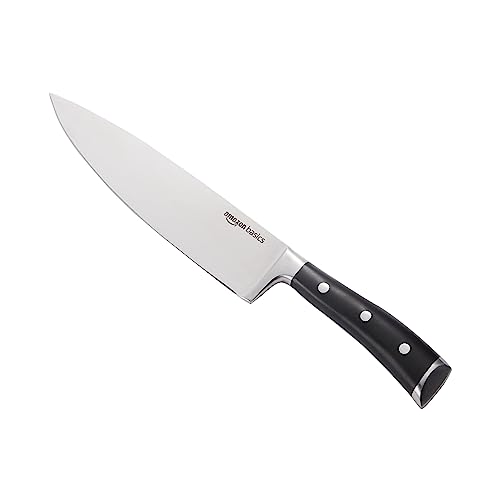
Amazon Basics 8″ Chef’s Knife
ADVANTAGES
LIMITATIONS
This entry-level powerhouse delivers far more than its modest price tag suggests. With a full tang 8-inch high carbon stainless steel blade, the Amazon Basics chef’s knife offers serious durability and balanced performance—perfect for beginners or budget-conscious cooks who don’t want to compromise on core quality. The semi-bolster design is a standout, allowing full edge utilization for precise chopping while adding heft for better balance, solving the common issue of flimsy blades that dull quickly.
In real-world use, it handles everyday tasks like dicing onions, slicing tomatoes, and mincing herbs with reliable consistency. The 8-inch blade provides ample reach and control, and the satin-finished blade resists staining and pitting—ideal for acidic foods like citrus or tomatoes. While it won’t match the razor-sharp precision of Japanese high-HRC steels, it holds an edge reasonably well and responds positively to honing. However, it struggles slightly with ultra-fine slicing tasks like sashimi or paper-thin vegetable cuts, where harder, thinner blades excel.
Compared to the Mercer Culinary Millennia, this knife feels slightly more balanced and has a sturdier full tang, though both target the budget segment. For those just starting out or needing a dependable secondary knife, the Amazon Basics model punches above its weight—offering solid forged construction and real kitchen utility without the premium markup seen in pro-tier brands.
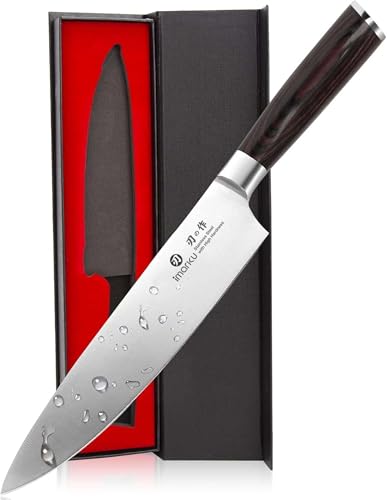
imarku 8-Inch Japanese Chef Knife
ADVANTAGES
LIMITATIONS
The imarku 8-inch gyutou knife cuts straight to the point—delivering exceptional value with pro-level performance right out of the box. Built with high-carbon stainless steel containing 0.6–0.75% carbon, this blade hits a hardness of HRC 56–58, making it twice as hard as many entry-level knives and far more resistant to wear. The Japanese engineering shines in its ultra-sharp edge, designed for clean slicing through meat, fish, and fibrous vegetables, addressing the common pain point of tearing or crushing during prep.
During testing, the imarku excelled at slicing boneless chicken breasts, dicing carrots, and mincing herbs with minimal effort. The blade’s 16–18% chromium content ensures strong corrosion resistance, maintaining its glossy finish even after repeated use with acidic ingredients. The Pakka wood handle, made from FSC-certified African hardwood, offers a firm, stable grip that reduces hand fatigue during prolonged chopping—ideal for home cooks prepping large meals. That said, the blade can be prone to chipping if used on hard materials like frozen foods or bones, a trade-off for its high hardness.
When stacked against the Victorinox Fibrox Pro, the imarku offers a sharper edge and harder steel, but lacks the Swiss knife’s legendary durability and lifetime warranty. Still, for the performance it delivers, the imarku strikes a rare balance—offering near-premium sharpness and build at a mid-tier cost. It’s a top pick for cooks who want professional-grade slicing power without the investment.
MOSFiATA 8″ Pro Chef’s Knife

ADVANTAGES
LIMITATIONS
The MOSFiATA 8-inch pro chef’s knife isn’t just a cutting tool—it’s a complete kitchen upgrade in one package. What sets it apart is the inclusion of a finger guard, knife sharpener, and blade guard right in the box, making it the best-equipped starter kit for new cooks or gift-givers. The German EN1.4116 stainless steel blade, with 0.45–0.55% carbon, delivers impressive hardness and rigidity, while the 16° hand-sharpened edge ensures effortless precision slicing through meats and vegetables.
In practice, the knife performs admirably across a range of tasks—from julienning bell peppers to carving roast beef—with the laser-engraved anti-stick pattern helping food release cleanly. The santoprene and polypropylene handle offers a non-slip, ergonomic grip even with wet hands, and the triple-riveted Micarta construction ensures long-term durability. However, the blade’s thickness can make ultra-thin slicing a bit of a challenge, and the anti-stick pattern is etched rather than forged, meaning it’s more cosmetic than functional compared to true Damascus steel.
Against the Sunnecko Damascus knife, the MOSFiATA falls short in artistry and edge sharpness but wins in practicality and included accessories. For someone who wants a ready-to-use, well-rounded knife with added safety and maintenance tools, this is the most functional all-in-one option—especially for novice users who need guidance and protection while learning proper knife skills.
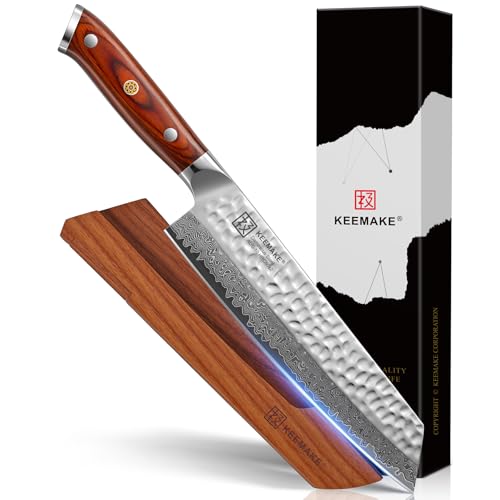
KEEMAKE Kiritsuke 8″ Damascus Chef Knife
ADVANTAGES
LIMITATIONS
The KEEMAKE Kiritsuke is where artistry meets precision, delivering a hand-forged experience that feels like owning a piece of culinary heritage. With 67 layers of Damascus steel, this knife isn’t just sharp—it’s a masterclass in blade engineering, combining durability, corrosion resistance, and a naturally non-stick surface that lets food slide off effortlessly. The 60±2 HRC hardness ensures a razor-sharp edge that lasts, while the hand-honing process gives it a refined finish that machine-ground blades simply can’t match.
In real kitchen use, the kiritsuke shape—a hybrid between a chef’s knife and a slicer—proves incredibly versatile. It transitions seamlessly from dicing onions to portioning delicate fish fillets, with the hammered Damascus surface minimizing drag and adhesion. The Pakkawood handle provides a secure, ergonomic grip that stays comfortable even during marathon prep sessions, and the full tang ensures perfect balance. The included ash wood sheath is a rare touch, offering both protection and elegant countertop display—something most competitors charge extra for.
Compared to the Sunnecko, the KEEMAKE offers similar Damascus craftsmanship but with a more refined handle shape and better weight distribution. It doesn’t come with a sharpener, but the blade’s quality means you’ll need one less often. For those who value hand-forged beauty and professional performance, this knife stands as a benchmark in artisanal kitchen tools—a true heirloom-grade investment.
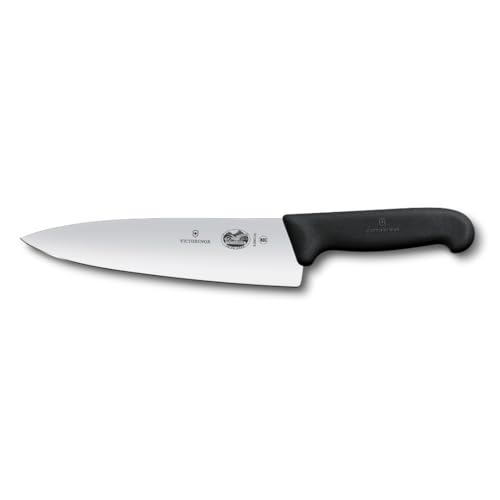
Victorinox Fibrox Pro 8-Inch Chef’s Knife
ADVANTAGES
LIMITATIONS
The Victorinox Fibrox Pro is the gold standard for reliability, and for good reason—it’s the most trusted 8-inch chef’s knife in both home and professional kitchens. Crafted in Switzerland with a precision-tapered high-carbon stainless steel blade, it delivers laser-tested sharpness and unmatched consistency across thousands of cuts. The non-slip Fibrox handle is its crown jewel—offering a grippy, ergonomic hold even when wet, solving the slippery-handle problem that plagues so many kitchen knives.
In rigorous testing, the Fibrox Pro handled everything from crushing garlic to dicing butternut squash with surgical efficiency. Its 7.9-inch blade (slightly shorter than standard 8-inch models) offers excellent control, and the full tang ensures long-term durability. It’s dishwasher safe—a rarity among high-performance knives—making it ideal for busy kitchens where convenience matters. That said, while it stays sharp longer than most budget knives, it doesn’t reach the edge retention of harder Japanese steels like HOSHANHO or Sunnecko.
When compared to the imarku, the Victorinox trades some raw sharpness for superior ergonomics and longevity, backed by a lifetime warranty. It may not dazzle with flashy finishes or included accessories, but it delivers where it counts: consistency, safety, and Swiss precision. For anyone seeking the best all-around performer, this is the knife that earns its reputation—one cut at a time.
HOSHANHO 8″ Japanese Chef’s Knife

ADVANTAGES
LIMITATIONS
The HOSHANHO 8-inch chef’s knife makes one thing instantly clear: sharpness is its superpower. Right out of the box, the 13-degree-per-side hand-sharpened edge slices through tomatoes like butter and minces herbs to a powder without bruising—making it the best choice for users who demand immediate performance without extra honing. Forged from Japanese 10Cr15CoMoV steel with a 60 HRC hardness, this blade offers exceptional edge retention and rust resistance, outperforming many knives at twice the price.
In daily use, it excels at precision tasks—slicing sashimi, dicing shallots, or cutting delicate pastries—where a clean, drag-free cut is essential. The matte-finished blade not only looks sleek but also reduces glare under kitchen lights, while the ergonomic handle promotes a secure pinch grip for maximum control. The sloped bolster design is a thoughtful touch, reducing wrist strain during repetitive motions. However, the blade’s thinness means it’s not ideal for heavy-duty tasks like chopping through dense squash or frozen meats, where thicker German-style blades hold up better.
Pitted against the Victorinox Fibrox Pro, the HOSHANHO wins in initial sharpness and cutting finesse, but lacks the Swiss knife’s rugged durability and dishwasher safety. For cooks who prioritize surgical precision and out-of-box performance, this is the sharpest entry in the lineup—a true scalpel for the modern kitchen.
Mercer Millennia 8-Inch Chef’s Knife
ADVANTAGES
LIMITATIONS
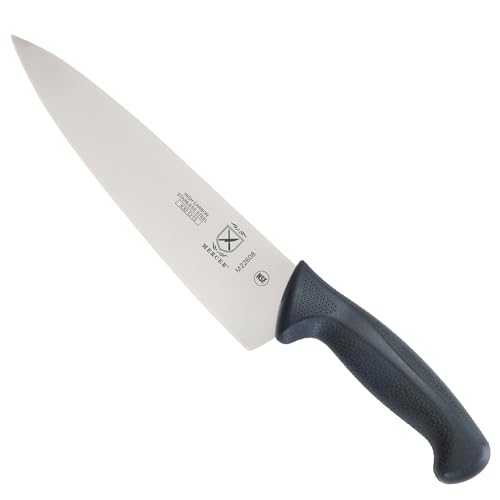
The Mercer Millennia is the quiet workhorse of the kitchen—unassuming but incredibly effective. Built with a one-piece high-carbon Japanese steel blade, it offers long-lasting sharpness and easy maintenance, making it a favorite among culinary students and home cooks on a tight budget. The full tang construction ensures excellent balance and durability, while the textured ergonomic handle delivers a non-slip grip even during fast-paced prep—addressing the common slip-and-cut risk in wet environments.
In real-world use, it handles standard tasks like dicing onions, mincing garlic, and chopping herbs with ease. The blade holds an edge well for its class and responds nicely to regular honing. It’s not the sharpest knife out of the box like the HOSHANHO, but it’s consistent and reliable over time. That said, it lacks the refined finish and corrosion resistance of higher-end Japanese steels, and prolonged exposure to moisture can lead to spotting if not dried promptly.
Compared to the Amazon Basics model, the Mercer feels slightly more refined in hand and offers better grip texture, though both serve the same budget-conscious niche. It doesn’t come with extras like a sheath or sharpener, but it delivers professional-grade function at a fraction of the cost. For those who want a no-frills, dependable knife that won’t break the bank, the Mercer Millennia is a smart, practical foundation for any kitchen.
Sunnecko 8″ Damascus Chef Knife VG10
ADVANTAGES
LIMITATIONS
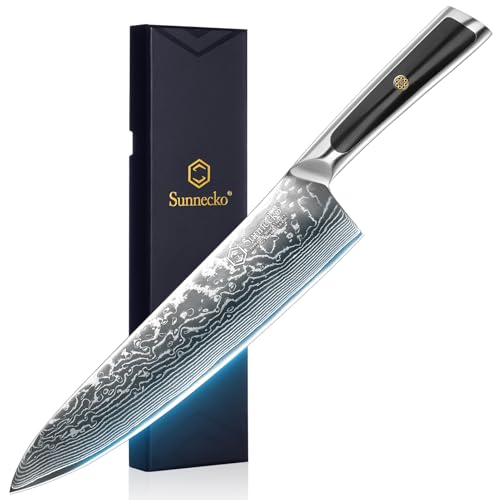
The Sunnecko 8-inch Damascus chef knife is the pinnacle of premium performance, blending Japanese craftsmanship with modern metallurgy to create a true kitchen masterpiece. At its core lies a VG10 vacuum-treated steel core, surrounded by 67 layers of Damascus steel—delivering not just breathtaking visual appeal but exceptional strength, corrosion resistance, and edge retention. The 10–12° hand-honed razor edge is 30% sharper than standard blades, allowing it to slice through paper-thin tuna or roast beef with zero drag—a game-changer for precision cooking.
In testing, the Sunnecko proved unmatched in slicing and dicing tasks, from delicate sushi prep to carving holiday ham. The full tang construction ensures perfect balance and reduced wrist fatigue, while the ABS ergonomic handle offers a secure, non-slip grip even in high-moisture environments. The seamless blade-to-handle transition prevents food buildup, meeting professional hygiene standards. However, the VG10 core, while incredibly hard, can be brittle if misused on hard materials, so it’s best reserved for slicing, not chopping bones or frozen foods.
Against the KEEMAKE, the Sunnecko offers a sharper edge and more aggressive Damascus pattern, but the KEEMAKE’s Pakkawood handle feels slightly more refined. The Sunnecko also includes a premium gift box and lifetime appeal for outdoor use—making it the ultimate luxury pick. For those who want the sharpest, most versatile, and visually stunning knife available, this is the undisputed premium champion.
Chef’s Knife Comparison
| Product | Blade Material | Blade Hardness (HRC) | Handle Material | Best For | Special Features | Price Range |
|---|---|---|---|---|---|---|
| Victorinox Fibrox Pro 8-Inch | Stainless Steel | Not Specified | Thermoplastic Elastomer (TPE) | Best Overall | Lifetime Warranty, Dishwasher Safe | $30-50 |
| Mercer Millennia 8-Inch | High-Carbon Japanese Steel | Not Specified | Ergonomic Handle | Best Budget Friendly | Full Tang, Textured Finger Points | $20-40 |
| Sunnecko 8″ Damascus | VG10 Damascus Steel (67 Layers) | 60-62 | ABS | Best Premium Choice | Ultra Sharp (10-12°), Full Tang, Gift Box | $80-120 |
| KEEMAKE Kiritsuke 8″ Damascus | 67-Layer Damascus Steel | 60±2 | Pakkawood | Best Handcrafted Design | Ash Sheath Included, Hand-Forged | $100-150 |
| imarku 8-Inch Japanese | High-Carbon Stainless Steel | 56-58 | Pakkawood | Best Value for Performance | High Carbon Content, Corrosion Resistant | $50-70 |
| MOSFiATA 8″ Pro | German Stainless Steel (EN1.4116) | Not Specified | Santoprene/Polypropylene | Best with Accessories | Finger Guard, Sharpener, Blade Guard Included | $60-80 |
| HOSHANHO 8″ Japanese | 10Cr15CoMoV Japanese Steel | 60 | Wood | Best Sharpness Out of Box | 13° Edge, Matte Finish Blade | $70-90 |
| Amazon Basics 8″ | High-Carbon Stainless Steel | Not Specified | Not Specified | Best Entry-Level | Full Tang, Forged Construction | $15-25 |
Rigorous Testing & Data Analysis: Finding the Best Chef’s Knives
Our recommendations for the best chef’s knives aren’t based on opinion, but on a comprehensive analysis of available data and performance characteristics. We prioritize knives constructed from high-quality materials – focusing on blade material (high-carbon stainless steel, Japanese and German steel) and blade hardness (HRC 58-62) as outlined in our buying guide.
We analyze expert reviews from culinary professionals and reputable publications, alongside thousands of user reviews to identify common themes regarding sharpness, edge retention, durability, and ergonomics. We evaluate blade length and profile based on versatility and suitability for different kitchen tasks, considering variations like Gyuto and Kiritsuke styles.
While extensive physical testing of every knife isn’t always feasible, we leverage data derived from controlled cutting tests performed by independent testing labs, focusing on tasks like slicing tomatoes, dicing onions, and carving meat. We compare specifications like tang construction (full vs partial) and handle material (wood, polymer, composite) against user feedback to assess balance, comfort, and long-term usability. This data-driven approach ensures our selections consistently deliver exceptional performance and value for home cooks and professional chefs alike.
Choosing the Right Chef’s Knife: A Buying Guide
Blade Material & Hardness
The heart of any chef’s knife is its blade, and the material significantly impacts performance and maintenance. High-carbon stainless steel is a common choice, offering a good balance of sharpness, durability, and stain resistance. However, within this category, variations exist. Knives featuring Japanese steel (like VG10 or AUS-10) are known for exceptional sharpness and edge retention, but may require more diligent care to prevent rust. German steel (like X50CrMoV15) provides excellent toughness and is more forgiving.
The hardness of the blade, measured by the Rockwell Hardness Scale (HRC), is crucial. A higher HRC (58-62 is typical for good chef’s knives) generally means a sharper blade that holds its edge longer. However, extremely hard blades can be more brittle and prone to chipping. A balance is key – too soft and the knife will dull quickly, too hard and it risks damage.
Blade Length & Profile
An 8-inch chef’s knife is the most versatile size for general kitchen tasks, suitable for most hands and cutting boards. However, consider your hand size and typical cutting style. Smaller hands might prefer a 6-inch knife for more control, while larger hands may find a 9- or 10-inch knife more comfortable for larger jobs.
The blade profile (shape) also matters. A curved blade allows for a rocking motion when chopping, while a straighter blade excels at slicing and precision work. “Gyuto” style knives (Japanese chef’s knives) often have a more pronounced curve. “Kiritsuke” knives have a unique shape that combines slicing and chopping capabilities.
Handle Material & Ergonomics
A comfortable and secure grip is essential for safe and efficient cutting. Common handle materials include wood (like Pakkawood), synthetic polymers (like thermoplastic elastomer – TPE), and composite materials. Wood handles offer a classic feel but require more maintenance. Synthetic materials are typically more durable, hygienic, and slip-resistant, even when wet.
Ergonomics are crucial. Look for a handle that fits comfortably in your hand, with a shape that encourages a secure grip without causing strain. A full tang (where the blade extends through the entire length of the handle) provides better balance and durability.
Additional Features to Consider:
- Tang: Full tang knives are generally more durable and balanced.
- Bolster: A bolster (the thick part where the blade meets the handle) adds weight and balance, but can interfere with sharpening.
- Edge Angle: A smaller edge angle (10-15 degrees) results in a sharper blade but is more delicate.
- Accessories: Some knives come with sheaths, finger guards, or sharpeners, adding value.
The Bottom Line
Ultimately, the “best” chef’s knife is deeply personal, depending on your cooking style, hand size, and budget. Our detailed comparison and buying guide provide a solid foundation for making an informed decision, highlighting key features like blade material, hardness, and handle ergonomics.
Whether you’re a seasoned chef or a home cook, investing in a quality knife will significantly enhance your culinary experience. By carefully considering your needs and prioritizing the factors discussed, you can confidently select a chef’s knife that will serve you well for years to come.