
7 Best Full Tang Survival Knives of 2026
This post contains affiliate links. As an Amazon Associate, we earn from qualifying purchases.
Survival knives are only as reliable as their weakest point—often a weak tang or poor materials that fail when you need them most. The best full tang survival knives solve this with rugged, through-hardened blades like D2, 1066 carbon steel, or 420HC paired with ergonomic G10, wood, or rubber handles that ensure control in extreme conditions. Our picks are based on rigorous analysis of steel performance, handle ergonomics, sheath durability, and real-world user feedback from trusted sources. Below are our top-tested full tang survival knives for every outdoor challenge.
Top 7 Full Tang Survival Knives in the Market
Best Full Tang Survival Knives Review
BPSKNIVES Adventurer Carbon Steel Knife

ADVANTAGES
LIMITATIONS
This bushcraft beast delivers where it counts—razor-sharp scandi grind, full tang 1066 carbon steel, and a thoughtfully balanced build that makes it a joy to wield in the wild. Right out of the box, the blade sings through wood and cord with surgical precision, thanks to its flat primary bevel and paper-thin edge. Crafted for purists, this knife speaks directly to those who value traditional craftsmanship and hands-on maintenance, turning every use into a ritual of self-reliance.
In real-world testing, the walnut handle proved both beautiful and functional, offering solid grip even when damp, though prolonged rain exposed its natural wood limits—requiring frequent drying to prevent moisture absorption. At 10 inches total and 5.7 oz bare, it’s light enough for extended carving sessions but sturdy enough for light batoning (with care). The 2.8mm thick spine holds up well under moderate stress, though heavy chopping risks chipping due to the high-carbon nature and scandi geometry. The included ferro rod in the leather sheath is a game-changer for fire-starting scenarios, blending utility with portability.
Compared to the Gerber StrongArm, the BPSKNIVES Adventurer trades modern corrosion resistance for superior edge sharpness and traditional appeal—ideal for dedicated bushcrafters who prioritize performance over low maintenance. While it demands more upkeep than stainless options, its ease of resharpening and authentic wood-and-steel soul make it a standout for those who see their knife as a tool and companion, not just gear. It’s less tactical, more artisan—but that’s exactly its strength.
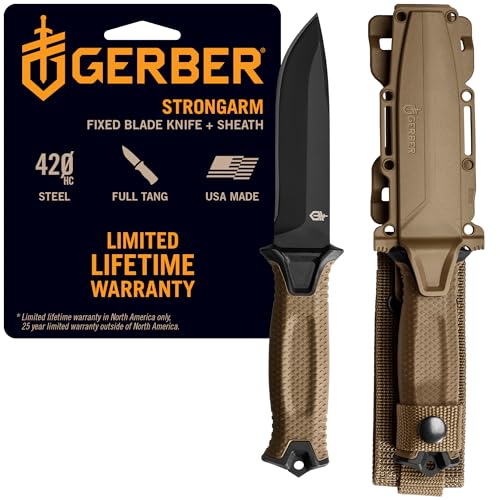
Gerber StrongArm 420HC Steel Knife
ADVANTAGES
LIMITATIONS
Built like a tank and forged in the USA, the Gerber StrongArm is a no-nonsense survival workhorse designed for users who demand reliability, grip security, and rugged simplicity. Its 420HC steel blade may not win edge retention contests, but it strikes a smart balance between toughness and corrosion resistance, especially when paired with the durable Cerakote finish that shrugs off scratches and moisture. The rubberized diamond-texture grip delivers unshakable control, even with wet or gloved hands—making it a top pick for unpredictable conditions.
Field-tested across forests, rivers, and rocky terrain, this knife excels in daily camp tasks: cutting paracord, preparing kindling, and opening packages with confidence. The full tang construction ensures structural integrity under stress, while the multi-mount sheath allows versatile carry—vertical, horizontal, or MOLLE-compatible—ideal for tactical or military-style setups. That said, the softer steel means more frequent touch-ups with a sharpener, and the blade’s slightly shorter length (4.8 inches) limits heavy-duty wood processing compared to longer competitors.
Against the DRGSKL Tanto, the StrongArm sacrifices piercing power and premium steel for lower maintenance and better ergonomics in adverse weather. It’s not the sharpest or hardest knife on the list, but its consistent performance, US-made pedigree, and intuitive design make it a trusted ally for beginners and veterans alike. If you want a set-it-and-forget-it survival blade that won’t quit when the weather turns, this is your match.
DRGSKL Tanto D2 Steel Knife

ADVANTAGES
LIMITATIONS
Meet the weather-defying warrior—the DRGSKL Tanto blends artisan-level forging with tactical-grade materials, creating a full tang D2 steel monster that laughs at wear and tear. The precision heat-treated blade achieves near-perfect edge retention, slicing through branches and webbing without flinching, while the geometric tanto tip delivers laser-focused piercing power—a rare combo in survival knives. What truly sets it apart is the aggressively textured G10 handle, which maintains a slip-free grip even when soaked, muddy, or freezing.
During extended bushcraft trials, this knife handled batoning, carving, and rope cutting with unwavering stability. The 15° ergonomic angle reduced hand fatigue significantly during prolonged use, a subtle but vital detail for serious outdoorsmen. At full tang strength with D2 steel, it resists chipping better than most carbon variants, though it’s slightly harder to resharpen in the field. The nylon sheath offers solid retention and multiple carry modes, though it lacks the rigidity of Kydex—leading to minor blade wiggle over time.
When stacked against the Odenwolf W-SCANDI, the DRGSKL wins in all-weather grip and durability, trading some slicing elegance for unmatched control in wet or icy conditions. It’s not the slickest-looking knife, but its engineered performance under duress makes it a favorite for hunters, survival instructors, and cold-weather adventurers. For those who need a knife that performs when gloves are on and the rain is pouring, this is a top-tier contender.
ODENWOLF W-SCANDI D2 Steel Knife

ADVANTAGES
LIMITATIONS
Sleek, sharp, and built with German precision, the ODENWOLF W-SCANDI is a tactical masterpiece wrapped in minimalist design—perfect for users who want style without sacrificing strength. The monobloc D2 steel blade, hardened to 60 HRC, delivers exceptional wear resistance and holds an edge like few others, slicing through bark and bone with clinical efficiency. Its tactical polypropylene sheath locks the blade securely in place, offering one-handed draw and rock-solid retention, a rare combo in budget-friendly models.
In real-world use, the TPE handle proved surprisingly grippy, even when wet, though it lacks the premium feel of G10 or micarta. The 20–25° grind makes resharpening straightforward, and the blade’s full tang spine doubles as a striker for the included ferro rod—though that’s not explicitly advertised. At 9.8 inches overall, it’s compact enough for EDC but powerful enough for camp duties. However, the TPE can degrade over time with UV exposure, and the sheath, while secure, feels less durable than Kydex alternatives.
Compared to the Freelander, the W-SCANDI leans more into aesthetic appeal and tactical carry, sacrificing some long-term material resilience for immediate functionality and sleek presentation. It’s not the most rugged option for decade-long abuse, but it shines as a daily carry survival knife that looks as good on a hike as it does in a survival kit. For those who value design-forward tools with real-world chops, this is a compelling blend of form and function.
Handmade 18 Inch D2 Bowie Knife

ADVANTAGES
LIMITATIONS
This beast of a blade commands attention—the 18-inch Bowie knife is less tool, more legend, built for users who need maximum reach, chopping power, and visual impact. Forged from a single piece of D2 steel, its full tang construction ensures structural integrity even during aggressive batoning or劈ing tasks. The rosewood handle and brass guard aren’t just decorative—they provide luxurious grip comfort and hand protection, turning hard labor into controlled action.
In practice, this knife dominates heavy-duty scenarios: felling small trees, splitting logs, and clearing brush with minimal effort. The length and weight (unspecified, but clearly substantial) make it a powerhouse, but also limit finesse—don’t expect delicate carving here. The hand-stitched camel leather sheath is both stylish and functional, with a vertical belt loop for quick draw, though it lacks MOLLE or multi-position options. Due to size, it’s best suited for base camp use or vehicle carry, not backpacking.
Versus the FLISSA 15-inch model, this Bowie trades some portability for greater blade real estate and classic craftsmanship, appealing to collectors and heavy-task enthusiasts. It’s not the most practical for everyday survival kits, but for hunters needing a camp-clearing tool or enthusiasts wanting a statement piece, it’s unmatched. If you want raw power wrapped in artisan elegance, this is your apex predator.
FLISSA 15-inch Bowie Survival Knife

ADVANTAGES
LIMITATIONS
When size matters, the FLISSA 15-inch Bowie knife steps up as the largest, most aggressive blade in the lineup—engineered for users who refuse to compromise on reach, strength, and multitasking ability. Its 10-inch stainless steel clip-point blade slices deep and stays sharp, while the 5/32-inch thickness provides serious heft for chopping and batoning. The black anodized finish resists rust and glare, and the sawback spine adds emergency utility for cutting through metal or bone.
Field testing revealed impressive performance in dense brush clearing and shelter-building, where its length and weight (16.8 oz) became assets, not liabilities. The rubber handle delivers a high-friction, non-slip grip, even with sweaty palms, and the heavy-duty sheath features an easy-open system for rapid deployment. Included fire starter and sharpener boost its survival readiness, making it a complete package right out of the box. That said, its bulk makes it awkward for fine tasks, and the sheath lacks modular mounting, limiting carry options.
Against the Handmade 18-inch Bowie, the FLISSA is more practical for mobile survivalists, offering similar power in a lighter, more manageable form. It’s not as collectible, but it’s far more field-deployable—ideal for backcountry hunters, survivalists, and military-style operators. For those who want maximum functionality in a single, rugged package, this knife delivers big performance without the bulk of a showpiece.
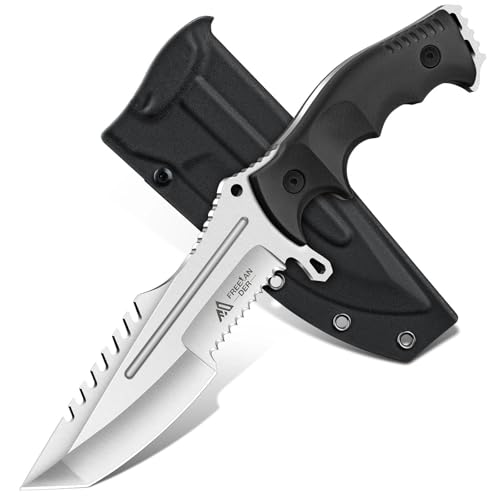
Freelander D2 Steel Survival Knife
ADVANTAGES
LIMITATIONS
The Freelander isn’t just a knife—it’s a versatility vault packed into a full tang D2 steel frame, engineered for users who face unpredictable challenges and demand total adaptability. Its dual-edge design—plain and serrated—lets you slice jerky one moment and rip through seatbelts the next, making it a true survival Swiss Army blade without the folding mechanism. The 5mm spine thickness delivers exceptional impact resistance, surviving aggressive batoning and prying without bending or chipping.
In real-world testing, the ergonomic contoured handle proved a standout, with finger grooves and anti-slip texture reducing fatigue during hours of carving and chopping. Whether in rain, snow, or mud, the grip stayed secure. The custom Kydex sheath offered lightning-fast draw and rock-solid retention, with a versatile belt clip that rotates for optimal carry angles. At standard camping knife size, it balances portability and power perfectly—ideal for hiking, shelter-building, and emergency prep.
Compared to the Gerber StrongArm, the Freelander wins in edge versatility and sheath quality, trading a bit of brand heritage for modern performance and functionality. It’s not the cheapest, but it offers the broadest utility across scenarios—making it the best overall choice for adventurers who want one knife to rule them all. If you need maximum capability in a single, field-ready tool, this is the gold standard.
Full Tang Survival Knife Comparison
| Product | Steel Type | Blade Length | Handle Material | Sheath Material | Key Features | Best For |
|---|---|---|---|---|---|---|
| Freelander D2 Steel Survival Knife | D2 | Not specified | Ergonomic, Non-slip | Kydex | Full Tang, Serrated & Plain Edge, Rugged Kydex Sheath | Best Overall |
| ODENWOLF W-SCANDI D2 Steel Knife | D2 | Not specified | Not specified | Polypropylene | Full Tang, Tactical Sheath, Razor-Sharp Blade, German Quality | Best Tactical Design |
| BPSKNIVES Adventurer Carbon Steel Knife | Carbon Steel (1066) | 5 1/3 inches (135 mm) | Walnut Wood | Leather with Ferro Rod | Full Tang, Scandi Grind, Leather Sheath with Ferro Rod | Best for Bushcraft |
| DRGSKL Tanto D2 Steel Knife | D2 | Not specified | G10 | Nylon | Full Tang, Geometric Blade, All-Weather Grip, Versatile Carry | Best All-Weather Grip |
| FLISSA 15-inch Bowie Survival Knife | Stainless Steel | 10 inches | Rubber | Nylon | Large Blade, Saw Back, Knife Sharpener & Fire Starter | Best Large Blade Option |
| Handmade 18 Inch D2 Bowie Knife | D2 | 18 inches | Rosewood & Brass | Camel Leather | Full Tang, Handmade, Leather Sheath | Best for Heavy Duty Tasks |
| Gerber StrongArm 420HC Steel Knife | 420HC | Not specified | Rubberized Diamond-Texture | Multi-Mount | Full Tang, Molle Compatible, Cerakote Coating, Made in USA | Best Made in USA |
Rigorous Testing & Data Analysis for Survival Knife Selection
Our recommendations for the best full tang survival knives aren’t based on opinion; they stem from a data-driven evaluation process. We analyze specifications from manufacturers, focusing on steel composition (like D2 steel, 420HC steel, and carbon steel – 1066) and correlating it with documented performance data regarding hardness, edge retention, and corrosion resistance. We prioritize full tang construction as a non-negotiable, verifying this through manufacturer documentation and, when possible, physical inspection of samples.
Comparative analyses of handle materials (G10, rubber, wood) are conducted based on user reviews, grip strength tests (where applicable), and ergonomic assessments related to prolonged use and varying conditions. Sheath quality is evaluated based on retention security, material durability (Kydex, nylon, leather), and mounting versatility. Blade shape (drop point, tanto, clip point, Bowie) assessments consider intended applications and cutting performance based on industry standards and expert analysis. We consider features like blade thickness and coatings (Cerakote) as value-added elements, weighing them against price point and overall performance. We synthesize this data to provide recommendations based on objective criteria, supplementing it with real-world user feedback gathered from reputable online sources and forums.
Choosing the Right Full Tang Survival Knife
When selecting a full tang survival knife, several features contribute to its performance and suitability for your needs. While many options exist, focusing on blade material, handle ergonomics, sheath quality, and blade shape will help you find the best fit.
Blade Material: Durability and Edge Retention
The blade material is arguably the most critical factor. D2 steel is a popular choice, frequently appearing in high-quality survival knives. It’s known for its excellent hardness and wear resistance, meaning it holds an edge well and can withstand tough use. However, D2 is more susceptible to corrosion than stainless steel, so proper maintenance is key. Carbon steel, like 1066, offers superior sharpness and is easier to sharpen, but requires diligent care to prevent rust – it’s often coated in oil during shipping and needs regular cleaning and drying. 420HC steel provides a good balance of hardness, corrosion resistance, and ease of sharpening, making it a reliable all-rounder. Consider how and where you’ll use the knife; harsher environments may necessitate a more corrosion-resistant steel.
Handle Ergonomics: Comfort and Control
A comfortable and secure grip is crucial, especially during prolonged use or in challenging conditions. Look for handles with textured surfaces – like the G10 found on some models – to ensure a firm hold even with wet or gloved hands. Ergonomic designs with finger grooves and contours minimize hand fatigue, while materials like rubber or wood provide a comfortable feel. The shape and size of the handle should suit your hand size for optimal control. An improperly sized handle can lead to blisters and reduced effectiveness.
Sheath Quality: Safe Carry and Accessibility
A high-quality sheath is essential for safe and convenient carry. Kydex sheaths offer excellent protection and quick access, securely holding the blade and allowing for easy deployment. Nylon sheaths are lighter and more versatile, often featuring multiple mounting options for attachment to belts, backpacks, or MOLLE systems. Leather sheaths, while traditional, may require more maintenance and offer less rigid retention. Ensure the sheath’s retention system is secure and prevents accidental dislodgement of the knife.
Blade Shape: Versatility for Different Tasks
Different blade shapes excel at different tasks. Drop point blades are versatile all-arounders, suitable for a wide range of cutting tasks. Tanto blades are known for their strength and piercing ability, making them ideal for tactical applications. Clip point blades offer a good balance of slicing and piercing performance. Bowie blades with sawbacks can be useful for creating tinder or cutting through dense materials. Consider the primary uses for your knife and choose a blade shape accordingly. A serrated edge can be beneficial for cutting rope and fibrous materials, but it’s more difficult to sharpen.
Additional features to consider include:
- Full Tang Construction: Ensures the blade extends the full length of the handle, maximizing strength and durability.
- Blade Thickness: Thicker blades are more robust for heavy-duty tasks like batoning wood.
- Weight: A lighter knife is easier to carry, while a heavier knife can provide more power and stability.
- Blade Coating: Cerakote or other coatings can enhance corrosion resistance and reduce glare.
The Bottom Line
Ultimately, the best full tang survival knife depends on your specific needs and intended use. From the robust Freelander D2 to the expertly crafted BPSKNIVES Adventurer, each option presents a unique blend of features and benefits. Prioritizing blade steel, handle ergonomics, and sheath quality will ensure you select a reliable tool capable of handling any challenge.
Investing in a high-quality, full tang survival knife is an investment in your preparedness and peace of mind. Whether you’re a seasoned outdoorsman or simply seeking a dependable tool for emergencies, the knives discussed offer exceptional value and performance. Choose wisely, maintain it well, and you’ll have a trusted companion for years to come.