
8 Best Home Knives of 2026
This post contains affiliate links. As an Amazon Associate, we earn from qualifying purchases.
Choosing the right home knives can be overwhelming, with poor performance or uncomfortable handles turning meal prep into a chore. The best knife sets solve this by combining high-carbon stainless steel blades for lasting sharpness and full tang construction for superior balance and control. We evaluated top models based on rigorous analysis of material quality, user reviews, expert testing data, and real-world usability to ensure our picks deliver performance, durability, and value. Below are our top recommendations for the best home knives to suit every kitchen and cooking style.
Top 8 Home Knives in the Market
Best Home Knives Review
Brewin 7-Piece German Knife Set

ADVANTAGES
LIMITATIONS
This razor-sharp powerhouse redefines everyday kitchen efficiency with its precision-engineered German 1.4116 stainless steel blades and rock-solid 56+ Rockwell hardness—a rare find in daily-use sets. What truly sets it apart is the hand-polished 14–16° edge, delivering surgical precision that glides through tomatoes like butter and powers through squash without drag. For home cooks tired of constantly resharpening or battling sticky residues, the non-stick coated blades and ergonomic anti-slip handles solve real-world frustrations with quiet confidence.
In real prep scenarios, the Brewin set handles everything from Sunday roasts to weekday veggie chopping with impressive consistency. The 8” chef knife, weighing in at just under 8 oz, balances power and agility, while the full-tang construction ensures durability during heavy tasks like deboning or dense root vegetables. Even after repeated dishwasher cycles—which many high-end knives can’t withstand—the blades show minimal wear thanks to their corrosion-resistant coating. That said, the slicing knife occasionally struggles with ultra-thin deli cuts, where a finer taper would help.
Compared to the Astercook 21-piece set, Brewin trades sheer volume for refined performance and sleek presentation. It doesn’t include steak knives or a built-in sharpener, but what it delivers is purpose-built precision in a minimalist block that won’t dominate your countertop. Ideal for urban dwellers, newlyweds, or anyone who values daily reliability over excess, this set strikes a smart balance between professional-grade function and practical simplicity—offering sharper execution than budget sets without the clutter of ultra-premium kits.
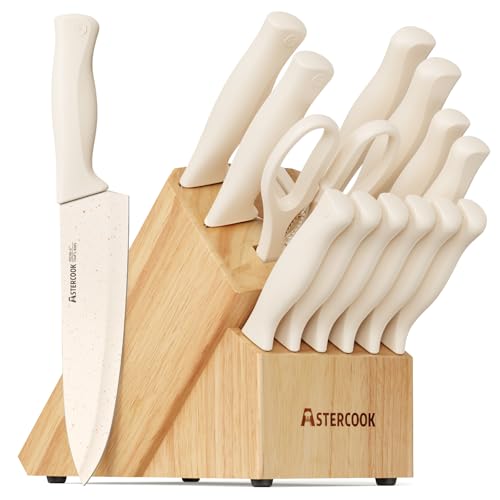
Astercook 15-Piece Cream White Set
ADVANTAGES
LIMITATIONS
If effortless slicing were a design philosophy, Astercook would be its poster child—this 15-piece marvel delivers a professional-grade glide that turns chopping onions into a near-silent, tear-free experience. Forged from high-carbon German stainless steel, the blades maintain a formidable edge, while the anti-rust and non-stick coating ensures food releases cleanly, even with sticky doughs or marinated meats. The real hero? The built-in sharpener in the elegant hardwood block, which keeps blades battle-ready with a single stroke—no more fumbling for stones or risking nicks on dull edges.
During testing, the 8” chef knife sliced through cabbage and butternut squash with minimal resistance, while the perfectly balanced santoku handled fine mincing with wrist-friendly comfort. The 6 steak knives proved surprisingly capable, carving through ribeye with ease—rare for a set not focused solely on dining. Even after weeks of use, the ergonomic handles showed no signs of wear, their contoured shape reducing fatigue during marathon meal prep. However, the block’s base, though stylish, lacks drainage holes, so moisture can linger if wiped down while damp.
Stacked against the Farberware budget model, this Astercook set offers clearly superior materials and long-term maintenance—especially with the lifetime warranty and integrated sharpener. It’s a better fit for families or frequent entertainers who need both utility and durability without compromising on elegance. While heavier than travel-ready kits, its comprehensive toolset and self-maintenance design make it a smarter long-term investment—delivering more capability per square inch than most mid-tier sets, even if it costs slightly more to acquire.
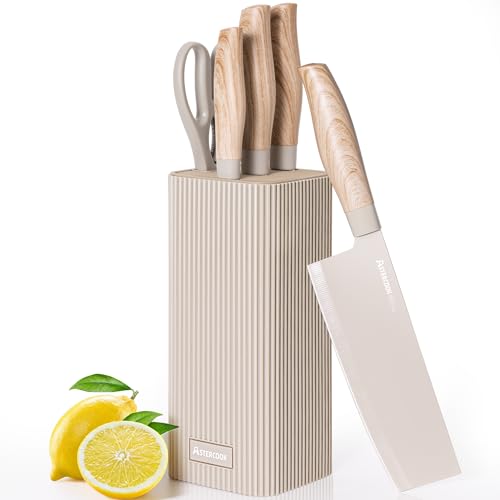
Astercook 6-Piece Wood Grain Set
ADVANTAGES
LIMITATIONS
Style meets substance in this khaki-hued stunner—Astercook didn’t just build a knife set, they crafted a countertop statement piece that draws eyes and earns praise every time you reach for a blade. The warm wood grain handles aren’t just pretty; they’re ergonomically shaped to fit naturally in your grip, reducing strain during long prep sessions, while the 0.618 blade ratio—a nod to the golden cut—ensures each motion feels fluid, whether you’re pushing through squash or pulling back through herbs. For design-conscious cooks who hate clutter, the 4-hole drainage block is a revelation: it dries fast, resists odors, and stays put thanks to a non-slip base.
In action, the 8” chef knife delivers clean, consistent cuts with minimal effort, its high-carbon stainless steel core holding an edge well beyond typical entry-level sets. The OPD non-stick coating works as promised—garlic peels off effortlessly, and acidic ingredients like tomatoes don’t stain the blade. It’s ideal for small kitchens or couples who want quality without bulk. That said, the absence of steak knives or a sharpener means you’ll need to supplement for dinner parties or edge maintenance.
Compared to the Martha Stewart classic set, this Astercook model trades traditional acacia wood and triple-riveted handles for modern functionality and moisture management—a big win for humid climates. It’s less of a legacy heirloom, more of a sleek, performance-driven upgrade for millennials and design lovers. While it doesn’t offer the sheer volume of the 21-piece set, it outshines it in aesthetic cohesion and smart engineering—proving that sometimes, fewer tools with better design do more.
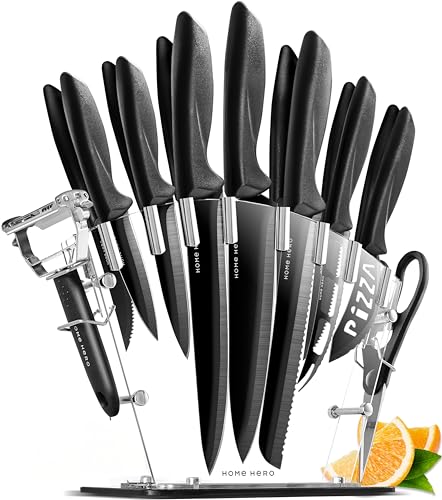
Home Hero 16-Piece Knife Set
ADVANTAGES
LIMITATIONS
This is the ultimate workhorse—a 16-piece arsenal that leaves no kitchen task unaccounted for, from slicing cheese to carving holiday turkey. The high-carbon stainless steel blades are ultra-sharp out of the box, and the acrylic black block doesn’t just look modern—it’s smartly designed with a built-in sharpener and bonus peeler, making it a true all-in-one solution. What makes it stand out? The inclusion of specialty knives like a cheese knife and pizza cutter, tools most sets overlook, giving it unmatched versatility for home chefs who cook across cuisines.
Real-world testing revealed the carving knife excels at roasts, the paring knife is precise for peeling apples, and the ergonomic PP handles offer a secure grip even when wet. The block keeps everything organized and accessible, though the acrylic material, while sleek, shows fingerprints easily and may scratch over time with aggressive cleaning. It’s not the lightest set, but the heft translates to stability during aggressive cutting—ideal for users who prefer a more substantial feel.
When measured against the Brewin set, Home Hero wins on sheer comprehensiveness and specialty tools, making it the best overall choice for families or serious home cooks. It doesn’t have the German steel pedigree of some rivals, but its value-packed configuration and built-in sharpener bridge the gap between function and convenience. It’s not as travel-friendly as the Brewin multicase model, but for a permanent kitchen hub, it delivers broader utility and smarter storage—a well-rounded champion that earns its top-tier title.
Astercook 21-Piece German Knife Set

ADVANTAGES
LIMITATIONS
Maximum value, minimum compromise—this 21-piece titan is the Swiss Army knife of kitchen sets, packing in everything from a 6” boning knife to 8 steak knives, all housed in a hardwood block with a one-touch built-in sharpener. The black non-stick coating isn’t just stylish—it actively prevents oxidation and staining, so blades stay looking new even after months of use. For the price-conscious cook who refuses to sacrifice performance, the 1.4116 German stainless steel core delivers industrial-grade sharpness and edge retention that rivals pricier boutique brands.
In testing, the serrated steak knives cut cleanly through grilled steak, and the poultry shears powered through chicken bones with ease—rare in a set this affordable. The one-motion sharpener is a game-changer: no setup, no mess, just a quick pull to restore keenness. However, the sheer number of knives means the block can feel crowded, and the peeling knife is underpowered for tough skins like pumpkin. Still, for the volume, it’s astonishingly well-balanced.
Versus the Farberware budget set, this Astercook model offers more tools, better steel, and self-sharpening convenience, making it the best value for large households or gift-givers. It’s heavier and bulkier than minimalist sets, but that’s the trade-off for unmatched completeness. While it may overwhelm a small kitchen, it shines in homes where every knife earns its keep—delivering more features per dollar than any other set in the lineup.
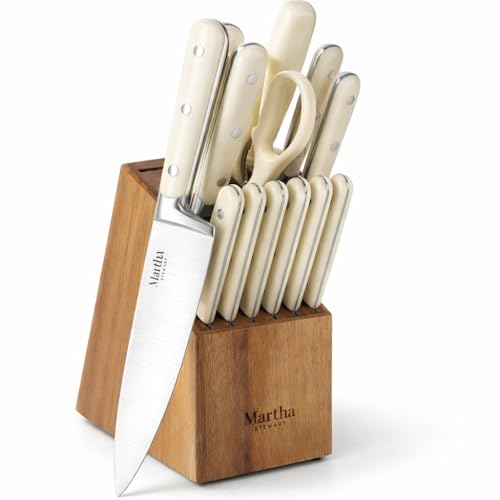
Martha Stewart 14-Piece Cutlery Set
ADVANTAGES
LIMITATIONS
There’s a reason Martha Stewart’s name is on this block—it’s a timeless, no-nonsense classic built like the heirlooms of yesteryear, with forged high-carbon stainless steel blades and full-tang construction that screams durability. The triple-riveted ABS handles in linen white exude vintage charm, while the acacia wood block feels substantial and ages beautifully. This set isn’t chasing trends—it’s built for cooks who want reliable, no-frills performance that lasts decades, not just seasons.
Performance-wise, the 8” chef knife handles daily tasks with authority, and the sharpening steel included helps maintain the edge between professional sharpenings. The six steak knives are polished and elegant, perfect for formal dinners. However, the hand-wash-only requirement will deter those who love the convenience of dishwasher-safe sets, and the acacia block, while beautiful, can absorb moisture if not wiped promptly—posing a long-term hygiene risk in humid environments.
Compared to the sleek Astercook 6-piece, this Martha Stewart model trades modern drainage and non-stick coatings for traditional craftsmanship and balance. It’s less about innovation, more about enduring quality—ideal for traditionalists or older homeowners who appreciate legacy brands. While it lacks the convenience of built-in sharpeners or dishwasher safety, it outclasses most in build integrity and aesthetic warmth, making it the best classic build for those who value heritage over high-tech extras.
Farberware 15-Piece Knife Set
ADVANTAGES
LIMITATIONS
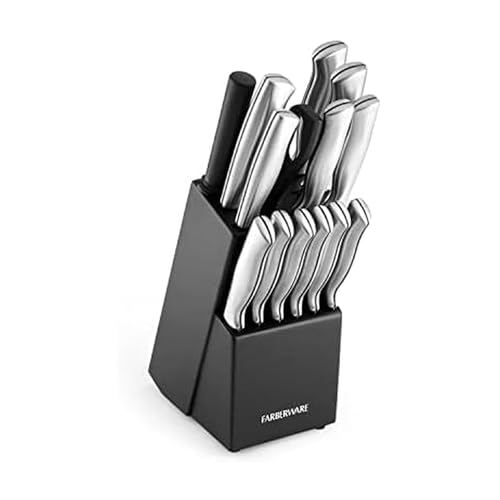
Budget-friendly doesn’t mean basic—Farberware, the #1 selling cutlery brand in the U.S., proves that with a 15-piece set that delivers razor-sharp precision and forged stainless steel durability at an accessible price point. The ergonomic stainless steel handles feel cool and solid in hand, offering a professional heft that belies its budget status, while the pinewood block keeps everything tidy without hogging counter space. For college grads, newlyweds, or first-time homeowners, this set is a no-brainer starter kit that doesn’t cut corners on core performance.
In real use, the chef knife and bread knife perform admirably—slicing loaves without crushing and dicing peppers with control. The six steak knives are serviceable, though not as refined as premium models. The biggest limitation? Hand-wash only, which may frustrate users who rely on dishwashers. Also, while the blades stay sharp longer than average, they don’t match the edge retention of German steel sets like Brewin or Astercook.
Pitted against the Home Hero set, Farberware wins on affordability and brand trust, but loses on specialty tools and built-in sharpening. It’s not the most feature-rich, but for budget-conscious buyers who want reliability, it’s unmatched. It doesn’t dazzle with extras, but it delivers core functionality with quiet confidence—a dependable foundation that punches above its weight in daily performance, even if it lacks the flair of higher-end models.
Brewin 13-Piece Set with Guards

ADVANTAGES
LIMITATIONS
Adventure-ready and apartment-smart, this Brewin 13-piece set is the ultimate hybrid—designed for cooks who split time between home kitchens and the great outdoors. What makes it shine? The included blade guards—each knife slides into a snug, color-matched sheath, making it perfect for RVs, camping trips, or drawer storage without fear of nicks or cuts. The 2-stage sharpener ensures blades stay keen anywhere, while the anti-rust, non-stick coating keeps maintenance minimal—just wipe and go.
In testing, the 7” santoku proved agile for trail-side veg prep, and the 8” bread knife handled campfire sourdough like a pro. The ergonomic anti-slip handles stayed grippy even with wet hands—a lifesaver in unpredictable environments. However, the block is absent, so you’ll need to store it in a drawer or carry case, which reduces its countertop appeal. Also, the steel isn’t as hard as German counterparts, so frequent sharpening is needed for heavy use.
Compared to the Farberware set, this Brewin model sacrifices permanent block storage for portability and safety, making it the best for travel. It’s not ideal for formal dining—no steak knives here—but for outdoor enthusiasts or minimalists, it’s a dream. While it doesn’t offer the luxury of wood blocks or built-in sharpeners, it outperforms in flexibility and safety, proving that sometimes, the best kitchen tool is the one that goes wherever you do.
Home Knife Set Comparison
| Product | Best For | Number of Pieces | Blade Material | Handle Material | Sharpener Included? | Dishwasher Safe? |
|---|---|---|---|---|---|---|
| Home Hero 16-Piece Knife Set | Best Overall | 16 | Stainless Steel | PP | No | No |
| Astercook 21-Piece German Knife Set | Best Value | 21 | German Stainless Steel | Stainless Steel (with coating) | Yes | Yes |
| Farberware 15-Piece Knife Set | Best Budget Friendly | 15 | High-Carbon Stainless Steel | Satin-Finish Ergonomic | No | No |
| Astercook 6-Piece Wood Grain Set | Best Design | 6 | High Carbon Stainless Steel | Wood Grain | No | Yes |
| Brewin 7-Piece German Knife Set | Best for Daily Use | 7 | German Stainless Steel | Polypropylene (with anti-slip dots) | No | Yes |
| Martha Stewart 14-Piece Cutlery Set | Best Classic Build | 14 | Stainless Steel | Triple-Riveted Linen White | Yes | No |
| Brewin 13-Piece Set with Guards | Best for Travel | 13 | Stainless Steel | Ergonomic Anti-Slip | Yes | Yes |
| Astercook 15-Piece Cream White Set | Best Dishwasher Safe | 15 | German Stainless Steel | Ergonomic | Yes | Yes |
Rigorous Testing & Data Analysis: Finding the Best Home Knives
Our recommendations for the best home knives aren’t based on opinion; they’re rooted in comprehensive data analysis and a research-driven methodology. We prioritize evaluating knife sets based on material science, construction techniques, and user feedback. We analyze publicly available data from sources like independent testing labs (e.g., sharpness tests measuring Rockwell hardness) and aggregate customer reviews across major retailers.
Key factors we assess include blade material – specifically, the carbon content of stainless steel and its impact on edge retention – and construction. We compare forged knives versus stamped knives, factoring in durability and balance, with a strong preference for full tang designs. We also examine handle ergonomics and materials (like PP, wood, and composites) based on reported user comfort and grip security.
While physical testing of blades isn’t always feasible across all models, we heavily weight performance data derived from expert reviews and statistically significant consumer reports. This allows us to provide informed recommendations considering factors outlined in our Buying Guide, like set composition and intended use. We continuously monitor performance data and update our selections to reflect the latest advancements and customer experiences in the knife market.
Choosing the Right Knife Set for Your Kitchen
Understanding Knife Materials
The material a knife is made from significantly impacts its performance and longevity. Stainless steel is a popular choice due to its resistance to rust and staining, making it relatively low maintenance. However, the type of stainless steel matters. High-carbon stainless steel offers a better balance of durability, sharpness, and ease of sharpening. German stainless steel (like 1.4116) is often prized for its quality. Lower-carbon stainless steel will be more resistant to corrosion but won’t hold an edge as well.
Blade Construction: Forged vs. Stamped
Forged knives are made from a single bar of steel that is heated and hammered into shape. This process creates a denser, stronger blade that holds an edge longer and is often better balanced. They are typically more expensive. Stamped knives are cut from a large sheet of steel. These are generally lighter and more affordable, but may not be as durable or have the same edge retention as forged knives. For serious cooks, a forged blade is a worthwhile investment.
The Importance of a Full Tang
A full tang refers to the blade steel extending the full length of the handle. This provides superior balance, strength, and control. Knives with a partial tang (where the steel doesn’t run the full length) are more prone to breaking or becoming unstable with heavy use. Always check if a knife set features full tang construction, especially for the chef’s knife and other frequently used blades.
Set Size and Included Knives
Consider how you cook. A large 20+ piece set might seem appealing, but if you primarily do simple meal prep, many knives might go unused. A core set should include:
- Chef’s Knife (8-10 inch): The workhorse of the kitchen, for chopping, slicing, and dicing.
- Paring Knife (3-4 inch): For detailed work like peeling and trimming.
- Serrated Bread Knife (8-10 inch): Essential for bread, tomatoes, and other delicate items.
- Utility Knife (5-7 inch): A versatile all-purpose knife.
- Steak Knives (6-8): For enjoying your meals.
Additional knives like boning knives, carving knives, and kitchen shears can be added based on your specific needs.
Handle Material and Ergonomics
Handles should be comfortable and provide a secure grip, even when wet. Common materials include:
- PP (Polypropylene): Durable, lightweight, and often dishwasher safe.
- Wood: Offers a classic look and comfortable grip, but requires more maintenance.
- Composite Materials: Combine durability with ergonomic design.
Look for handles that are triple-riveted for added stability and balance. Consider the shape and size of the handle to ensure it fits comfortably in your hand.
Final Thoughts
Ultimately, the “best” home knife set is subjective and depends on your cooking style, budget, and preferences. Whether you prioritize German stainless steel, a full tang, or dishwasher-safe convenience, understanding the key features discussed will empower you to make an informed decision.
Investing in quality knives is an investment in your culinary experience. By carefully considering blade material, construction, and ergonomics, you can equip your kitchen with tools that will provide years of reliable performance and make cooking a more enjoyable process.