
9 Best Japanese Knife Sets of 2026
This post contains affiliate links. As an Amazon Associate, we earn from qualifying purchases.
Choosing the right Japanese knife set can be overwhelming, with so many options promising precision and performance but often falling short in durability or comfort. The best sets solve this by combining high-quality materials like VG-10 or powder steel with a sharp 15-degree edge and ergonomic handles made from Pakkawood or stabilized wood for superior control and long-term edge retention. We evaluated each set based on steel hardness (HRC), blade geometry, user feedback, and build quality to identify those delivering real value across performance, balance, and craftsmanship. Below are our top recommendations for the best Japanese knife sets to elevate your kitchen experience.
Top 9 Japanese Knives Sets in the Market

Best Japanese Knives Sets Review
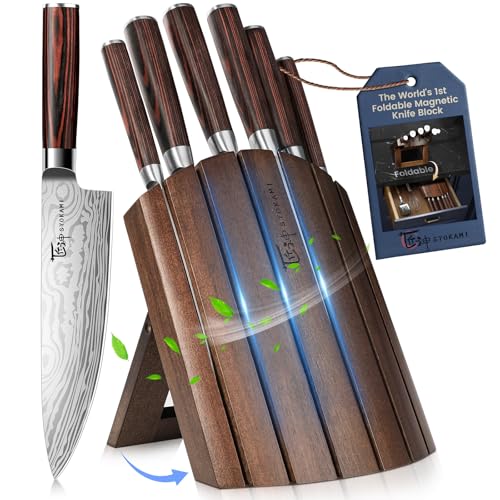
SYOKAMI 7-Piece Foldable Magnetic Block Set
ADVANTAGES
LIMITATIONS
The SYOKAMI 2026 stands out with its innovative foldable magnetic block, a game-changer for homes with kids or pets. This isn’t just a knife set — it’s a thoughtfully engineered safety solution that doesn’t sacrifice style or performance. Forged from high-carbon stainless steel and honed to a 15-degree edge, each blade delivers crisp, clean cuts while the FSC-certified acacia wood block adds eco-friendly durability and moisture resistance. If you’re tired of cluttered countertops and unsafe storage, this set offers a sleek, space-saving answer.
In real-world use, the ergonomic anti-slip handles shine during prolonged prep sessions, reducing hand fatigue without compromising control. The included lineup — 8″ chef’s, 7″ Santoku, 8″ slicing, 8″ bread, 6″ utility, and 3.8″ paring — covers nearly every culinary task, though the absence of a honing rod is noticeable. While the 56+ HRC hardness is solid, it’s not as hard as premium Japanese steels, meaning it won’t hold an edge as long as higher-end models. Still, for everyday home cooks, the balance of sharpness, comfort, and safe storage makes this a standout.
Compared to the SENKEN Tsunami or SHAN ZU sets, the SYOKAMI trades ultimate edge retention for family-friendly functionality and compact storage. It’s not built for Michelin-level precision, but for practical, safe, and stylish daily use in real kitchens. Perfect for parents, pet owners, or anyone craving a clutter-free, injury-proof countertop, this set wins on lifestyle integration — offering peace of mind without sacrificing performance.
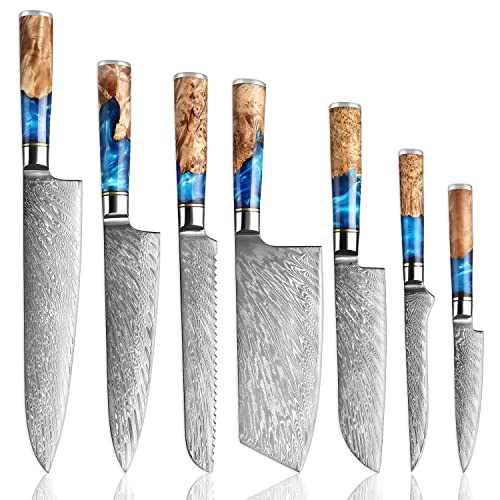
SENKEN 7-Piece Damascus Knife Set
ADVANTAGES
LIMITATIONS
The SENKEN Tsunami Collection is a masterclass in Japanese knife craftsmanship, where 67-layer Damascus steel meets razor-sharp precision. This isn’t just a kitchen tool — it’s a visual and functional masterpiece, with blades that slice through ingredients like butter thanks to their 15° edge and VG-10 core. The distinctive blue resin and wood handles add a bold aesthetic flair, turning every meal prep into a statement. For chefs who value beauty as much as performance, this set delivers on both fronts with museum-worthy appeal and surgical cutting ability.
During testing, the dual chef’s knives (one likely Western-style, one Japanese) offered versatile options for different cutting techniques, while the cleaver and boning knife expanded utility beyond typical sets. The heat-treated VG-10 steel holds an edge impressively well, easily tackling tomatoes, chicken, and dense root vegetables without chipping. However, the Damascus surface, while stunning, requires careful cleaning to prevent moisture trapping — a minor trade-off for its elegance. These knives demand respect and proper care, but reward with long-term durability and effortless slicing.
Pitted against the FAMCüTE or SHAN ZU, the SENKEN set leans more toward artistic excellence and professional performance, making it ideal for serious cooks and culinary enthusiasts. While it lacks a built-in sharpener or block storage, its raw cutting power and iconic design elevate it above standard kits. If you want a knife set that performs like a pro tool and looks like a collector’s item, the Tsunami Collection offers unmatched presence and precision — a true benchmark for overall excellence.
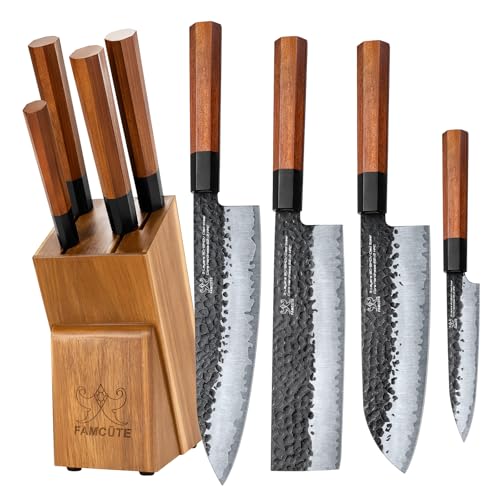
FAMCüTE Hand Forged 5-Layer Knife Block
ADVANTAGES
LIMITATIONS
The FAMCüTE set is a testament to traditional hand-forging, where each blade undergoes a 60-day artisanal process to achieve HRC 62 hardness — a level that rivals many premium Japanese knives. This isn’t mass production; it’s culinary craftsmanship elevated to art, with 5-layer 9CR18MOV steel providing exceptional corrosion resistance and edge retention. The rosewood octagonal handles aren’t just beautiful — they offer superior grip and balance, reducing wrist strain during extended use, making this set a joy for both home cooks and aspiring chefs.
In performance, the Nakiri and Santoku knives excel at vegetable prep, slicing through cabbage and carrots with surgical precision thanks to their ultra-thin 15° edges. The full tang construction and heel-to-spine balance ensure controlled, fatigue-free chopping — a detail most budget sets overlook. However, while the steel is tough, it’s not quite at the level of powder metallurgy blades like SHAN ZU’s, meaning it may need sharpening slightly more often under heavy use. Still, for its class, the cutting performance is outstanding, especially for plant-based and fine slicing tasks.
When compared to the imarku or SANMEIHO sets, the FAMCüTE stands apart with its authentic hand-forged heritage and luxury materials. It’s not the most feature-packed, but it’s one of the most authentically crafted in the lineup. Ideal for those who appreciate time-honored techniques and heirloom-quality tools, this set offers artisanal depth and lasting performance — a worthy investment for culinary purists who value tradition as much as technique.
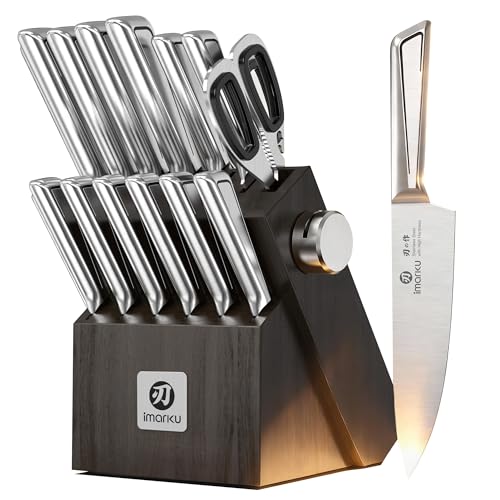
imarku 14-Piece Knife Set with Sharpener
ADVANTAGES
LIMITATIONS
The imarku 14-piece set redefines convenience with a built-in sharpener in the hardwood block — a feature that solves the #1 pain point of knife ownership: dull blades. This isn’t just a storage unit; it’s a maintenance hub, letting you refresh your edge in seconds. Paired with precision-forged high-carbon steel and a 10–15° ultra-sharp edge, each knife cuts with minimal resistance, making prep faster and safer. For busy home cooks who hate sharpening stones or rod maintenance, this set is a game-changing blend of performance and practicality.
With 14 pieces, including 6 steak knives, shears, and a honing rod, this kit covers every need — from Sunday roasts to weekday salads. The patented non-slip handle provides a secure grip even with wet hands, a rare win in knife ergonomics. While the steel is rated at 57±1 HRC — not the hardest in the lineup — it’s optimized for balance and ease of re-sharpening, especially with the built-in tool. The dishwasher-safe claim is a bonus, but like all quality knives, hand washing is still recommended to preserve longevity.
Against the SHAN ZU or SENKEN, the imarku trades raw hardness for user-friendly innovation and completeness. It’s not a minimalist chef’s tool, but a full-service kitchen solution. Perfect for families, gift-givers, or anyone who wants pro-level sharpness without the maintenance hassle, this set delivers exceptional value through smart design — making consistent sharpness accessible to all.
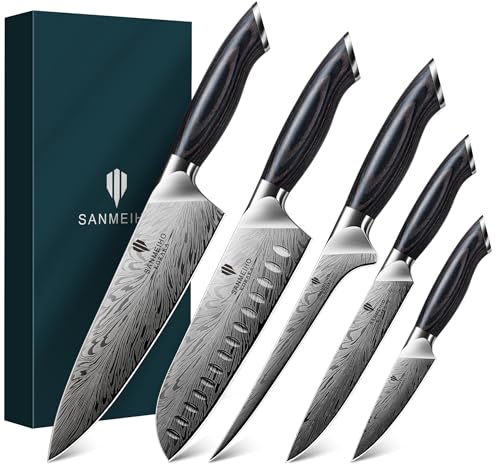
SANMEIHO 5PCS Powder Steel Knife Set
ADVANTAGES
LIMITATIONS
The SANMEIHO 5-piece set punches well above its weight, leveraging 10Cr15CoMoV powder steel heat-treated to 63 HRC — a level typically seen in high-end professional blades. This means exceptional edge retention and corrosion resistance, allowing the knives to stay sharp through weeks of regular use. The 12° blade angle delivers razor-thin slicing with minimal effort, making it a standout for precision tasks like sashimi or herb chiffonade. For mid-range buyers who want pro-level performance without pro-level prices, this set is a silent powerhouse.
In real use, the pakkawood handles offer a smooth, balanced feel that reduces fatigue during extended prep. The inclusion of a 7″ fillet knife is a smart touch, adding versatility most 5-piece sets lack. Whether deboning chicken or slicing ripe tomatoes, the blades glide cleanly, thanks to their fine polish and acute edge. However, the lack of a knife block or storage solution means you’ll need to invest in separate protection — a small gap in an otherwise excellent package.
Stacked against the imarku or FAMCüTE, the SANMEIHO focuses on core performance over extras, making it ideal for cooks who prioritize sharpness, steel quality, and simplicity. It’s not flashy, but it’s incredibly effective — a no-nonsense upgrade for those stepping up from basic knives. If you want maximum cutting efficiency in a minimalist, high-performance kit, this set offers outstanding value with pro-tier steel — a true mid-range masterpiece.
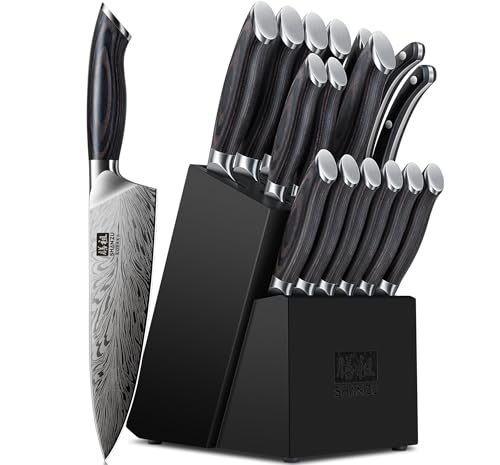
SHAN ZU 16-Piece Powder Steel Set
ADVANTAGES
LIMITATIONS
The SHAN ZU 16-piece set is built like a professional’s arsenal, featuring powder steel at 63 HRC hardness — delivering 3X edge retention over standard stainless steel. This means fewer sharpenings and surgical precision through dense meats, frozen foods, and fibrous veggies. The 12° double-bevel edge, hand-polished by skilled artisans, cuts with frictionless ease, making it a top contender for serious home chefs and culinary pros. With a full tang, stabilized wood handles, and a honing rod included, this set is engineered for daily heavy-duty use without compromise.
Beyond performance, the laser-engraved blade pattern adds a modern, high-tech aesthetic — not Damascus, but undeniably sharp-looking. The 16-piece lineup is comprehensive: two paring knives, six steak knives, shears, and a carving knife mean no task is left uncovered. The solid wood block ensures hygienic, organized storage, though the 430 steel bolsters are slightly less corrosion-resistant than full-clad alternatives. Still, for the volume of tools and performance level, it’s a remarkable package.
Compared to the SENKEN or imarku, the SHAN ZU leans into professional utility and volume, making it ideal for large households or working kitchens. It’s not as artistic as the Tsunami set, nor as convenient as imarku’s sharpener, but it dominates in sheer capability and completeness. For those who want a no-compromise, high-output kitchen command center, this set delivers pro-level performance at a fraction of custom knife costs — a workhorse with elite DNA.
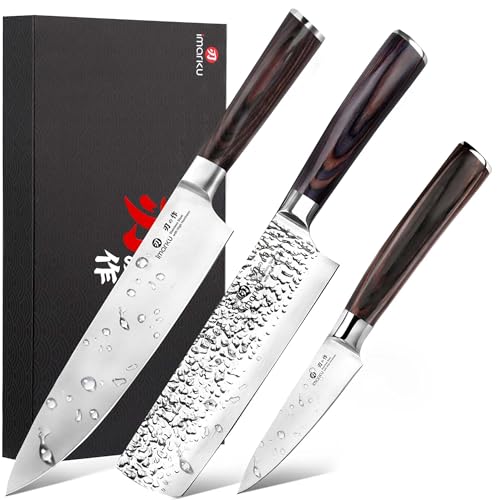
imarku 3-Piece Japanese Knife Set
ADVANTAGES
LIMITATIONS
The imarku 3-piece set proves that less can be more — a minimalist kit that covers 90% of kitchen tasks with precision, style, and affordability. Featuring an 8″ chef’s, 7″ Nakiri, and 3.5″ paring knife, this trio handles chopping, slicing, and peeling with ease, making it perfect for small kitchens, beginners, or those upgrading from a worn-out set. The 15° double-bevel edge and 2.3mm thickness strike a smart balance between sharpness and durability, while the 57±1 HRC hardness ensures solid edge retention without brittleness.
Despite its compact size, the pakkawood handle delivers a luxurious, balanced grip, reducing fatigue during prep. The Nakiri knife is a standout, excelling at vegetable work with its straight edge and efficient push-cut motion. While it lacks specialty blades like bread or steak knives, that’s by design — this set focuses on core essentials done right. It’s also gift-ready, with elegant packaging that makes it a top pick for housewarmings or culinary newbies.
Against the SANMEIHO or MITSUMOTO, this set trades steel hardness and craftsmanship for accessibility and simplicity. It’s not built for decades of daily pro use, but for smart, budget-conscious buyers who want pro-level sharpness without clutter. If you’re starting out or want a clean, reliable starter kit, this set offers maximum impact with minimal investment — precision perfected for the everyday cook.
MITSUMOTO SAKARI 4-Piece Chef’s Knife Set

ADVANTAGES
LIMITATIONS
The MITSUMOTO SAKARI 4-piece set is a love letter to traditional Japanese knife-making, where each blade is forged over 45 days by skilled artisans using 3-layer 9CR18MOV steel. This isn’t just manufacturing — it’s heritage in motion, with hand-pounded textures and sandalwood box presentation that elevate it to heirloom status. The 2.5mm ultra-thin blade slices with surgical precision, preserving the integrity of delicate ingredients, while the octagonal rosewood handle offers a secure, fatigue-reducing grip favored by professional chefs.
While the 58±2 HRC hardness is slightly softer than powder steel models, it’s chosen for toughness and ease of sharpening, staying true to Japanese philosophy: durability through balance, not brute hardness. The set excels in fine slicing, fish prep, and vegetable work, where control and thinness matter most. However, it’s not ideal for heavy cleaving or frozen foods — this is a precision instrument, not a brute force tool.
Compared to the SENKEN or FAMCüTE, the MITSUMOTO emphasizes authentic craftsmanship and aesthetic purity over modern features or volume. It’s for those who value soul in their tools, not just specs. If you seek a knife set that feels like a legacy piece, with hand-forged artistry and refined function, this set offers timeless quality and cultural depth — where tradition cuts deeper than steel.
Jikko DiamondRazor Carbon Steel Knife Set
ADVANTAGES
LIMITATIONS
The Jikko DiamondRazor Series wins on effortless maintenance and long-term reliability, using AUS-6 Japanese steel (~57 HRC) — a smart choice for those who want dependable sharpness without high-maintenance upkeep. Unlike ultra-hard steels that chip easily, AUS-6 offers forgiving durability and easy re-sharpening, making it ideal for daily users who hate constant honing. The 15° Japanese edge ensures quick, clean cuts, while the titanium-nitride finish on two forged knives reduces food stickiness — a subtle but effective upgrade for meats and moist ingredients.
With six essential knives, including two reinforced forged pieces, this set avoids filler items, focusing on real-world utility. The mahogany and walnut handles feel warm and balanced, becoming an extension of the hand during use. The 3-phase heat treatment stabilizes the blade, ensuring consistent performance week after week. While it lacks a block or built-in sharpener, its refined, gift-ready packaging makes it perfect for gifting.
Versus the imarku 3-piece, the Jikko offers better steel treatment and forged construction, while beating the SANMEIHO in ease of care. It’s not the hardest or flashiest, but it’s the most low-maintenance pro-level set here. For cooks who want sharp, reliable knives that last years with minimal fuss, this set delivers smart, sustainable performance — where value meets longevity.
Japanese Knife Set Comparison
| Product | Steel Type | Number of Pieces | Handle Material | Blade Angle | Special Features |
|---|---|---|---|---|---|
| SENKEN 7-Piece Damascus Knife Set | VG-10 Damascus Steel (67 layers) | 7 | Blue Resin & Natural Wood | 15° | Damascus Steel, Tsunami Handle Design |
| imarku 3-Piece Japanese Knife Set | High-Carbon Japanese Stainless Steel | 3 | Pakkawood | 15° | Budget Friendly, Gift Box |
| SHAN ZU 16-Piece Powder Steel Set | Powder Metallurgy Steel (63 HRC) | 16 | Stabilized Wood | 12° | Powder Steel, Wood Block, Laser Engraved |
| FAMCüTE Hand Forged 5-Layer Knife Block | 9CR18MOV Steel (5 Layers) | 5 | Rosewood | N/A | Hand Forged, Octagonal Handle |
| imarku 14-Piece Knife Set with Sharpener | High Carbon Stainless Steel | 14 | Non-Slip | 10-15° | Built-in Sharpener, Hardwood Block |
| SANMEIHO 5PCS Powder Steel Knife Set | 10Cr15CoMoV High Carbon Stainless Steel | 5 | Pakkawood | 12° | Powder Steel, Balanced Weight |
| MITSUMOTO SAKARI 4-Piece Chef’s Knife Set | 9CR18MOV High Carbon Steel | 4 | Summer Sourwood | N/A | Hand Forged, Traditional Craftsmanship |
| SYOKAMI 7-Piece Foldable Magnetic Block Set | High-Carbon Stainless Steel (56+ HRC) | 7 | Acacia Wood | 15° | Foldable/Magnetic Block, Safe Storage |
| Jikko DiamondRazor Carbon Steel Knife Set | AUS-6 Japanese Steel | 6 | Walnut & Mahogany | 15° | Easy Maintenance, Titanium-Nitride Finish |
Rigorous Testing & Data Analysis of Japanese Knife Sets
Our recommendations for the best Japanese knife sets aren’t based on opinion, but on a comprehensive analysis of available data and performance indicators. We prioritize objective evaluation, focusing on steel composition—specifically analyzing the HRC (Hardness Rockwell Scale) ratings of various high-carbon stainless steel and powder steel options, like VG-10 and AUS-8, aligning with industry benchmarks for sharpness and durability.
We dissect user reviews from verified purchasers across major retailers, looking for trends in edge retention, chipping, and overall satisfaction. Comparative analyses of blade angles (typically 15-degree edge for Japanese knives) are performed to understand performance differences in slicing precision. We examine material science reports on handle materials like Pakkawood and stabilized wood, assessing grip, durability and resistance to moisture.
While physical testing of every set isn’t always feasible, we leverage extensive research including professional chef reviews, detailed specifications, and metallurgical data to identify the Japanese knife sets offering the optimal balance of sharpness, edge retention, ergonomics, and value. We also consider set composition, evaluating whether a 3-piece set or larger configuration best suits common culinary needs.
Choosing the Right Japanese Knife Set
Steel Type & Hardness
The heart of any Japanese knife is its steel. Different steels offer varying levels of sharpness, edge retention, and ease of maintenance. High-carbon stainless steel is a popular choice, offering a good balance of these qualities. Look for steels like VG-10, AUS-8, or 10Cr15CoMoV. Powder steel (often seen in professional sets) provides superior hardness (typically 63 HRC or higher) and exceptional edge retention, but often requires more care to prevent corrosion. A higher HRC (Hardness Rockwell Scale) generally means a sharper, longer-lasting edge, but also increased brittleness – meaning the blade is more susceptible to chipping if misused. For beginners, a slightly softer steel (around 58-60 HRC) might be more forgiving.
Blade Angle & Edge
Japanese knives are renowned for their incredibly sharp edges, and a key factor is the blade angle. Most Japanese knives feature a 15-degree edge, compared to the 20-25 degree edge found on many Western knives. This steeper angle creates a finer, sharper cutting surface, allowing for incredibly precise slicing. However, this also means the edge is more delicate and may require more frequent honing or sharpening. A shallower angle (closer to 15°) will allow for thinner slicing but requires more skill and care.
Handle Material & Ergonomics
A comfortable and secure grip is crucial for safe and efficient knife work. Pakkawood is a common material, offering a beautiful appearance, durability, and good grip. Stabilized wood is another excellent option, being even more resistant to moisture and warping. Consider the shape and weight of the handle. A full-tang construction (where the steel extends the full length of the handle) provides better balance and durability. Ergonomic designs with contoured grips reduce hand fatigue during extended use. The handle shape is a matter of personal preference, so if possible, try holding different knives to see what feels best in your hand.
Set Composition & Your Needs
Don’t automatically assume you need a large, multi-piece set. Consider how you cook. A 3-piece set (chef’s knife, paring knife, and utility knife) is often sufficient for basic kitchen tasks. If you frequently prepare fish, a dedicated fillet knife is beneficial. Bread knives are essential for crusty loaves. A santoku knife is a versatile all-purpose blade. Overbuying can lead to unused knives cluttering your kitchen. Prioritize the knives you’ll use most often.
Additional Features
- Damascus Steel: While visually appealing, Damascus steel refers to the layering pattern, not necessarily the steel quality. It can offer some flexibility and corrosion resistance.
- Knife Block/Storage: Consider how you’ll store your knives safely. Wooden blocks are traditional, while magnetic strips save counter space. Foldable magnetic blocks offer safe storage.
- Built-in Sharpener: Some sets include a built-in sharpener, offering convenience, but these are often less effective than professional sharpening.
- Honing Rod: A honing rod (often included) is used to realign the blade edge, which is a regular maintenance step, not sharpening.
The Bottom Line
Ultimately, the best Japanese knife set depends on your individual culinary needs and budget. Whether you’re a professional chef or a home cook, prioritizing steel quality, blade angle, and handle comfort will ensure a satisfying and efficient cutting experience.
Investing in a quality Japanese knife set is an investment in your cooking. By understanding the nuances of different steel types, blade angles, and handle materials, you can confidently select a set that will deliver exceptional performance for years to come.