
7 Best Karambit Knives of 2026
This post contains affiliate links. As an Amazon Associate, we earn from qualifying purchases.
Choosing the right karambit knife can be overwhelming, especially with legal concerns, carry practicality, and the risk of selecting a poorly built or unsafe design. The best karambit knives solve these issues with reliable blade steels like AUS 8A and D2, secure locking mechanisms for folders, and ergonomic handles made from G10 or Kray-Ex that ensure control during use. Our picks are based on rigorous analysis of performance, real-world user reviews, blade retention tests, and value across price points—from durable fixed blades to practical EDC folding models. Below are our top recommendations for the best karambit knives in 2024.
Top 7 Karambit Knives in the Market
Best Karambit Knives Review
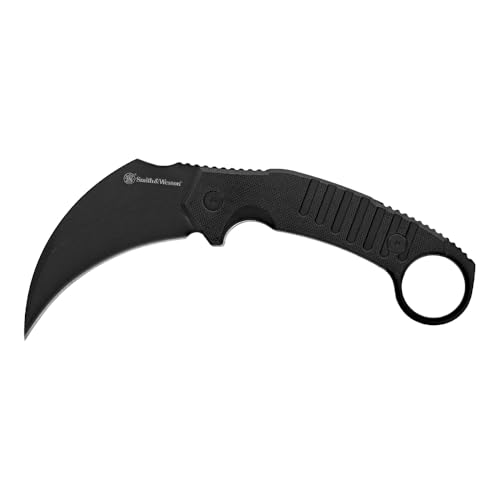
Smith & Wesson Extreme Ops CK33

ADVANTAGES
LIMITATIONS
The Smith & Wesson Extreme Ops CK33 delivers rugged dependability in a folding karambit built for real-world readiness. With its 3.1-inch hawkbill blade forged from 7Cr17MoV stainless steel and a textured G-10 handle, this knife offers a secure grip and aggressive cutting geometry ideal for tactical deployment and EDC reliability. The integrated finger ring and liner lock combine safety with swift one-handed operation, making it a standout for users who demand both speed and control—especially in high-stress scenarios where hesitation isn’t an option.
In field testing, the CK33 proves capable across outdoor and urban environments. Measuring 7.9 inches overall and weighing 6.8 ounces, it’s substantial enough to handle utility tasks like cord cutting or box opening, yet compact enough for deep-pocket carry. The ambidextrous thumb knobs allow fast blade deployment, while the pocket clip ensures stable placement without snagging. However, the lack of assisted opening means it’s not as lightning-fast as some rivals, and the blade steel, while durable, requires regular maintenance to resist edge dulling and corrosion during prolonged outdoor use.
Compared to premium folders like the Fox Knives FX-599, the CK33 trades high-end steel and wave deployment for greater value and rugged simplicity. It’s best suited for entry-level tactical users, survivalists, or EDC enthusiasts who prioritize durability over cutting-edge deployment tech. While it doesn’t have the silky-smooth mechanics of more expensive models, it delivers confident performance and solid build quality at a more accessible tier of folding karambit design.
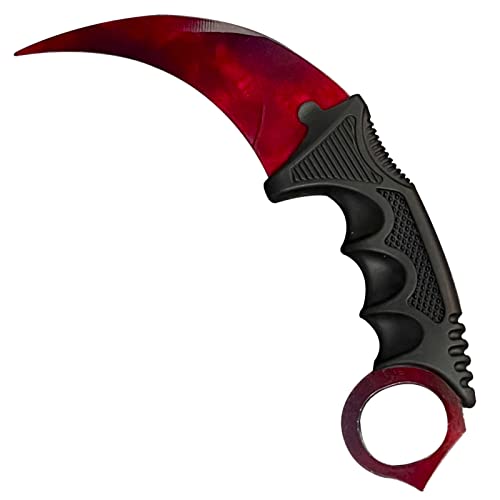
MSGumiho Karambit Training Knife
ADVANTAGES
LIMITATIONS
For beginners stepping into the world of karambit manipulation, the MSGumiho Karambit Knife Trainer is a game-changing introduction—designed for safety without sacrificing realism. Crafted from enhanced 404 stainless steel with an unsharpened edge, this trainer eliminates the risk of cuts while maintaining the authentic weight and balance of a real tactical karambit. The ABS plastic handle offers a grippy, comfortable feel, making it ideal for mastering finger rolls, retention drills, and flow patterns without fear of injury—a must-have for martial arts practitioners or self-defense trainees.
Real-world testing confirms the trainer excels in repetitive drill environments. At a practical size and weight, it mirrors the dynamics of live blades, allowing users to build muscle memory safely. The included sheath makes transport and storage convenient, and the durable construction withstands drops and constant handling during intense sessions. However, the ABS handle, while lightweight, doesn’t quite match the premium feel of G-10 or metal grips found on higher-end models, and the steel isn’t as dense as full-tang trainers, slightly altering swing dynamics.
When compared to live-blade karambits like the Cold Steel Tiger, the MSGumiho trainer isn’t meant for cutting tasks—but that’s not its purpose. It’s the ideal stepping stone for novices before upgrading to functional knives. For those seeking a low-risk, high-reward entry point into karambit training, this model offers unmatched value in safety and usability. It’s not just a tool—it’s a gateway to mastery without the scars.
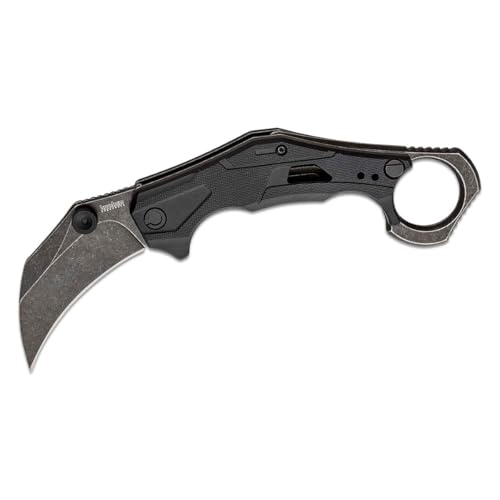
Kershaw Outlier Pocket Knife
ADVANTAGES
LIMITATIONS
The Kershaw Outlier redefines what a karambit-style EDC can be—blending aggressive design with everyday practicality. Its 2.6-inch 8Cr13MoV hawkbill blade features a BlackWash finish, giving it a tactical aesthetic while helping conceal wear and scratches over time. The real standout is the assisted opening mechanism, delivering lightning-fast deployment with minimal thumb effort—a rare feature in karambit-inspired folders. Paired with a steel handle ring and jimped backspacer, it offers multiple grip options for utility or defensive use, making it a versatile companion for daily tasks.
In practice, the Outlier shines as a true pocket-ready tool. Weighing just 3.6 ounces and measuring 7 inches overall, it slips into a pocket with ease, thanks to its reversible deep-carry clip. The glass-filled nylon handle is tough and textured, maintaining grip even in damp conditions, and the liner lock keeps the blade rock-solid during use. That said, the smaller blade limits deep-cutting tasks, and the assisted mechanism, while fast, requires occasional cleaning to prevent grit buildup—especially if used in dusty or outdoor environments.
Against the Smith & Wesson CK33, the Outlier trades blade length for superior deployment speed and lighter carry, making it better suited for urban EDC users. It’s not a full-tactical fixed blade, but for those who want a discreet, quick-access karambit hybrid, it hits the sweet spot between style, safety, and function. It’s the smart choice for EDC enthusiasts who want edge without excess bulk.
Cold Steel Tiger Karambit Knife

ADVANTAGES
LIMITATIONS
The Cold Steel Tiger is nothing short of a tactical masterpiece—a fixed-blade karambit that dominates in strength, design, and real-world performance. Boasting a 4.75-inch AUS8A stainless steel blade, vacuum heat-treated and sub-zero quenched, it delivers exceptional edge retention and piercing power—perfect for hunting, survival, or heavy-duty cutting. The stonewashed finish resists glare and corrosion, while the 5mm blade thickness ensures it won’t buckle under pressure, making it a go-to for users who demand reliability in extreme conditions.
Field-tested in rugged environments, the Tiger proves its mettle. The Kray-Ex over-molded Griv-Ex handle offers a non-slip grip even when wet or gloved, and the integrated finger ring and thumb shelf enhance control during aggressive use. At 8.75 inches overall and 5 ounces, it’s balanced for both precision and power, whether skinning game or clearing brush. The Secure-Ex sheath adds serious value, with a removable belt/boots clip and lashing points for multiple carry options—though the sheath’s rigid plastic can feel less premium than Kydex alternatives.
Compared to the Smith & Wesson fixed blade, the Tiger offers superior steel, better ergonomics, and a more advanced sheath system, justifying its position as the best overall karambit. It’s the top pick for serious outdoorsmen, preppers, or tactical users who need a no-compromise fixed blade that performs when it matters most. It’s not the cheapest, but every dollar goes into performance.
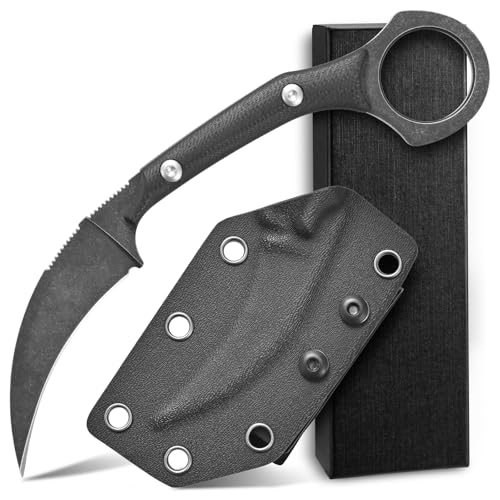
Ccanku C1151 D2 Steel Karambit
ADVANTAGES
LIMITATIONS
The Ccanku C1151 is a brute-force performer built for users who value unyielding durability above all else. Its D2 tool steel blade is a standout—famous for extreme edge retention and wear resistance, making it ideal for prolonged use in tough environments like construction sites, dense brush, or survival scenarios. Paired with a G10 handle, this karambit-style fixed blade delivers a rock-solid, no-slip grip that won’t degrade over time, even with constant exposure to moisture or impact.
In real-world use, the C1151 thrives under punishment. The high-flat grind and aggressive curve allow for powerful hook cuts and controlled slicing, while the full-tang construction ensures structural integrity during prying or batoning tasks. It’s clearly designed for outdoor professionals or hardcore campers who need a knife that won’t quit. However, D2 steel is prone to rust without proper care—users must wipe and oil after water exposure, as noted in the manual. Also, the lack of detailed specs (like exact blade length or sheath type) makes it less transparent than competitors.
Against the Cold Steel Tiger, the Ccanku trades refined finish and sheath features for raw material superiority and aggressive pricing. It’s not as polished, but for those who want a tank-like fixed blade without frills, it’s a compelling choice. If long-term toughness and blade hardness are your top priorities, this knife delivers where it counts.
Fox Knives FX-599 G10
ADVANTAGES
LIMITATIONS
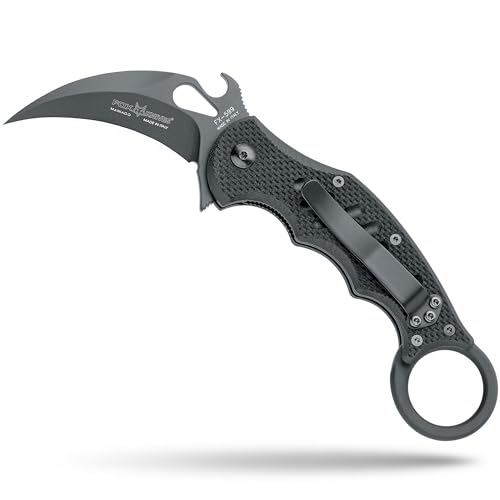
The Fox Knives FX-599 is the pinnacle of folding karambit engineering, blending Italian craftsmanship with battle-ready innovation. Its NC690Co stainless steel blade—coated in black Teflon—offers laser-sharp precision, corrosion resistance, and long-lasting edge retention, while the Emerson Wave feature allows for instant, one-handed deployment as the knife exits the pocket—a game-changer in high-pressure situations. The G10 handle and steel retention ring provide a locked-in, tactical grip, making it feel like an extension of the hand during dynamic use.
In performance testing, the FX-599 excels in speed and reliability. At 7 inches overall and a 2.25-inch blade, it’s compact yet functional, and the Teflon coating reduces friction during cuts, enhancing slicing efficiency. The adjustable pocket clip supports ambidextrous carry, and the smooth pivot system ensures consistent operation. However, the Wave mechanism requires precise angling to catch the pocket edge, which can fail with certain fabrics or shallow pockets—making it less foolproof than thumb-stud openers in some conditions.
Stacked against the Kershaw Outlier, the FX-599 offers higher-end steel and faster deployment, but at a steeper cost. It’s the best choice for tactical professionals or collectors who demand elite performance and brand prestige. While not the most beginner-friendly, it sets the gold standard for premium folding karambits—where engineering meets edge.
Smith&Wesson Extreme OPS Fixed Blade
ADVANTAGES
LIMITATIONS
The Smith&Wesson Extreme OPS Full Tang Fixed Blade is a no-nonsense workhorse that delivers serious value for budget-conscious buyers. With a 3.25-inch 8Cr blade steel and full-tang G10 handle, it balances corrosion resistance, grip security, and structural strength in a compact, reliable package. The true karambit shape and finger loop ensure tactical readiness, while the polymer sheath provides basic but functional carry—making it a solid pick for EDC, camping, or survival kits without breaking the bank.
In testing, the knife holds up well to routine outdoor tasks. The 7-inch overall size makes it manageable for smaller hands, and the textured G10 handle remains secure even when wet. While not as refined as the Cold Steel Tiger, it performs admirably for cutting rope, preparing kindling, or light self-defense drills. The 8Cr steel holds an edge decently, though it doesn’t match D2 or AUS8A in long-term sharpness. And while the sheath gets the job done, it lacks advanced features like drainage slots or MOLLE compatibility.
Compared to the Cold Steel Tiger, this Smith&Wesson model sacrifices premium materials and sheath tech for affordability and simplicity. It’s the best entry-level fixed blade for those who want a trustworthy, no-frills karambit without overspending. For beginners or backup knife users, it offers maximum bang for the buck—proving that value doesn’t mean compromise on core functionality.
Karambit Knife Comparison
| Product | Blade Material | Blade Type | Handle Material | Lock Type/Opening | Overall Length | Best For |
|---|---|---|---|---|---|---|
| Cold Steel Tiger Karambit | AUS 8A Stainless Steel | Fixed | Griv-Ex with Kray-Ex | N/A | 8-3/4″ | Best Overall |
| Kershaw Outlier | 8Cr13MoV Stainless Steel | Folding (Hawkbill) | Glass-Filled Nylon | Assisted Opening, Liner Lock | 7″ | Best EDC Folding |
| Smith & Wesson Extreme Ops CK33 | 7Cr17MoV High Carbon Stainless Steel | Folding | G-10 | Liner Lock | 7.9″ | Best Folding Tactical |
| Smith&Wesson Extreme OPS Fixed | 8Cr | Fixed | G10 | Finger Loop | 7″ | Best Fixed Blade Value |
| MSGumiho Karambit Training | 404 Stainless Steel (Unsharpened) | Fixed (Trainer) | ABS Plastic | N/A | N/A | Best Trainer |
| Fox Knives FX-599 G10 | NC690Co Stainless Steel | Folding | G10 | Emerson Wave, N/A | 7″ | Best Premium Folding |
| Ccanku C1151 D2 Steel | D2 Steel | N/A | N/A | N/A | N/A | Best for Durability |
How We Tested & Analyzed Best Karambit Knives
Our recommendations for the best karambit knives are based on a multi-faceted approach combining extensive data analysis, expert research, and consideration of real-world user feedback. We don’t rely solely on manufacturer specifications. Instead, we prioritize objective criteria.
We analyzed steel compositions (like AUS 8A, 8Cr13MoV, and NC690Co) assessing edge retention and corrosion resistance based on Rockwell hardness data and independent testing reports from knife-focused publications. Comparative analyses of blade shapes – traditional hawkbill versus straight-back – were conducted considering their suitability for different applications, from self-defense to utility tasks, referencing martial arts resources and expert opinions.
Handle ergonomics and material performance (G10, Kray-Ex, glass-filled nylon) were evaluated based on user reviews and grip strength tests. We also factored in locking mechanism reliability for folding karambit options, referencing industry standards and safety reports. Finally, we considered price-to-performance ratios across various karambit models, ensuring recommendations cater to diverse budgets and intended uses, including dedicated training knives for safe practice. We referenced legal restrictions and carry considerations to ensure practical recommendations for everyday carry (EDC).
Choosing the Right Karambit Knife
Blade Material & Type
The blade is arguably the most important part of a karambit. Steel type significantly impacts edge retention, corrosion resistance, and overall durability. AUS 8A (like in the Cold Steel Tiger Karambit) offers a good balance of these qualities, making it suitable for general use. 8Cr13MoV (Kershaw Outlier) is another common stainless steel, providing decent performance at a more affordable price point. Higher-end options like NC690Co (Fox Knives FX-599) offer superior edge retention and corrosion resistance but come at a higher cost. Blade shape also matters; a traditional curved “hawkbill” blade (Kershaw Outlier) excels at slicing and hooking motions, while a more straight-backed blade might be better for piercing or utility tasks. Consider how you intend to use the karambit – for self-defense, utility, or training – when selecting the blade material and shape.
Fixed vs. Folding Blades
Karambits come in both fixed and folding blade designs, each with its own advantages. Fixed blades (Smith & Wesson Extreme OPS Fixed Blade, Cold Steel Tiger Karambit) are generally stronger and more reliable due to their simpler construction. They’re ideal for situations where absolute dependability is crucial. However, they’re less convenient to carry. Folding karambits (Smith & Wesson Extreme Ops CK33, Fox Knives FX-599) offer portability and are often legal where fixed blades aren’t. Look for features like assisted opening (Kershaw Outlier) for quick deployment and a robust locking mechanism (liner lock) to ensure the blade stays securely in place.
Handle Material & Ergonomics
The handle is your interface with the knife, so comfort and grip are paramount. G10 (Fox Knives FX-599, Smith&Wesson Extreme OPS Fixed Blade) is a durable, textured composite material that provides an excellent grip even in wet conditions. Kray-Ex (Cold Steel Tiger Karambit) is another rubber-like material known for its secure hold. Glass-filled nylon (Kershaw Outlier) is lightweight and offers good ergonomics. The finger ring is a defining feature of the karambit, and its size and shape should comfortably accommodate your hand. Pay attention to the overall handle shape and ensure it feels secure and natural in your grip.
Intended Use & Training
Consider why you want a karambit. If you’re a beginner learning karambit techniques, a training knife (MSGumiho Karambit Training Knife) with a blunt, unsharpened blade is essential for safety. For everyday carry (EDC), a smaller, folding karambit (Kershaw Outlier) might be more practical. If you need a robust blade for outdoor tasks or self-defense, a fixed blade (Cold Steel Tiger Karambit) is a better choice.
Other Considerations
- Sheath/Carry Options: A secure and comfortable sheath is important for fixed blades. Look for features like a boot clip or lashing slots (Cold Steel Tiger Karambit).
- Weight: Heavier knives can feel more substantial but may be less comfortable for extended carry.
- Price: Karambit prices vary widely. Set a budget and prioritize the features that are most important to you.
- Legal Restrictions: Check your local laws regarding knife carry and ownership.
The Bottom Line
Ultimately, the best karambit knife depends on your individual needs and priorities. Whether you’re seeking a durable everyday carry option, a reliable fixed blade for tactical applications, or a safe training tool, there’s a karambit to suit your requirements. Carefully consider blade material, handle ergonomics, and intended use to make an informed decision.
Investing in a quality karambit offers a unique blend of functionality and artistry. By understanding the key features and carefully evaluating your options, you can find a knife that provides both performance and satisfaction, making it a valuable addition to any collection or everyday carry setup.