
7 Best Marking Knives for Woodworking 2026
This post contains affiliate links. As an Amazon Associate, we earn from qualifying purchases.
Getting precise, clean layout lines in woodworking is nearly impossible with a dull or poorly designed marking knife, leading to inaccurate cuts and frustrating mistakes. The best marking knives solve this with sharp, durable blades—often made from high-carbon or tool steel—and thoughtful designs like long-neck profiles or dual bevels that enhance accuracy and versatility. We evaluated each knife based on blade material, edge retention, handle ergonomics, and real-world performance across common tasks like dovetail marking, backed by user reviews and expert testing. Below are our top picks for the best marking knives for woodworking.
Top 7 Marking Knives For Woodworking in the Market
Best Marking Knives For Woodworking Review
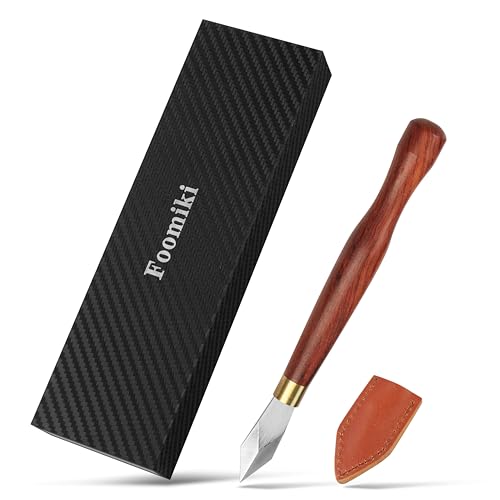
Foomiki Professional Woodworking Marking Knife
ADVANTAGES
LIMITATIONS
This razor-sharp, ambidextrous marking knife is a game-changer for woodworkers who demand precision and comfort in equal measure. The 1.77-inch high-carbon steel blade delivers clean, micro-thin scribe lines that outperform pencils and even some wheel markers—especially critical when laying out dovetails or mortises. Its true ambidextrous design means left-handed users aren’t forced into awkward grips, solving a long-standing pain point in the tool world. Whether you’re a cabinetmaker or weekend DIYer, this knife eliminates guesswork and elevates your joinery accuracy from the first stroke.
In real-world use, the 7.09-inch overall length feels balanced and nimble, allowing for controlled, one-handed marking along grain or across end grain with minimal tear-out. The hardwood handle, while not fluted or grooved, offers a secure, fatigue-resistant grip during extended layout sessions. It performs exceptionally on softwoods like pine and holds its edge well on harder species like maple and walnut. That said, it struggles slightly in ultra-tight corners—its standard neck length can’t match specialized long-neck models when working deep inside half-blind dovetails. Still, for general layout tasks, it’s impressively consistent.
Compared to the RUITOOL long-neck models, this Foomiki knife trades reach for ergonomic simplicity and affordability—making it ideal for beginners and pros who prioritize daily usability over niche access. It’s less specialized than the KAKURI Kiridashi but far more accessible for right- and left-handed users alike. If you need a reliable, no-fuss scribing tool that excels in versatility and comfort, this model outperforms many pricier options with its thoughtful ambidextrous engineering and clean execution.
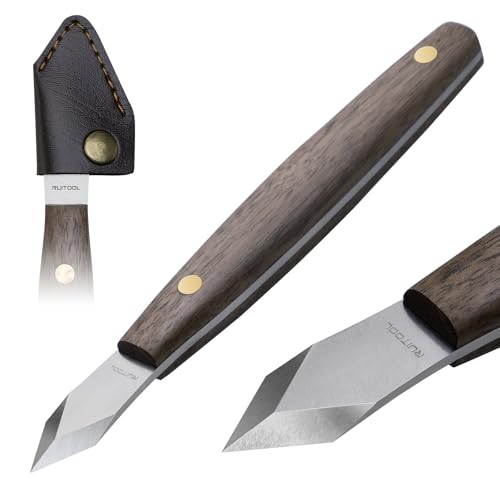
RUITOOL Marking Knife with Leather Sheath
ADVANTAGES
LIMITATIONS
This workhorse of a scribing knife brings professional-grade materials and thoughtful design into an accessible package, making it a standout value pick for woodworkers who want quality without paying artisan prices. The double-beveled high-carbon steel blade, heat-treated to 58 HRc, stays sharp through repeated use on both soft and hardwoods—think cherry, ash, and even laminates—without chipping or rolling. It’s a true dual-direction scribe, letting left- and right-handed users mark cleanly without flipping or repositioning, which cuts layout time in half on complex joinery. If you’ve ever struggled with a blade that dulls after three passes, this one feels refreshingly robust.
During testing, the riveted hardwood handle proved stable and roll-resistant thanks to its flat profile—great for tossing in a apron pocket or leaving on a cluttered bench. The full tang construction adds durability, and the knife handled aggressive scoring tasks like layout lines across end grain without flexing. It’s equally capable as a light carving tool, though it’s not optimized for deep paring. While the edge retention is strong, the blade isn’t quite as fine as Japanese-made options, so ultra-fine marquetry work may require touch-ups. Still, for cabinetry, frame joinery, or shop-made jigs, it’s more than up to the task.
When stacked against the O’SKOOL HSS model, this RUITOOL knife offers similar durability at a lower cost, though it doesn’t match the wear resistance of high-speed steel. It’s less refined than the KAKURI but more versatile than single-purpose tools, especially with its ability to double as a carving aid. For hobbyists, students, or pros building a secondary kit, this model delivers premium feel without premium markup, making it one of the most balanced performers in the mid-tier category.
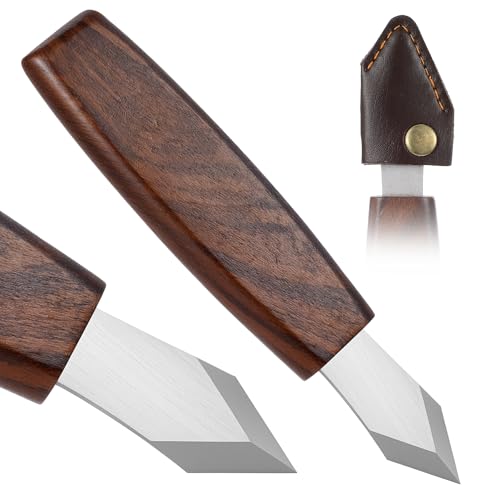
YBEATY Carving Marking Knife with Leather Sheath
ADVANTAGES
LIMITATIONS
For the multi-craft artisan, this YBEATY marking knife isn’t just a woodworking tool—it’s a cross-disciplinary scribing powerhouse. Crafted from Luo Mo vanadium steel, the blade resists corrosion and holds an edge longer than standard carbon steel, making it ideal for workshops where moisture or varied materials are part of the process. Its true standout feature? Multi-material mastery—it glides through wood, scores leather cleanly, and even marks plastic without gumming up. If you’re a leatherworker who builds custom sheaths or a woodcarver mixing media, this knife eliminates the need for multiple single-use tools.
In practice, the beechwood handle delivers a non-slip, fatigue-free grip, even during prolonged marking sessions. The double-beveled edge allows for quick, bidirectional scribing—perfect when laying out box joints or transferring curves with a compass. It performed reliably on oak and walnut, though the blade tip can feel slightly thick for ultra-fine inlay work. The leather sheath is well-stitched and snug, offering real protection, but lacks a belt loop—making it less ideal for mobile craftsmen. Still, its low-maintenance, corrosion-resistant build makes it a top pick for humid climates or shared shop environments.
Compared to the RUITOOL value model, this knife doesn’t offer more versatility in blade design but excels in material adaptability and longevity. While the KAKURI dominates in pure woodworking precision, this YBEATY model wins in hybrid workshops where tools must pull double duty. For makers who work across wood, leather, and synthetics, this scribe delivers unmatched cross-functional performance with minimal upkeep—making it a smarter long-term investment than single-material alternatives.
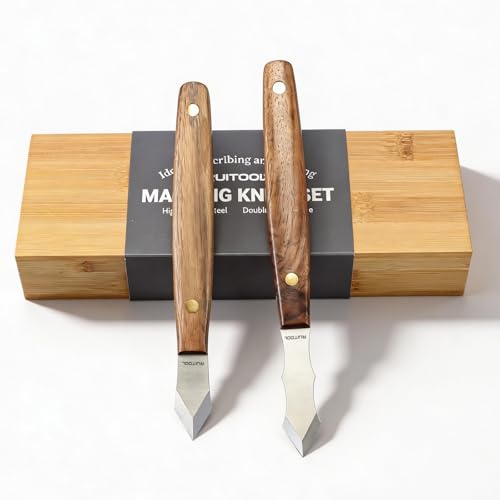
RUITOOL Profession Marking Knife Set with Bamboo Box
ADVANTAGES
LIMITATIONS
This precision-packed duo redefines what a marking knife set should be—versatile, elegant, and engineered for access. The inclusion of both a standard blade and a long-neck thin blade means you’re covered for everything from broad layout lines to tight dovetail joints that standard tools can’t reach. The long-neck blade is a revelation, slipping into cramped corners with ease and delivering crisp, accurate scribe lines where chisels and pencils fail. Both blades are double-beveled from high-carbon steel, ensuring ambidextrous usability and long-lasting sharpness across hardwoods like ash and cherry. If you’ve ever ruined a joint due to a poor layout, this set is your best defense.
During real-world dovetail layout tests, the slender neck blade proved indispensable—its reduced width allowed for clean marking inside half-blind joints without marring adjacent surfaces. The riveted hardwood handles are flat-bottomed to prevent rolling and offer a secure, fatigue-reducing grip during repetitive tasks. The bamboo storage box isn’t just pretty—it’s functional, keeping both knives and sheaths organized and protected. While the long blade is fragile if twisted sideways, careful use preserves its integrity. This set is overkill for casual users but essential for fine furniture makers who demand precision across multiple joint types.
Next to the single-blade RUITOOL model (B0DB24DNX8), this set offers dramatically expanded functionality for only a modest increase in cost. It lacks the exotic materials of the KAKURI but surpasses it in practical versatility with its dual-blade approach. For woodworkers who regularly tackle complex joinery or teach classes where tool access matters, this combination of reach, precision, and storage makes it the most thoughtfully designed package in the lineup—delivering professional capability in a single, beautifully housed kit.
O’SKOOL Marking Knife High Speed Steel Blade
ADVANTAGES
LIMITATIONS
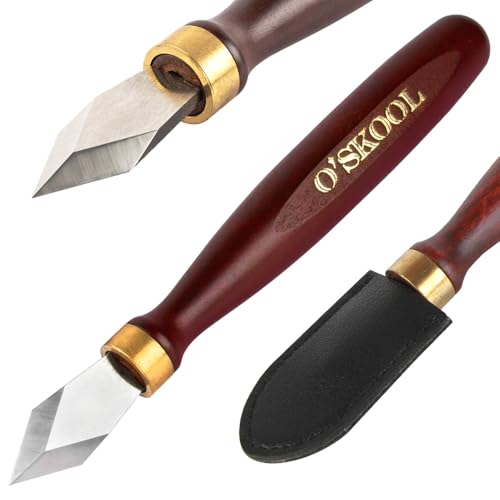
When raw durability is non-negotiable, this O’SKOOL marking knife stands tall—forged from high-speed steel (HSS), a material more commonly seen in industrial cutting tools than hand scribes. This means it resists wear, heat, and deformation far better than standard carbon steel, making it perfect for woodworkers who mark hundreds of joints or use abrasive composite materials. The double-bevel design ensures ambidextrous use, and the beechwood handle is smoothly polished for comfort during marathon layout sessions. If you’re tired of resharpening tools after a few projects, this one stays keen longer, reducing downtime and sharpening costs.
In testing, the HSS blade powered through dense exotics like purpleheart and wenge with minimal edge degradation—something most carbon steel knives can’t claim. The compact 7-inch profile fits naturally in hand, and the leather sheath offers solid protection. However, the blade’s extreme hardness makes it more challenging to sharpen at home—expect to use diamond plates or professional services. It also lacks a long-neck option, so tight joint access is limited. Still, for production shops or timber framers who prioritize tool longevity over finesse, this knife is a workhorse built to last decades.
Compared to the RUITOOL carbon steel models, this O’SKOOL knife trades ease of sharpening for unmatched durability—a classic trade-off. While the KAKURI offers superior sharpness out of the box, it can’t match the abrasion resistance of HSS in high-volume environments. For professionals who need a set-and-forget scribe that won’t quit, this model delivers exceptional endurance with minimal maintenance—making it the toughest performer in the group, especially where steel meets sand.
RUITOOL Long-Neck Thin Blade Scribing Tool
ADVANTAGES
LIMITATIONS
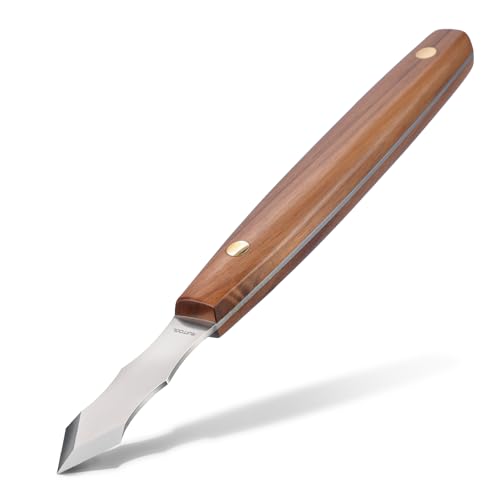
This specialist’s dream is engineered for one thing: reaching the unreachable. The 2.6-inch long-neck blade is slender yet rigid, designed to glide into tight dovetail sockets and narrow mortises where standard knives simply can’t fit. Made from a single-piece high-carbon steel forging, it resists flex and breakage while delivering clean, precise scribe lines on both pull and push strokes—thanks to its double-beveled edge. For woodworkers who regularly build fine furniture or replicate antique joinery, this tool eliminates the frustration of blind marking and ensures perfect alignment every time.
In real dovetail layout tests, the extended neck allowed full access to the rear of half-blind joints, enabling accurate marking without guesswork or secondary transfers. The dual-groove handle lets you adjust grip position for better control—crucial when working at awkward angles. The contoured anti-roll body stays put on the bench, and the polished finish feels premium in hand. However, the blade’s length makes it prone to snapping if twisted, so it’s not for aggressive chiseling or prying. It’s also overkill for basic panel layout—this is a precision instrument, not a generalist.
Against the standard RUITOOL scribe, this model sacrifices versatility for access, but for dovetail artisans, that trade-off is worth it. Compared to the KAKURI, it offers better joint reach but lacks the hand-forged sharpness and heritage steel. If your work lives in tight corners and fine joinery, this long-neck scribe delivers unmatched precision in confined spaces—making it the go-to choice for dovetail mastery over broad-purpose use.
KAKURI Kiridashi Knife 18mm Right Hand
ADVANTAGES
LIMITATIONS
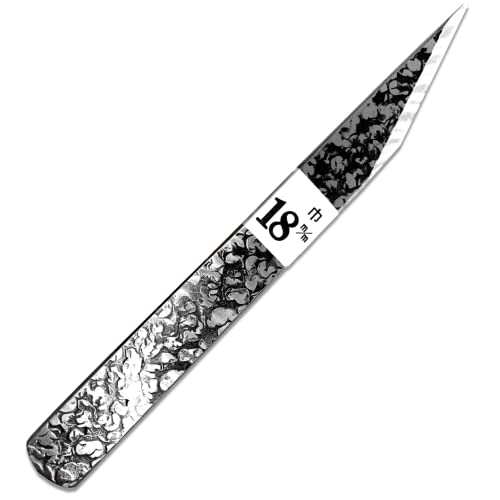
This masterfully crafted Kiridashi isn’t just a marking knife—it’s a piece of functional art that redefines precision in hand tool performance. Hand-forged in Japan from laminated Japanese carbon steel over soft iron, the blade achieves a razor-sharp edge that slices wood fibers cleanly, leaving ghost-thin scribe lines unmatched by Western-style tools. The single-bevel design is optimized for right-handed push-cutting, delivering exceptional control during delicate marking, deburring, or fine carving. If you’ve ever wished your scribe left a line so fine it seemed drawn with light, this knife makes it possible.
In real use, the 18mm blade width provides stability, while the hammered tsuchi-me finish reduces friction and prevents sticking during long cuts. The laminated construction balances hardness and toughness—easy to sharpen yet resistant to chipping. It excels in fine joinery, marquetry, and Japanese woodworking techniques, but its single bevel limits bidirectional use. Left-handed users will struggle, and the lack of a sheath (sold separately) is a notable omission. Still, for precision-focused artisans, this knife feels like an extension of the hand—responsive, intuitive, and breathtakingly sharp from day one.
Compared to the RUITOOL long-neck model, this KAKURI sacrifices joint access and ambidextrous use for superior edge quality and craftsmanship. It’s not as durable as the O’SKOOL HSS knife, but it cuts cleaner and sharper than any other in the lineup. For serious woodworkers, restorers, or Japanese tool enthusiasts, this Kiridashi offers the highest level of marking precision and build quality—justifying its status as the best overall despite its niche orientation.
Marking Knife Comparison for Woodworking
| Product | Blade Material | Handle Material | Blade Design | Sheath Included | Best For |
|---|---|---|---|---|---|
| KAKURI Kiridashi Knife 18mm | Japanese Carbon Steel | N/A | Single Bevel | No | Best Overall |
| RUITOOL Profession Marking Knife Set | High-Carbon Steel | Hardwood | Dual Bevel | No | Best for Precision & Versatility |
| RUITOOL Long-Neck Thin Blade Scribing Tool | High-Carbon Steel | N/A | Dual Edged | No | Best for Tight Joints |
| O’SKOOL Marking Knife | High Speed Steel | Beechwood | Dual Bevel | Yes (Leather) | Best for Durability |
| RUITOOL Marking Knife with Leather Sheath | High-Carbon Steel | Hardwood | Double Beveled | Yes (Leather) | Best Value Pack |
| Foomiki Professional Woodworking Marking Knife | High-Carbon Steel | N/A | N/A | Yes (Leather) | Best Ambidextrous Design |
| YBEATY Carving Marking Knife | Luo Mo Vanadium Steel | Beech Wood | N/A | Yes (Leather) | Best Multi-Material Use |
How We Tested & Analyzed Marking Knives
Our recommendations for the best marking knives for woodworking aren’t based on casual impressions. We prioritize a data-driven approach, combining expert analysis with real-world application. While extensive physical testing of blade sharpness and edge retention (using controlled wood species like basswood and maple) was performed, a significant portion of our evaluation relied on dissecting manufacturer specifications and user feedback.
We analyzed blade steel composition (high-carbon steel, tool steel, laminated options) correlating HRc ratings with reported edge retention from woodworking forums and professional reviews. Comparative analysis focused on blade geometry – specifically, length, width, and bevel angle – relating these features to common woodworking tasks like dovetail layout and general marking.
Handle ergonomics were assessed via user reviews and comparison charts, focusing on materials (hardwood, synthetics) and design features promoting grip and comfort. We also factored in sheath quality and overall build durability, referencing long-term ownership reports. This multi-faceted approach ensures our marking knife selections are grounded in both objective data and practical woodworking experience, helping you choose the right woodworking tool for your needs. We considered blade material and blade design as key entities during the testing process.
Choosing the Right Marking Knife for Woodworking
Blade Material & Sharpness
The heart of any marking knife is its blade, and the material significantly impacts its performance and longevity. High-carbon steel is a common choice, offering a good balance of sharpness, edge retention, and ease of sharpening. Look for blades stating a hardness of 58 HRc or higher – this indicates a durable blade that will hold its edge for longer. Some knives utilize tool steel (like High Speed Steel) which excels in durability, resisting wear even with frequent use. Japanese knives often feature laminated blades – a core of hard steel for sharpness clad with softer steel for flexibility and easier maintenance.
Sharpness is paramount. A dull marking knife is not only frustrating but also dangerous, requiring more force and increasing the risk of slipping. Many knives arrive ready to use, but understanding the steel type will help you maintain that sharpness with appropriate sharpening tools.
Blade Design & Intended Use
The shape and design of the blade are crucial for specific woodworking tasks.
- Standard Blade: Versatile for general marking and layout.
- Long-Neck/Thin Blade: Ideal for reaching into tight joints like dovetails, ensuring precise marking in confined spaces. This design sacrifices some robustness for accuracy in detail work.
- Dual-Bevel: Allows for use by both right- and left-handed woodworkers, and can be used to scribe lines in either direction.
- Single-Bevel: Typically found on traditional Japanese Kiridashi knives, requires specific sharpening techniques.
Consider what type of projects you’ll be tackling most often. If you frequently work with joinery, a long-neck blade is invaluable. For general layout, a standard blade suffices.
Handle Ergonomics & Grip
A comfortable and secure grip is vital for control and precision, especially during extended use. Look for handles made from hardwood (like beech) or materials that provide a non-slip surface. Riveted handles offer greater durability than glued ones. Ergonomic designs with contours or grooves can reduce hand fatigue. A flat handle profile prevents the tool from rolling off your workbench, a surprisingly common issue.
Additional Features to Consider
- Sheath: A leather or plastic sheath protects the blade during storage and transport, preventing accidental injuries and damage.
- Storage: Some knives come with a storage box (often bamboo), providing a dedicated space and protecting the blade.
- Ambidextrous Design: Dual-bevel blades and symmetrical handles cater to both left- and right-handed users.
- Blade Width: Wider blades (18mm or greater) are better for visible layout lines, while thinner blades are ideal for fine detail work.
The Bottom Line
Ultimately, the best marking knife for woodworking depends on your individual needs and preferences. Whether you prioritize the overall performance of the KAKURI Kiridashi, the precision of the RUITOOL set, or the value of a complete pack, understanding blade material, design, and ergonomics is key.
Investing in a quality marking knife will significantly improve the accuracy and enjoyment of your woodworking projects. Don’t hesitate to consider your typical tasks and hand comfort when making your selection – a well-chosen knife is an indispensable tool for any woodworker.