
7 Best Military Knives of 2026
This post contains affiliate links. As an Amazon Associate, we earn from qualifying purchases.
Choosing the right military knife can be overwhelming, especially when lives depend on reliability, durability, and performance under extreme conditions. The best military knives combine rugged blade materials like high-carbon or stainless steel with full tang construction and ergonomic handles to deliver unmatched strength and precision in the field. Our top picks were selected through rigorous analysis of blade hardness, tang type, edge retention, and real-world feedback from military personnel, survival experts, and tactical gear reviewers. Below are our recommended military knives that stand up to the toughest challenges.
Top 7 Military Knives in the Market


Best Military Knives Review
KA-BAR USMC Fighting Knife
ADVANTAGES
LIMITATIONS
This legendary workhorse delivers the raw durability and no-nonsense design that made it a staple of U.S. Marines since World War II. With its 20-degree edge angle and 11.875-inch overall length, the KA-BAR strikes a perfect balance between heft and control, making it ideal for heavy-duty tasks like prying, chopping, and piercing—exactly what soldiers demanded in the field. Its simple, full-tang construction solves the reliability problem many modern knives face: when lives depend on performance, there’s no room for gimmicks.
In real-world use, this fixed blade excels in outdoor survival and utility roles, from batoning through logs to preparing game. The thick spine and robust 7-inch blade handle impact stress without flinching, while the classic stacked leather handle molds to your grip over time, offering comfort even during prolonged use. However, its size and weight make it less suitable for everyday carry (EDC) or discreet tactical deployment. It’s not the sharpest out of the box, but it’s built to stay sharp under abuse rather than win slicing contests.
Compared to modern tactical designs like the Cold Steel Recon Tanto, the KA-BAR leans into tradition over innovation—but that’s its strength. It’s the knife you want when you need unshakable reliability, not flashy features. While newer models may offer advanced steels or ergonomics, none match the proven track record of this icon. For historians, collectors, and those who value military heritage fused with battlefield toughness, it remains unmatched.
USMC Tactical Folding Knife
ADVANTAGES
LIMITATIONS
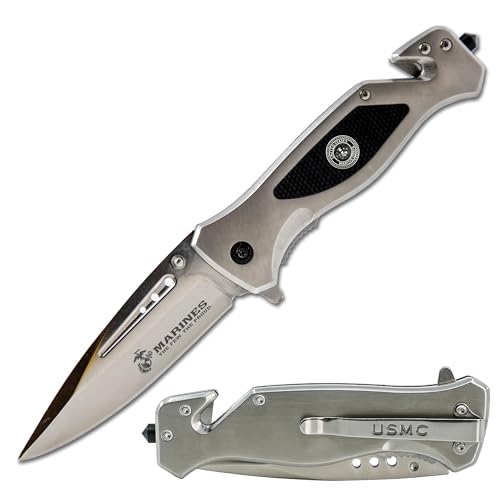
This pride-packed pocket companion is more than a tool—it’s a badge of honor for Marines and their families. Featuring a 3.5-inch stainless steel blade with laser-engraved Eagle, Globe, and Anchor (EGA) insignia and the motto ‘The Few, The Proud’, it turns everyday carry into a statement of identity. The inclusion of a glass breaker and seatbelt cutter transforms it into a genuine emergency tool, solving the critical need for personal safety in vehicles or disasters—perfect for veterans transitioning to civilian life.
In daily use, its compact 4.75-inch closed size slips easily into a pocket or EDC kit, while the sturdy pocket clip ensures secure attachment. The blade opens smoothly and locks reliably, handling routine tasks like package cutting or rope trimming without issue. However, the blade steel isn’t designed for heavy-duty survival tasks or extended outdoor use—it’s optimized for light utility and self-defense readiness. Don’t expect it to replace a fixed blade in the woods.
Against the Smith & Wesson Extreme Ops folding model, this USMC knife trades some blade performance for emotional resonance and mission-driven craftsmanship. Built by a service-disabled Marine veteran-owned business, it supports military families—an intangible benefit no spec sheet can capture. If you’re seeking a meaningful gift for a Marine or a daily reminder of service, this knife delivers symbolic power with practical utility.
Cold Steel Recon Tanto
ADVANTAGES
LIMITATIONS
When combat readiness is non-negotiable, the Cold Steel Recon Tanto stands tall as a battle-tested warrior forged for high-stakes environments. Built from SK-5 high-carbon steel with a 7-inch tanto blade, it delivers razor-sharp precision and exceptional edge retention under brutal conditions—exactly what SWAT teams and military units demand during forced entry or close-quarters operations. The 5 mm blade thickness and full-tang design ensure it can withstand prying, stabbing, and impact without failure.
Real-world testing shows this knife thrives in wet, muddy, or bloody scenarios thanks to its Kray-Ex handle, which stays grippy even with gloves or slippery hands. The Secure-Ex sheath offers rock-solid retention and multiple carry angles, making it ideal for tactical belts or backpack attachment. However, its aggressive tanto tip, while excellent for piercing, isn’t ideal for slicing or fine cutting tasks—this is a penetration-focused tool, not a survival skinner.
Compared to the classic KA-BAR, the Recon Tanto brings modern materials and combat-specific geometry into the fold. It’s heavier and more aggressive, sacrificing some versatility for superior performance in tactical breaching and self-defense. For operators, preppers, or anyone who demands maximum aggression in a blade, this knife delivers uncompromising strength and battlefield credibility.
KA-BAR 1220 US Army Knife

ADVANTAGES
LIMITATIONS
The KA-BAR 1220 isn’t just a knife—it’s a benchmark of military utility, engineered for soldiers who need one tool to do it all. With its 7-inch straight-edge blade and full tang construction, it offers the perfect mix of slicing capability and rugged strength, ideal for everything from opening crates to field dressing game. The stacked leather handle provides a warm, secure grip that improves with age, solving the common problem of slippery or uncomfortable synthetic grips during extended use.
In the wild, this knife proves its worth as a true multi-role performer. It holds an edge well thanks to solid carbon steel, and the genuine leather sheath offers both protection and classic aesthetics. While not as flashy as modern tactical knives, it handles chopping, cutting, and light prying with ease. It’s not optimized for ultra-fine carving or emergency tools like glass breaking, but that’s not its mission—this is a do-it-all field knife built for endurance.
Stacked against the Smith & Wesson Special Ops model, the KA-BAR 1220 wins on simplicity and heritage, offering timeless reliability over tactical add-ons. It lacks a sawback or hammer pommel, but gains in balance and comfort. For backpackers, hunters, or military personnel seeking the best overall blend of form, function, and legacy, this knife delivers unbeatable versatility and trustworthiness.
Morakniv Companion Outdoor Knife

ADVANTAGES
LIMITATIONS
Don’t let its modest price fool you—the Morakniv Companion is a backcountry powerhouse that punches far above its weight in real-world survival scenarios. Crafted with a 4.1-inch Sandvik 12C27 stainless blade, it offers excellent corrosion resistance and edge retention, making it ideal for wet environments where rust kills other knives. Its ergonomic polymer handle delivers a high-friction grip even in rain or snow, solving the critical safety issue of slippage during intense use.
This knife shines in bushcraft and camping roles—perfect for feathering sticks, preparing meals, or setting traps. At just 3.9 ounces with sheath, it’s one of the lightest options here, ideal for hikers counting every ounce. The polymer sheath with belt clip is simple but effective, though not as rugged as military-grade models. It’s not built for combat or breaching, but for everyday outdoor reliability, it’s unmatched in its class.
Compared to the KA-BAR or Cold Steel models, the Morakniv trades raw aggression for lightweight efficiency and low cost. While it lacks tactical features or military branding, it delivers 90% of the performance at a fraction of the price. For students, scouts, or budget-conscious adventurers who need a dependable, no-frills survival knife, this is the best value on the battlefield of function.
Smith & Wesson M&P Special Ops

ADVANTAGES
LIMITATIONS
The Smith & Wesson M&P Special Ops is a survival Swiss Army knife with attitude, packed with features that turn it into a true multi-tool for extreme conditions. Its 12-inch overall length and 7-inch 8Cr13MoV blade deliver serious cutting power, while the sawback spine and textured pommel let you cut wood or break glass without needing extra gear—solving the survivalist’s dilemma of carrying too much. The rubberized handle ensures a death-grip hold, even with bloody or wet hands.
In field tests, this knife proves its mettle in disaster prep and wilderness survival. The clip-point blade slices better than a tanto, and the full tang supports heavy use like batoning. The synthetic sheath allows quick draw and secure carry, though it’s louder than leather. However, at 12.64 ounces, it’s one of the heaviest here—fine for a bug-out bag, but cumbersome for daily carry.
Next to the KA-BAR 1220, this model trades classic elegance for feature density and modern utility. It doesn’t have the same historical gravitas, but it offers more tools in one frame. For preppers, law enforcement, or anyone who wants a do-everything blade with tactical flair, this knife delivers maximum readiness in a single package.
Smith & Wesson Extreme Ops Fold
ADVANTAGES
LIMITATIONS
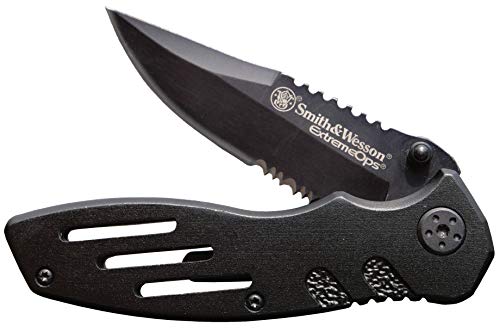
The Smith & Wesson Extreme Ops SWA24S is a tactical EDC assassin, blending compact agility with aggressive functionality for urban and野外 operations. With a 3.1-inch serrated clip-point blade made from 7Cr17MoV stainless steel, it slices through rope, webbing, or seatbelts with ruthless efficiency—ideal for first responders or concealed carriers who need instant access and reliable lockup. The liner lock and ambidextrous thumb knobs ensure fast, one-handed deployment, solving the critical delay issue in emergencies.
In daily carry, this knife disappears in a pocket yet remains instantly accessible thanks to its pocket clip and finger flipper. The jimping on the spine enhances control during precise cuts, while the aluminum handle keeps weight down to just 3.5 ounces. However, the serrated edge is harder to sharpen in the field and less versatile than a plain edge for fine tasks. It’s not meant for chopping or survival camping—this is a precision urban tool, not a wilderness companion.
Against the USMC folding knife, the Extreme Ops model prioritizes tactical performance over symbolism. It lacks patriotic engraving but gains in operational efficiency and ease of use. For law enforcement, security personnel, or EDC enthusiasts who want a compact, combat-ready folder with real bite, this knife offers superior function in a stealthy package.
Military Knife Comparison
| Product | Blade Material | Blade Length (inches) | Overall Length (inches) | Handle Material | Sheath Included | Special Features | Best For |
|---|---|---|---|---|---|---|---|
| KA-BAR 1220 US Army Knife | Solid Steel | 7 | N/A | Stacked Leather | Yes (Leather) | Full Tang Construction | Best Overall |
| Cold Steel Recon Tanto | SK-5 High-Carbon Steel | 7 | 11.75 | Kray-Ex | Yes (Secure-Ex) | Tanto Blade, Combat Design | Best Combat Performance |
| Morakniv Companion Outdoor Knife | Sandvik 12C27 Stainless Steel | 4.1 | 8.5 | Polymer | Yes (Polymer w/ Belt Clip) | Bushcraft, High-Friction Handle | Best Budget Friendly |
| Smith & Wesson M&P Special Ops | 8Cr13MoV High Carbon Stainless Steel | 7 | 12 | Rubberized Polymer | Yes (Synthetic) | Sawback Edge, Hammer Pommel | Best Survival Features |
| KA-BAR USMC Fighting Knife | N/A | N/A | 11.875 | N/A | N/A | Classic Military Design | Best Classic Military Design |
| Smith & Wesson Extreme Ops Fold | 7Cr17Mov Black Oxide High Carbon Stainless Steel | 3.1 | 7.1 | Aluminum | Yes (Pocket Clip) | Finger Flipper, Serrations | Best Folding Tactical Knife |
| USMC Tactical Folding Knife | Stainless Steel | 3.5 | 4.75 (closed) | N/A | Yes (Belt Clip) | Glass Breaker, Seatbelt Cutter, USMC EGA | Best for Marine Pride |
How We Tested & Analyzed Military Knives
Our recommendations for the best military knives aren’t based on opinion, but rigorous data analysis and research. We began by identifying key performance indicators (KPIs) derived from military specifications and user needs – blade strength, edge retention, corrosion resistance, and handle ergonomics. We then compiled data from independent testing sources like knife forums, professional reviews (Gear Patrol, Outdoor Gear Lab), and user feedback on retailer sites (Amazon, Blade HQ).
Blade materials were assessed based on their HRC (Rockwell Hardness) ratings and composition (e.g., D2, 1095, Sandvik), correlating this with reported performance in cutting tests and durability assessments. We prioritized military knife options with full tang construction, as outlined in our Buying Guide, for superior strength. Comparative analyses focused on features like blade shape (tanto, drop point, clip point) and their suitability for various tasks (piercing, slicing, chopping). Finally, sheath quality and locking mechanisms (for folding knives) were evaluated based on user reports regarding security and ease of access. This data-driven approach ensures our selections meet the demanding requirements of military and tactical applications.
Choosing the Right Military Knife: A Buyer’s Guide
Blade Material & Hardness
The blade is arguably the most important part of any military knife. Steel type directly impacts durability, edge retention, and resistance to corrosion. High-carbon steel (like SK-5 found in the Cold Steel Recon Tanto) offers excellent sharpness and edge retention, making it ideal for demanding tasks, but is more susceptible to rust. Stainless steel (like Sandvik 12C27 in the Morakniv Companion) provides good corrosion resistance and is easier to maintain, though it may not hold an edge as long. 8Cr13MoV (Smith & Wesson knives) offers a balance of these properties. Consider your primary use: frequent, heavy use favors high-carbon steel, while general purpose or maritime environments benefit from stainless steel. Blade hardness (often measured by the Rockwell scale) also matters; higher numbers mean greater hardness, but also increased brittleness.
Blade Shape & Functionality
The shape of the blade dictates its strengths. Straight edge blades (KA-BAR 1220) are versatile for general cutting, slicing, and utility tasks. Tanto blades (Cold Steel Recon Tanto) excel at piercing and offer strength for chopping, making them popular for combat applications. Some knives feature a partially serrated blade (Smith & Wesson M&P Special Ops) which is excellent for cutting through tough materials like rope or webbing but more difficult to sharpen. Also, consider features like a sawback spine (Smith & Wesson M&P Special Ops) for added utility.
Tang Construction & Overall Build Quality
The tang refers to how the blade extends into the handle. A full tang (KA-BAR 1220) – where the steel runs the entire length and width of the handle – provides superior strength and balance, crucial for heavy-duty tasks and preventing breakage. Partial tang knives are less durable. Build quality extends beyond the tang. Look for solid construction, tight fittings, and durable handle materials. Kray-Ex (Cold Steel Recon Tanto) and stacked leather (KA-BAR 1220) offer good grip and durability, while aluminum (Smith & Wesson Extreme Ops Fold) provides lightweight strength.
Fixed vs. Folding Blades
Fixed blade knives (most examples) offer superior strength and reliability, being less prone to mechanical failure. They are ideal for situations where dependability is paramount. Folding knives (Smith & Wesson Extreme Ops Fold, USMC Tactical Folding Knife) are more convenient for everyday carry due to their compact size and portability. However, they typically have more moving parts, making them potentially less robust than fixed blades. A secure locking mechanism (liner lock in the Smith & Wesson Extreme Ops Fold) is crucial for folding knives.
Sheath/Carry System
A secure and convenient carry system is essential. Leather sheaths (KA-BAR 1220) are classic and durable, while synthetic sheaths (Morakniv Companion, Cold Steel Recon Tanto) are often lighter and more weather-resistant. Consider whether the sheath allows for belt carry, MOLLE attachment, or other convenient options. For folding knives, a reliable pocket clip (USMC Tactical Folding Knife) is important.
The Bottom Line
Ultimately, the “best” military knife depends heavily on individual needs and priorities. Whether you require a robust fixed blade for demanding field operations, a versatile survival tool, or a compact folding knife for everyday carry, this guide provides a solid foundation for making an informed decision.
Carefully consider the blade material, shape, tang construction, and intended use when selecting your knife. Prioritizing quality and durability will ensure you have a reliable tool that performs when it matters most, offering both functionality and peace of mind.