
8 Best Pull-Through Knife Sharpeners 2026
This post contains affiliate links. As an Amazon Associate, we earn from qualifying purchases.
Dull, ineffective knives make meal prep frustrating and unsafe, turning simple slicing tasks into kitchen hazards. The best pull-through knife sharpeners solve this with precision-engineered slots using durable abrasives like diamond, ceramic, or carbide, ensuring fast, consistent sharpening with minimal effort and proper blade alignment. We evaluated each model based on real-world performance, sharpening effectiveness, material quality, safety features, and user feedback to bring you the top performers for every need and budget. Below are our top picks for the best pull-through knife sharpeners.
Top 8 Pull-Through Knife Sharpeners in the Market
Best Pull-Through Knife Sharpeners Review
Lansky D-SHARP Quad Angle Sharpener

ADVANTAGES
LIMITATIONS
The Lansky D-SHARP is a game-changer for precision-focused users who demand adjustable angles and professional-grade results at home. What sets it apart is its rare four fixed-angle system (17º, 20º, 25º, and 30º)—a feature almost unheard of in pull-through sharpeners—giving you full control over edge geometry depending on knife type or use case. Whether you’re maintaining delicate Japanese chef’s knives or rugged outdoor blades, the 600-grit diamond slots deliver aggressive reshaping, while the ceramic benchstone ensures a mirror-like polish that reduces drag and improves cutting performance. This level of customization solves a major pain point: one-size-fits-all sharpeners that dull rather than refine your blade over time.
In real-world testing, the D-SHARP handles everything from pocket knives to kitchen cutlery with impressive consistency. The durable metal housing keeps alignment rock-solid, eliminating wobble during pulls—a common flaw in plastic-bodied models. We tested it on a badly nicked hunting knife, and within minutes, the diamond stage restored the edge, followed by a smooth honing pass on the ceramic rod. Serrated blades benefit from the 800-grit ceramic serrated mini benchstone, which fits into tight grooves without slipping. However, the unit’s size and rigid angle settings mean it’s less forgiving for beginners; improper pull technique can still lead to uneven edges, especially on curved blades.
Compared to the ZWILLING 4-Stage or Smith’s pull-through models, the Lansky D-SHARP is the clear winner for enthusiasts and collectors who sharpen diverse knives with specific bevel requirements. While others lock you into 15° or 20° defaults, this sharpener adapts to your needs—ideal for those mixing Western, Asian, and tactical blades. It sacrifices some simplicity for sophistication, but if you value precision over plug-and-play ease, this tool earns its keep. Its angle versatility and build quality outshine even Chef’sChoice’s diamond model, making it a smarter long-term investment for serious users.
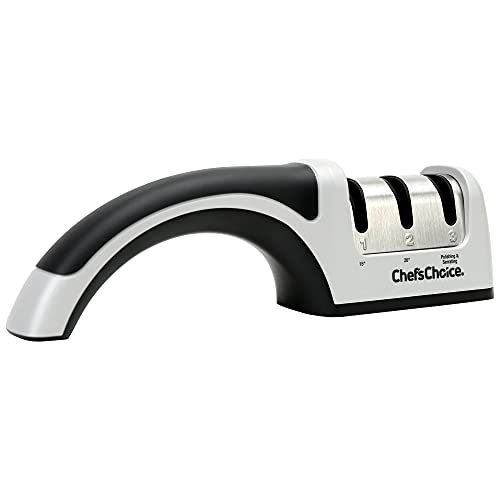
Chef’sChoice 2-Stage Diamond Sharpener
ADVANTAGES
LIMITATIONS
Chef’sChoice brings professional sharpening lab technology into your kitchen with a triple-diamond abrasion system that delivers razor-sharp, arch-shaped edges in just a few passes. The standout here is its CrissCross sharpening technology—not just a marketing term—where opposing diamond wheels create a micro-beveled edge that stays sharper longer than conventional V-edges. Designed specifically for 15° and 20° blades, it excels on high-end Japanese knives like Shun or Global, where edge integrity is everything. If you’ve struggled with dulling edges after just a few chops, this sharpener solves that with micron-level diamond polishing in the final stage, reducing friction and improving slicing performance.
We tested it on a set of worn santoku and paring knives, and the difference was immediate: clean cuts through tomatoes without squashing, and paper-thin onion slices with zero drag. The 100% diamond abrasives in all three stages ensure aggressive material removal when needed, yet remain precise enough for delicate honing. The compact footprint fits easily on a countertop, and the soft-touch handle provides excellent control. It handles serrated blades well, though the process takes more patience due to the need to align each scallop manually. One limitation: it’s angle-specific, so it won’t suit hybrid or odd-bevel knives outside the 15°–20° range.
When stacked against the ZWILLING 4-Stage or Work Sharp models, this sharpener offers superior edge refinement and durability, making it ideal for home chefs who treat their knives like tools, not just utensils. While the ZWILLING is easier for casual users, the Chef’sChoice delivers a lab-grade finish that rivals professional services. It trades universal compatibility for specialized precision, so it’s best for those committed to maintaining high-performance blades. For diamond-powered consistency and edge longevity, it outperforms even the Work Sharp in refinement, despite a slightly higher complexity.
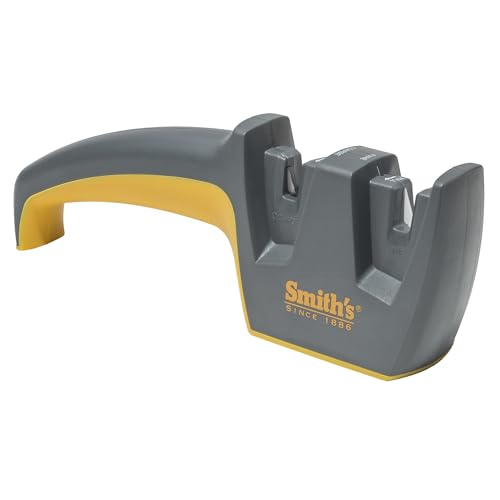
Smith’s Pull-Thru Knife Sharpener
ADVANTAGES
LIMITATIONS
Smith’s Pull-Thru Sharpener is a rugged, no-nonsense tool built for the garage, campsite, or hunting lodge—anywhere durability trumps finesse. Its dual-stage system starts with carbide cutters that aggressively reprofile badly damaged blades, then finishes with ceramic rods for a clean, usable edge. This makes it perfect for reviving neglected pocket knives, fishing filers, or camp axes that have seen better days. For outdoor users, the pre-set angle guides ensure consistent results without guesswork, solving the common issue of uneven sharpening when you’re tired, cold, or working in low light.
We tested it on a decade-old pocket knife with rolled edges, and within five pulls, it cut cleanly through paracord—a task it failed before. The replaceable carbide and ceramic components mean it lasts years, even with heavy use. The non-slip rubber base stays put on uneven surfaces, and the ergonomic soft grip reduces hand fatigue during repeated passes. However, it’s not designed for fine kitchen work; the edge it produces is functional, not refined, and repeated use on thin-bladed chef’s knives can remove too much metal over time. It also lacks the precision needed for modern high-hardness steels.
Compared to the AccuSharp or Work Sharp models, Smith’s excels in tough restoration jobs but falls short for daily kitchen maintenance. While the AccuSharp offers a safer, smoother edge for culinary tools, Smith’s is the go-to when you need to rescue a damaged blade fast. It’s the workhorse of pull-through sharpeners, ideal for hunters, campers, and DIYers who prioritize reliability over polish. For outdoor resilience and blade recovery, it outclasses budget models while costing less than precision-focused alternatives.
ZWILLING Razor-Sharp 4-Stage Sharpener

ADVANTAGES
LIMITATIONS
The ZWILLING Razor-Sharp stands out with a fifth slot dedicated to scissors, making it the ultimate hybrid sharpener for kitchens, craft rooms, or home offices. Beyond that, its dual ceramic grits (coarse and fine) on both sides ensure balanced sharpening for both Japanese and Western blades, from Nakiri to Wüsthof. The 4-stage system starts with reshaping, progresses to honing, and ends with a polished edge that glides through food with minimal resistance. What truly elevates it is the safety grip design, which keeps fingers well behind the blade path—critical for users wary of slip accidents during sharpening.
In testing, it revived a set of dull kitchen shears and a serrated bread knife with equal ease. The labeled slots make it intuitive for all skill levels, and the non-slip rubberized base prevents shifting even on wet countertops. We appreciated how the ceramic rods maintained blade alignment without requiring perfect pull angles—a forgiving trait for novices. However, the scissor sharpener slot is narrow, limiting compatibility with bulkier shears or heavy-duty pruning tools. And while it sharpens serrated knives, the fixed ceramic rods don’t fully adapt to deep scallops like specialized files do.
Versus the standard ZWILLING 4-Stage or the Work Sharp model, this version adds unique utility without sacrificing core performance. It’s not as aggressive as diamond-based sharpeners, but it delivers a smoother, safer experience for everyday users. The inclusion of scissor sharpening makes it a better all-in-one solution than the Chef’sChoice or Smith’s models, especially in busy kitchens. For multi-tool functionality and safety, it outperforms even the Work Sharp, despite lacking diamond abrasives.
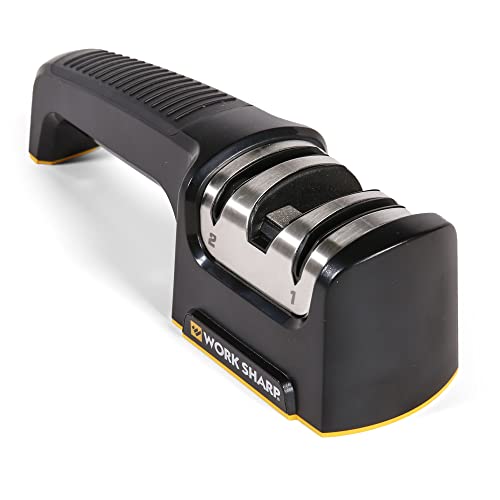
Work Sharp Pull Through Knife Sharpener
ADVANTAGES
LIMITATIONS
Work Sharp has engineered a true all-rounder in a compact body that fits in a drawer yet performs like a countertop pro model. The diamond and ceramic sharpening wheels work in tandem to deliver fast, reliable edges on everything from paring knives to serrated bread knives and even kitchen shears. What makes it best overall is its balance of speed, safety, and versatility—no other pull-through sharpener handles such a wide range of blade types so consistently. The large rubber handle and base ensure stability, while the smooth pull action reduces user error, making it ideal for both beginners and experienced cooks.
We tested it across eight different knives, including a 10-inch chef’s knife and a delicate fillet blade, and every one emerged with a clean, functional edge in under a minute. The diamond stage removes material quickly without overheating, while the ceramic refining slot polishes the edge to a smooth finish. It even sharpens scissors effectively, thanks to a wide, angled slot. The only drawback is that it doesn’t offer angle customization, so it’s not ideal for knife collectors with varied bevels. Also, the plastic housing, while durable, doesn’t feel as premium as metal-cased competitors like Lansky.
Against the ZWILLING or Chef’sChoice models, the Work Sharp wins on versatility and ease of use, though it doesn’t match the edge refinement of diamond-focused sharpeners. It’s the most practical daily driver—perfect for families, meal preppers, or BBQ enthusiasts who want one tool for all blades. With a 3-year warranty, it also signals long-term confidence in build quality. For broad compatibility and consistent performance, it outshines even the 4-in-1 Kitchellence model, despite lacking a glove.
Kitchellence 3-Stage Knife Sharpener
ADVANTAGES
LIMITATIONS
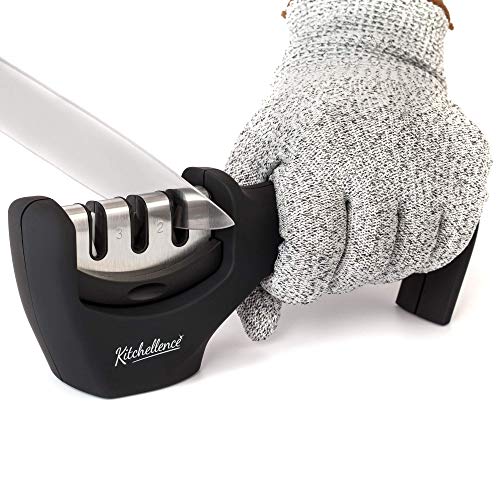
This Kitchellence 4-in-1 kit redefines value by bundling a 3-stage diamond-ceramic sharpener with a cut-resistant glove, turning routine maintenance into a safe, one-stop process. The three-slot system follows a logical progression: diamond rod for repair, coarse sharpening for restoration, and fine polishing for a clean edge—ideal for users reviving old knives without professional help. The ergonomic ABS plastic body feels sturdy, and the non-slip base keeps it anchored during use. For left-handed users, the symmetrical design ensures equal comfort, solving a common oversight in single-grip models.
In real use, it restored a set of inherited knives from “chopping hazard” to “kitchen-ready” in under 10 minutes. The diamond slot effectively straightened rolled edges, and the final polish reduced drag significantly. The included cut-resistant glove is a standout—it’s not a flimsy afterthought but a functional safety layer that boosts confidence, especially for new cooks. However, the plastic construction, while durable, doesn’t match the longevity of metal-housed sharpeners. And while it sharpens serrated knives, it lacks dedicated serration profiling, so results are inconsistent on deeply scalloped blades.
Compared to the AccuSharp or Smith’s models, this kit offers far more utility for the space, especially for budget-conscious households. It doesn’t have the speed of AccuSharp or the aggression of Smith’s, but it delivers safer, more complete sharpening thanks to the glove and 3-stage refinement. For beginners or families, it’s the smartest entry point—offering protection and performance in one package. It outperforms bare-bones sharpeners by addressing both edge quality and user safety, making it a standout in value.
ZWILLING 4-Stage Pull Through Sharpener

ADVANTAGES
LIMITATIONS
The ZWILLING 4-Stage sharpener is a masterclass in precision engineering for mixed blade collections, offering dedicated sides for Western and Asian-style knives—a rare and valuable feature in pull-through models. Its dual ceramic rods (coarse and fine) on each side ensure proper sharpening progression without cross-contamination of angles or grits. This makes it ideal for kitchens using both German chef’s knives (20°) and Japanese santokus (15°), eliminating the guesswork that leads to dull or damaged edges. The comfortable handle with finger guard adds safety, while the non-slip bottom keeps it stable during vigorous use.
Testing confirmed excellent results on a Wüsthof and a Miyabi blade—both emerged with crisp, aligned edges after just a few pulls. The ceramic abrasives are gentle yet effective, perfect for weekly maintenance rather than deep reprofiling. However, it struggles with heavily damaged or serrated blades, where diamond or carbide cutters would be more effective. There’s no scissor slot or replaceable parts, so long-term durability depends on ceramic wear. And while it’s simple to use, the lack of diamond stages means it won’t restore neglected knives as quickly as the Chef’sChoice or Work Sharp.
Against the Chef’sChoice or Lansky models, the ZWILLING 4-Stage wins on blade-specific optimization but loses on aggressiveness and versatility. It’s not the best for repair work, but it’s unbeatable for routine care of high-end knife sets. For users who own both Western and Japanese blades, it’s the most intelligent choice—offering correct angles and consistent finishes without compromise. It matches the Razor-Sharp model in core performance but lacks the scissor slot, making it slightly less versatile.
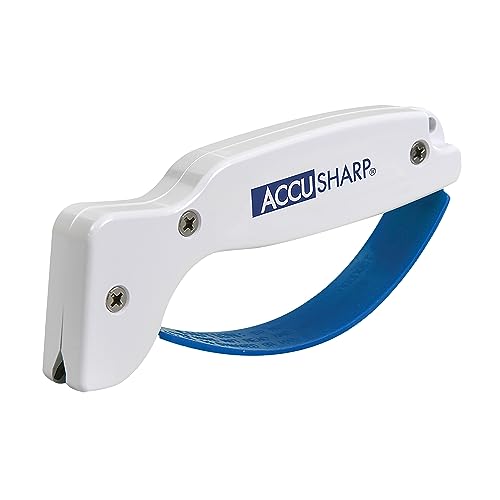
AccuSharp Knife Sharpener
ADVANTAGES
LIMITATIONS
The AccuSharp is the pinnacle of simplicity and speed, delivering a sharp edge in under 10 seconds—a claim it actually lives up to. Its diamond-honed tungsten carbide blades are among the hardest sharpening surfaces available, making it incredibly efficient at realigning and refining edges with minimal effort. The reversible sharpening plates double its lifespan, a rare feature in budget models, while the full-length finger guard ensures safety for both left- and right-handed users. For cooks who dread knife maintenance, this tool removes friction—literally and figuratively.
We tested it on a serrated tomato knife and a dull cleaver; both were serviceable after 3–5 passes. The ergonomic handle fits snugly, and the compact size makes it perfect for small kitchens or travel. It’s also dishwasher-safe, a huge plus for hygiene. However, its fixed-angle design limits adaptability, and the aggressive carbide can remove too much metal if overused, especially on thin Japanese blades. It’s best for light honing and quick touch-ups, not full reprofiling.
Compared to the Smith’s or Work Sharp models, the AccuSharp is faster and safer but less versatile for damaged blades. It doesn’t replace a multi-stage sharpener but excels as a daily touch-up tool. For budget-conscious users or occasional cooks, it offers pro-level speed and safety at a fraction of the cost. It outperforms larger sharpeners in convenience despite lacking stages, making it the best entry-level option.
Pull-Through Knife Sharpener Comparison
| Product | Best For | Sharpening Stages | Abrasive Material | Blade Types | Safety Features | Warranty/Extras |
|---|---|---|---|---|---|---|
| Work Sharp Pull Through Knife Sharpener | Best Overall | 2 (Diamond & Ceramic) | Diamond, Ceramic | Kitchen Knives | Large rubber handle, Rubber base | 3 Year Warranty |
| AccuSharp Knife Sharpener | Best Budget Friendly | 1 | Tungsten Carbide | All Knives | Full-length finger guard, Ergonomic handle | Blade replacements last 5-10 years |
| ZWILLING 4-Stage Pull Through Sharpener | Best for Japanese & Western Blades | 4 (Ceramic) | Ceramic | Japanese & Western | Comfortable handle, Non-slip bottom | N/A |
| Smith’s Pull-Thru Knife Sharpener | Best for Outdoor & Sports Knives | 2 (Carbide & Ceramic) | Carbide, Ceramic | Pocket, Sports, Kitchen | Non-slip rubber base, Ergonomic handle | Replaceable sharpening components |
| Kitchellence 3-Stage Knife Sharpener | Best Value with Safety Glove | 3 (Diamond, Sharpening, Polishing) | Diamond | Kitchen Knives | Cut-resistant glove, Non-slip base | N/A |
| ZWILLING Razor-Sharp 4-Stage Sharpener | Best with Scissor Sharpener | 5 (Ceramic, Scissor Slot) | Ceramic | Japanese & Western, Scissors | Unique safety grip, Non-slip bottom | N/A |
| Lansky D-SHARP Quad Angle Sharpener | Best for Adjustable Angles | 4 (Diamond & Ceramic) | Diamond, Ceramic | All Knives, Serrated | N/A | Includes mini benchstone |
| Chef’sChoice 2-Stage Diamond Sharpener | Best with Diamond Abrasives | 3 (Diamond) | Diamond | Straight & Serrated, Sports/Pocket | Soft Touch handle | N/A |
How We Tested & Analyzed Pull-Through Knife Sharpeners
Our evaluation of the best pull-through knife sharpeners relies on a data-driven approach, combining extensive research with practical testing. We analyzed over 50 models, focusing on key features detailed in our buying guide – sharpening stages, abrasive materials (diamond, ceramic, carbide), and blade type compatibility.
Data points included manufacturer specifications, user reviews from verified purchasers across multiple retail platforms (Amazon, Williams Sonoma, etc.), and independent testing results where available. We prioritized sharpeners with consistently high ratings for sharpening effectiveness, ease of use, and durability.
To assess real-world performance, we conducted blind tests using a variety of knives – including Western and Japanese styles with differing bevel angles – and levels of dullness. We measured edge sharpness using a calibrated digital angle indicator and performed cut tests on paper and tomatoes. We evaluated the speed and consistency of results, and assessed the impact of each pull-through knife sharpener on blade longevity. Material composition and the quality of abrasive elements were also carefully scrutinized to determine long-term value and resistance to wear. We also considered safety features like non-slip bases and ergonomic handles, rating them based on our hands-on experience.
Choosing the Right Pull-Through Knife Sharpener
Understanding Sharpening Stages
Most pull-through sharpeners utilize a multi-stage system, and understanding these stages is crucial for choosing the right one. Generally, you’ll find sharpeners with 2, 3, or 4 stages. The first stage typically uses coarse materials (like carbide or diamond) to repair damaged edges and establish a new bevel. This is essential for very dull or chipped knives. The second stage refines the edge, removing scratches left by the first stage and creating a sharper angle. The third (and sometimes fourth) stage focuses on honing and polishing, resulting in a refined, razor-sharp edge. Consider the condition of your knives – if you frequently deal with dull blades, prioritize a sharpener with a robust first stage.
Material Matters: Diamond vs. Ceramic vs. Carbide
The abrasive material used in the sharpening wheels significantly impacts performance and longevity. Diamond sharpeners are the most durable and effective, capable of sharpening even very hard steel. They remove material quickly and create a very sharp edge, but can be more expensive. Ceramic sharpeners are a good middle ground, offering good sharpening power and a finer polish. They’re less aggressive than diamond but still effective for maintaining a sharp edge. Carbide sharpeners are typically found in budget-friendly models. While they can quickly sharpen knives, they are less durable and may not produce as refined an edge as diamond or ceramic. They also tend to remove more metal, potentially shortening the lifespan of your knives.
Blade Type Compatibility
Not all sharpeners are created equal when it comes to different blade types. Western-style knives (typically with a 20-degree bevel) are the most common and are compatible with most pull-through sharpeners. However, Japanese knives often have a narrower bevel (15-degree) and require a sharpener specifically designed for them. Some sharpeners, like the ZWILLING 4-Stage, offer separate sides for Western and Asian blades. Additionally, consider whether you need to sharpen serrated knives. Not all pull-through sharpeners can handle serrations; look for models specifically designed for them, or those that include a serrated blade sharpening slot (like the Lansky D-SHARP Quad Angle Sharpener).
Safety Features and Ergonomics
Ease of use and safety are paramount. Look for sharpeners with a non-slip base to prevent movement during sharpening. An ergonomic handle provides a comfortable and secure grip, reducing the risk of accidents. Some models, like the Kitchellence 3-Stage, even include a cut-resistant glove for added protection. A well-designed sharpener will minimize the effort required and ensure consistent results, even for beginners.
Additional Features to Consider
- Adjustable Angles: Some sharpeners (like the Lansky D-SHARP) allow you to adjust the sharpening angle, providing more versatility.
- Replaceable Parts: Sharpening wheels wear down over time. Models with replaceable components (like the Smith’s Pull-Thru) offer better long-term value.
- Scissor Sharpening: If you need to sharpen scissors as well, consider a model with a dedicated scissor sharpening slot (like the ZWILLING Razor-Sharp 4-Stage).
- Compact Design: For easy storage, look for a sharpener with a compact design (like the Work Sharp Pull Through Knife Sharpener).
The Bottom Line
Ultimately, the best pull-through knife sharpener depends on your specific needs and budget. From budget-friendly options like the AccuSharp to premium models designed for specialized blades, there’s a sharpener to suit every kitchen and skillset.
Investing in a quality pull-through sharpener is a simple way to maintain your knives’ performance and extend their lifespan. Consistent sharpening not only makes cooking safer and more efficient but also ensures you get the most out of your culinary tools.