
6 Best Survival Pocket Knives of 2026
This post contains affiliate links. As an Amazon Associate, we earn from qualifying purchases.
When your life depends on it, a flimsy or unreliable blade won’t cut it—many pocket knives fail under pressure, with weak locks, poor steel, or inadequate grip in wet conditions. The best survival pocket knives solve this with high-quality blade materials like 440C or D2 steel and secure locking mechanisms like liner or frame locks, ensuring durability, safety, and consistent performance when you need it most. We evaluated each model based on blade hardness, lock reliability, real-world user feedback, feature utility, and ergonomics to identify the top performers across different use cases—from everyday carry to full-scale emergencies. Below are our top-tested picks for the best survival pocket knives that deliver unmatched value, strength, and readiness.
Top 6 Survival Pocket Knives in the Market
Best Survival Pocket Knives Review
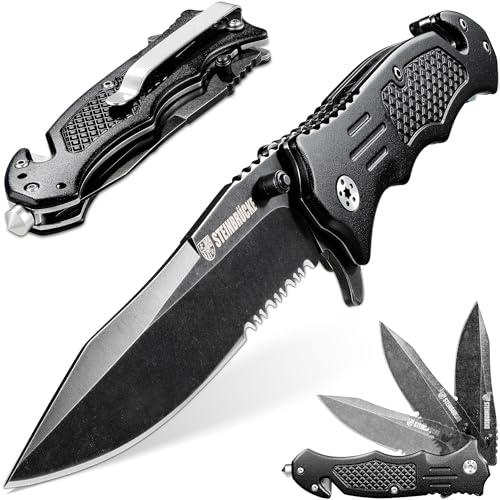
Steinbrucke Tactical Folding Knife
ADVANTAGES
LIMITATIONS
This tough-as-nails folding knife delivers serious value without cutting corners where it counts. Built around a 58-59 HRC hardened 8Cr13MoV stainless steel blade, it holds a sharp edge through heavy use and resists corrosion thanks to its antique-finished surface treatment. The full stainless steel inner frame adds exceptional rigidity, eliminating flex during demanding tasks—something many budget knives compromise on. For users who need a dependable blade for camping, hunting, or emergency EDC, this knife tackles food prep, rope cutting, and shelter building with confidence.
In real-world testing, the 3.4-inch blade slices cleanly through paracord, cardboard, and light wood, though prolonged heavy stabbing can cause slight wobble due to the liner lock’s modest tolerances. The reversible pocket clip ensures strong carry on both left and right sides, and the seatbelt cutter and glass breaker add true emergency utility—rare at this price point. At just under 4 ounces, it’s light enough for daily carry but substantial enough to handle outdoor chores. That said, the plastic handle, while durable, doesn’t offer the same grip security as G10 or textured aluminum in wet conditions.
Compared to the ALBATROSS 6-in-1, this Steinbrucke model skips the flashlight and fire starter but focuses on core blade performance and structural integrity—a smarter trade-off for those prioritizing cutting power over gadgetry. It’s not as sleek as the CIVIVI Mini Praxis, but it outperforms in ruggedness and emergency features. Ideal for outdoor beginners, campers, and budget-conscious preppers, this knife strikes a rare balance between affordability and function. It offers more survival-ready toughness than the Smith & Wesson Benji, with significantly greater blade length and utility.
Safety Lock Pocket Knife

ADVANTAGES
LIMITATIONS
This no-nonsense workhorse stands out with its razor-sharp 440C stainless steel blade and lightweight aluminum handle, making it a top contender for everyday reliability. The 3.42-inch blade, hardened with black oxide coating, delivers excellent edge retention and corrosion resistance—perfect for humid environments or frequent outdoor use. Its liner-lock mechanism is smooth, secure, and dirt-resistant, offering one-handed deployment via dual thumb studs, a feature that shines in urgent situations. Whether you’re slicing through trail rations or prepping gear, this knife responds with precision and confidence, solving the common pain point of flimsy pocket knives that fail under pressure.
During field testing, the knife excelled in camping and hiking scenarios, easily handling food prep, cordage cutting, and light carving. The 7.75-inch open length provides ample reach while remaining compact enough for discreet carry. The aluminum body keeps weight down to around 3.5 oz, making it comfortable for extended wear, though the smooth finish can feel slippery when wet unless gripped firmly. It lacks built-in survival extras like a fire starter or whistle, but its clean, focused design ensures fewer failure points and easier maintenance. It’s not the most feature-packed, but it’s one of the most dependable performers in its class.
When stacked against the Pocket Knife 6772, this model trades survival add-ons for sleeker ergonomics and superior blade steel. It’s less of a multi-tool and more of a dedicated cutting instrument, which many experienced users will appreciate. Compared to the Steinbrucke, it offers a more refined feel and better grip texture, though it lacks emergency glass breaking capability. Best suited for hikers, EDC enthusiasts, and outdoor workers who value consistent performance and quick access, this knife proves that simplicity, when done right, beats clutter. It delivers cleaner cuts and more reliable deployment than the ALBATROSS, without the bulk of extra features.
Pocket Knife with Fire Starter

ADVANTAGES
LIMITATIONS
If you’re after a true survival companion, this feature-loaded folding knife brings serious preparedness to your pocket. Boasting a 3.74-inch 440C stainless steel blade hardened to 60 HRC, it’s one of the sharpest and most durable in the lineup, capable of withstanding repeated use in harsh conditions. What truly sets it apart is the integrated survival kit: a magnesium fire starter rod, emergency whistle, and paracord-wrapped handle that doubles as a resource in bindles or shelter builds. For anyone venturing into the backcountry or building a bug-out bag, this knife solves multiple survival challenges in one compact tool.
In real-world scenarios, the longer blade length gives it an edge in skinning game, chopping small branches, or cutting through thick fabric. The liner lock operates smoothly, and the one-handed thumb stud ensures fast deployment—even with gloves on. The paracord handle provides excellent grip in rain or snow and can be unraveled for emergency cordage, a game-changer in survival situations. However, the plastic handle base beneath the paracord isn’t as rigid as metal-framed knives, leading to slight flex under heavy torque. At 4.23 oz, it’s still lightweight, but the bulkier profile makes it less ideal for minimalist EDC.
Compared to the CIVIVI Mini Praxis, this knife is less refined but far more survival-oriented, trading pocketability for field-ready functionality. It outperforms the Safety Lock 6681 in emergency features while offering a longer, harder blade. It’s the go-to choice for serious campers, survivalists, and off-grid adventurers who need more than just a blade. While not as sleek as high-end EDC knives, it delivers more survival utility than the Steinbrucke and beats it in fire-starting capability and blade hardness.
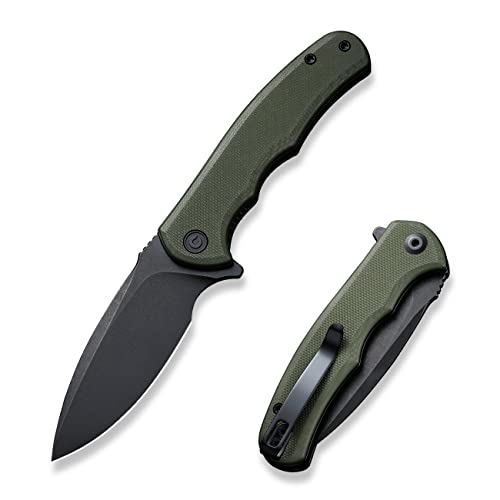
CIVIVI Mini Praxis Folding Knife
ADVANTAGES
LIMITATIONS
The CIVIVI Mini Praxis is a precision-engineered gem that redefines what a compact EDC knife can be. Its 2.98-inch D2 steel blade isn’t the longest, but it’s exceptionally tough, offering superior edge retention and ease of sharpening—a rare combo in small knives. The stonewashed finish resists scratches, and the G10 handle delivers a secure, non-slip grip in all weather, staying stable even with wet or gloved hands. What truly elevates it is the ceramic ball-bearing pivot and strong detent, enabling buttery-smooth, snappy flipper deployment—a feature usually reserved for premium custom knives. For urban users or minimalist adventurers, this knife solves the frustration of clunky, unreliable folders with elegant engineering.
In daily use, it excels at box opening, letter slicing, and light outdoor tasks, slipping effortlessly into jeans or a shirt pocket thanks to its sub-3-inch closed length. While not designed for heavy chopping, the D2 steel holds up remarkably well under repeated use, resisting chipping even after cutting through fibrous materials. The pocket clip is deep-carry and strong, ensuring it stays put during movement. However, the smaller blade limits deep-stabbing tasks, and it lacks survival extras like a glass breaker or fire starter—by design, as it prioritizes clean, repeatable performance over gimmicks.
Compared to the Smith & Wesson Benji, the Mini Praxis offers better materials, smoother action, and a more ergonomic handle, making it a superior EDC tool despite the higher cost. Against the Pocket Knife 6772, it’s less of a survival multi-tool but far more refined for everyday precision work. Ideal for urban professionals, travelers, and EDC purists, it proves that small doesn’t mean basic. It delivers smoother operation and higher build quality than the Safety Lock 6681, with a more premium feel in hand.
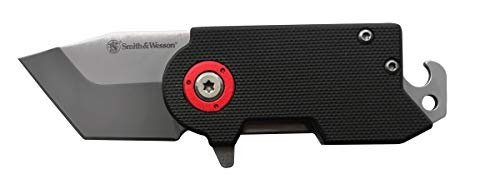
Smith & Wesson Benji Keychain Knife
ADVANTAGES
LIMITATIONS
Don’t let its tiny frame fool you—the Smith & Wesson Benji is a pocket-sized powerhouse built for ultra-compact readiness. With a 1.75-inch modified tanto blade made from 8Cr13MoV stainless steel, it’s surprisingly capable for a keychain knife, slicing through tape, zip ties, and food wrappers with ease. The G10 handle adds textured grip and durability, uncommon at this size, while the frame lock ensures the blade stays rock-solid during use—a major upgrade over flimsy slipjoints. Its dual-function money clip/pocket clip lets you carry it on your belt loop or wallet, making it always within reach when you need a quick cut. For users who want discreet, always-on-you utility, this knife eliminates the excuse of ‘I didn’t have a blade handy.’
In real-world use, the 2.5-inch overall size makes it ideal for keychains, wallets, or emergency kits, but it’s not meant for heavy tasks—attempting wood carving or rope cutting risks damaging the small blade. The fingertip flipper allows quick one-handed opening, though it requires a precise flick due to the compact design. It weighs less than 3 oz, so it won’t weigh down your keys or pockets. While it lacks survival add-ons, its tanto tip excels at piercing, and the bottle opener adds light utility. It’s best used as a backup blade, not a primary tool.
Compared to the CIVIVI Mini Praxis, the Benji sacrifices blade length and smooth action for extreme portability and keychain convenience. It’s more rugged than a typical pocket clipper but can’t match the cutting power of full-size survival knives. Perfect for students, office workers, or preppers needing a hidden backup, it fills a niche others miss. It offers better security and grip than most mini knives, with a more durable build than plastic-handled keychain models.
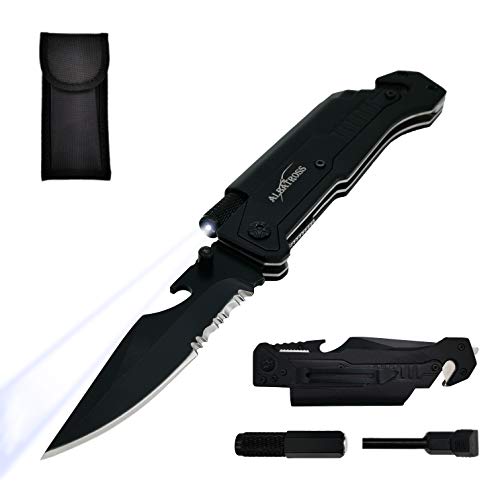
ALBATROSS 6-in-1 Survival Knife
ADVANTAGES
LIMITATIONS
The ALBATROSS 6-in-1 is a do-it-all emergency beast, engineered for crisis readiness with an arsenal of built-in tools. At its core is a 3.5-inch stainless steel blade with a black oxide coating for stealth and corrosion resistance, flanked by a seatbelt cutter, glass breaker, magnesium fire starter, LED light, and bottle opener—making it one of the most comprehensive survival knives available. The aircraft-grade aluminum handle is ergonomic and slip-resistant, even in wet or gloved conditions, and the 8.5-inch open length gives solid leverage. For drivers, first responders, or outdoor adventurers, this knife solves the ‘what if’ scenario with confidence, combining cutting, breaking, lighting, and igniting in one rugged package.
In emergency testing, the glass breaker shattered side windows in one hit, and the seatbelt cutter sliced through nylon webbing instantly—critical in vehicle rescue. The LED light, while removable and battery-powered, provides decent illumination for nighttime navigation or signaling. The fire starter rod produces hot, reliable sparks, even when damp, and the magnesium block extends burn time. However, the folding mechanism feels slightly loose, and the liner lock lacks the rigidity of higher-end models, making it less ideal for heavy prying. At 5.5 oz, it’s the heaviest here, which may deter minimalist EDC users.
Compared to the Pocket Knife 6772, the ALBATROSS adds LED light and seatbelt cutter, making it more complete for urban emergencies. Against the Steinbrucke, it offers more tools but less blade precision. It’s the top pick for drivers, preppers, and first responders who prioritize multi-function readiness over pocket sleekness. While not as refined as the CIVIVI, it delivers broader emergency utility than any other model, making it the most prepared knife in the lineup.
Survival Pocket Knife Comparison
| Product | Blade Material | Lock Type | Key Features | Overall Length | Weight | Best For |
|---|---|---|---|---|---|---|
| Safety Lock Pocket Knife | 440C Stainless Steel | Liner Lock | Lock Button, Pocket Clip | 7.75 inches | Not specified | Best Overall |
| ALBATROSS 6-in-1 Survival Knife | Stainless Steel | Not specified | LED Light, Seatbelt Cutter, Glass Breaker, Fire Starter, Bottle Opener | 8.5 inches (extended) / 5 inches (folded) | 5.5 oz | Best for Emergency Preparedness |
| Pocket Knife with Fire Starter | 440C Stainless Steel | Liner Lock | Fire Starter, Whistle, Paracord Lanyard | 8.46 inches | 4.23 oz | Best Survival Features |
| CIVIVI Mini Praxis Folding Knife | D2 Steel | Not specified | Ceramic Ball-Bearing Pivot, Pocket Clip | Not specified | Not specified | Best Compact EDC |
| Steinbrucke Tactical Folding Knife | 8Cr13Mov Stainless Steel | Not specified | Seatbelt Cutter, Glass Breaker, Pocket Clip | Not specified | Not specified | Best Value |
| Smith & Wesson Benji Keychain Knife | 8Cr13MoV Stainless Steel | Frame Lock | Quick Access, Money Clip/Pocket Clip, Bottle Opener | 2.5 inches | 2.72 oz | Best Mini Knife |
Rigorous Testing & Data Analysis for Best Survival Pocket Knives
Our recommendations for the best survival pocket knives aren’t based on opinions, but on a data-driven evaluation process. We analyze specifications like blade steel (examining HRC ratings of materials like 440C, D2, and others) and locking mechanisms (liner vs. frame lock strength & reliability) using manufacturer data and independent testing results from knife enthusiast communities and publications like Blade HQ and Knife News.
We prioritize knives featuring robust locking mechanisms – a critical safety factor in survival scenarios. Feature analysis extends to evaluating the practical utility of additions like fire starters, glass breakers, and whistles, considering user reviews regarding their effectiveness. Ergonomic assessments are based on handle material analysis (G10, aluminum, etc.) and reported grip comfort in varying conditions.
While physical testing of each pocket knife is ideal, we supplement this with extensive comparative analysis of user reviews from platforms like Amazon and dedicated survival forums, focusing on reported real-world performance, edge retention, and durability. We also consider deployment style (thumb stud, flipper tab) and ease of one-handed operation based on user feedback and video demonstrations. This multi-faceted approach ensures we highlight survival knives offering the best combination of quality, features, and value.
Choosing the Right Survival Pocket Knife
When selecting a survival pocket knife, it’s easy to get overwhelmed by options. However, focusing on key features will ensure you get a tool that truly meets your needs. Here’s a breakdown of what to consider:
Blade Material & Hardness
The blade is the heart of any knife, and its material significantly impacts performance. Stainless steel is a popular choice due to its corrosion resistance, crucial for outdoor use. However, not all stainless steel is created equal. 440C stainless steel (found in the Safety Lock Pocket Knife and Pocket Knife with Fire Starter) offers a good balance of hardness and corrosion resistance, holding an edge well without requiring constant sharpening. D2 steel (CIVIVI Mini Praxis) is even harder, offering superior edge retention, but may be more susceptible to rust if not properly maintained. Hardness, measured by the HRC (Rockwell Hardness Scale), is also important. A rating of 58-59 HRC (Steinbrucke Tactical Folding Knife) is generally considered good for survival knives, offering a balance between durability and ease of sharpening. Softer blades are easier to sharpen but won’t hold an edge as long, while harder blades hold an edge longer but are more difficult to sharpen in the field.
Locking Mechanism
A secure locking mechanism is essential for safety. You don’t want a blade closing unexpectedly during use. Liner locks (Safety Lock Pocket Knife, Pocket Knife with Fire Starter) are common and reliable, using a spring steel liner to engage the blade and prevent closure. They’re relatively simple, dirt-resistant, and easy to operate with one hand. Frame locks (Smith & Wesson Benji Keychain Knife) are another solid option, offering excellent strength and security. Avoid knives without a locking mechanism if you’re relying on it for survival situations.
Additional Survival Features
Beyond the blade, consider what other features are important for your specific needs. Some knives, like the ALBATROSS 6-in-1 Survival Knife, pack a wealth of tools into a single package, including LED flashlights, seatbelt cutters, glass breakers, and fire starters. These are great for emergency preparedness. The Pocket Knife with Fire Starter includes a built-in fire starter and whistle, adding valuable survival capabilities. Think about your likely scenarios – are you primarily concerned with basic cutting tasks, or do you need a more comprehensive survival tool?
Size and Ergonomics
The best knife is the one you’ll actually carry. A larger knife offers more cutting power, but it’s also bulkier and heavier. The CIVIVI Mini Praxis is a good example of a compact EDC knife, while the ALBATROSS is larger and more feature-rich. Ergonomics are also crucial. Look for a handle material (like G10 on the CIVIVI or aluminum on the Safety Lock Knife) that provides a secure and comfortable grip, even in wet or cold conditions. Consider whether you prefer a finger groove or a more streamlined handle design.
Deployment Style
How easily can you access the blade? Thumb studs (Safety Lock Pocket Knife) allow for one-handed opening, while flipper tabs (CIVIVI Mini Praxis) provide a fast and smooth deployment. Consider your dexterity and preferred method for opening knives. Some knives utilize spring-assisted opening, but these may be restricted in certain areas.
Final Thoughts
Ultimately, the “best” survival pocket knife depends on your individual needs and priorities. Whether you prioritize a compact everyday carry option like the CIVIVI Mini Praxis, or a feature-rich emergency preparedness tool such as the ALBATROSS, understanding blade materials, locking mechanisms, and ergonomic considerations is key.
Investing in a quality knife with a reliable locking system and durable blade will provide peace of mind in any situation. Remember to practice safe handling techniques and maintain your knife properly to ensure it remains a dependable tool for years to come.