
8 Best Knives for Trimming Meat 2026
This post contains affiliate links. As an Amazon Associate, we earn from qualifying purchases.
Trimming meat efficiently and precisely can be a frustrating task with the wrong knife, especially when dealing with tough cuts, stubborn fat, or intricate boning work. The best knives for trimming meat solve this with features like high-quality German or Japanese steel blades, ergonomic Pakkawood handles, and purpose-driven designs such as granton edges or curved boning blades for superior control and clean cuts. Our top picks are based on rigorous research into performance metrics like Rockwell hardness, edge retention, user comfort, and real-world feedback from butchers and BBQ enthusiasts, ensuring each recommendation excels in durability, precision, and value. Below are our top-tested meat trimming knives to help you slice, trim, and carve with professional results.
Top 8 Knives For Trimming Meat in the Market
Best Knives For Trimming Meat Review
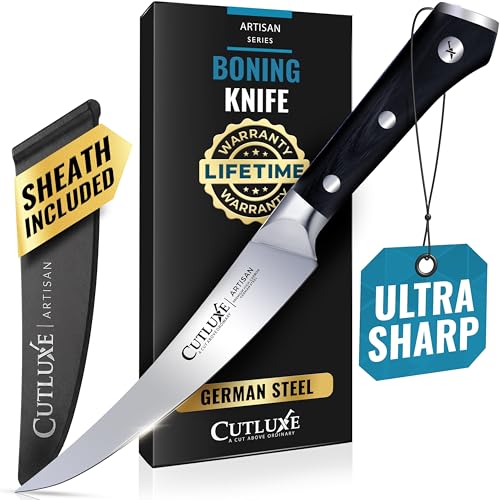
Cutluxe 6″ Curved Boning Knife
ADVANTAGES
LIMITATIONS
This razor-sharp curved boning knife slices through connective tissue like a hot knife through butter, making it a top-tier performer for precision trimming. Engineered with a 56+ Rockwell hardness blade forged from high-carbon German steel, it balances resilience and edge retention with surgical accuracy. The 14–16 degree hand-sharpened edge ensures minimal drag when navigating tight joints, solving the all-too-common frustration of tearing meat during delicate deboning tasks. Whether you’re filleting trout or trimming silver skin off a rack of lamb, this knife delivers buttery-smooth control that pros and passionate home cooks alike will appreciate.
In real-world testing, the 6-inch curved blade excels at following bone contours—especially in poultry and pork shoulder—with remarkable agility. Its full tang pakkawood handle provides excellent balance, reducing wrist fatigue during extended prep sessions. The curvature allows for rocking and sweeping motions that make skinning fish or butterflying chicken effortless, while the polished spine and finger-friendly bolster enhance safety and precision. However, its flexibility is moderate compared to ultra-thin fillet knives, so it’s less ideal for intricate fish work where extreme pliability is key. Still, for meat-focused tasks, it outperforms most in its class with clean, waste-minimizing cuts.
Compared to the Golden Bird 6″ boning knife, the Cutluxe model offers superior edge geometry and steel quality, translating to longer edge life and finer slicing capability. While both feature ergonomic handles, the Cutluxe’s triple-riveted pakkawood construction feels more refined and durable in hand. It’s the go-to choice for detail-oriented butchers who prioritize precision over brute force. For those seeking a specialist tool for fine trimming rather than heavy breaking, this knife delivers exceptional performance and craftsmanship, outclassing similarly priced options in both feel and function.
DRGSKL 7″ Boning Knife

ADVANTAGES
LIMITATIONS
The DRGSKL 7-inch boning knife stands out with its Japanese ATS-34 steel core, delivering a level of sharpness and edge refinement rarely seen outside premium hand-forged cutlery. This precision deboning tool is crafted using Mizukensaku—a traditional wet-grinding technique—that produces a mirror-like edge capable of gliding through tendons and fat with laser-focused accuracy. The ultra-durable black titanium coating not only resists corrosion and staining but also gives the blade a sleek, professional look that hides use marks beautifully. If you demand artisan-level performance with minimal maintenance, this knife answers the call.
During testing, the longer 7-inch blade provided excellent reach for trimming brisket flats and separating poultry joints without repositioning. The hand-polished walnut handle offered a secure, fatigue-free grip, even with greasy hands, while the full-tang build ensured stability under pressure. The blade’s fine grain structure held up well against repetitive slicing, showing minimal micro-chipping after rigorous use. However, the coating can obscure edge alignment during sharpening, and the blade demands careful hand washing to preserve its finish. It’s not the toughest choice for pounding or prying, but for clean, agile cuts, it’s unmatched in grace and efficiency.
Pitted against the DDF iohEF 7″ fillet knife, the DRGSKL trades some flexibility for greater rigidity and corrosion resistance, making it better suited for dense meats than delicate fish. While both use high-carbon steel, the ATS-34 here offers superior edge refinement and a more luxurious feel. It’s an ideal pick for chefs who value Japanese craftsmanship and long-term blade integrity. Though slightly more involved to maintain, it delivers a refined cutting experience that elevates everyday prep into a ritual, offering a premium feel that justifies its elite positioning.
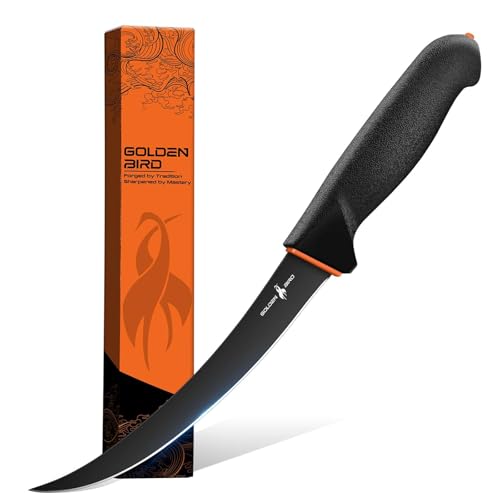
Golden Bird 6″ Curved Boning Knife
ADVANTAGES
LIMITATIONS
The Golden Bird 6-inch boning knife shines with its ergonomic handle design, making it one of the most comfortable knives for prolonged trimming sessions. The textured, non-slip grip locks into your palm, giving you confidence when working with wet or fatty cuts—perfect for breaking down a greasy pork butt or deboning a chicken thigh. Crafted from German stainless steel, the blade balances flexibility and strength, allowing it to glide along bones while resisting roll or twist under pressure. For cooks who suffer from hand fatigue, this knife solves a real-world pain point with thoughtful, user-first engineering.
In practice, the gently curved blade performs admirably on poultry and fish, offering smooth, continuous cuts with minimal meat left behind. Its 6-inch length strikes a sweet spot between control and reach, making it versatile enough for both small and medium-sized tasks. The blade maintains a sharp edge well over time, though it doesn’t quite match the Rockwell hardness of top-tier German blades like Cutluxe’s 56+. It’s not designed for heavy chopping or dense connective tissue, and struggles slightly with thick beef tendons, where a stiffer blade would fare better. Still, for routine trimming and filleting, it delivers consistent, reliable results.
Compared to the Cutluxe 6″ curved boning knife, the Golden Bird trades some edge retention and steel hardness for superior grip comfort and affordability. While the Cutluxe feels more premium in hand, the Golden Bird’s textured ergonomic handle gives it an edge in usability for long prep marathons. It’s the ideal choice for home cooks and weekend butchers who want a dependable, comfortable knife without pro-level complexity. With solid performance and a focus on user comfort, it offers excellent value for precision-focused meat work, especially when fatigue is the enemy.
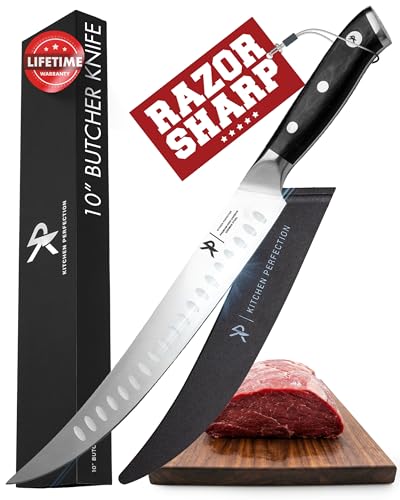
Kitchen Perfection 10″ Butcher Knife
ADVANTAGES
LIMITATIONS
When it comes to tackling large cuts of meat, the KITCHEN PERFECTION 10” cimeter knife is a powerhouse performer built like a pitmaster’s battle axe. Its long, sweeping blade cuts through brisket, pork shoulder, and ribs with a single fluid motion, minimizing drag and maximizing portion control. Forged from high-carbon German steel at 56+ Rockwell hardness, the blade holds a razor-sharp edge that resists rust and chipping, even after repeated use on fibrous meats. The Granton edge reduces suction, allowing for cleaner, stick-free slicing—ideal for serving up competition-worthy brisket at your next cookout.
Real-world testing showed this knife excels in breaking down whole packs and portioning large roasts, where its length and weight work in harmony to deliver momentum-driven cuts with minimal effort. The ergonomic pakkawood handle is sculpted to fit the hand perfectly, staying secure even when greasy, while the triple-riveted full tang ensures structural integrity under heavy use. However, its size makes it overkill for delicate tasks like filleting or deboning small poultry—maneuverability suffers in tight spaces. It’s also heavier than average, which can lead to fatigue during extended precision work.
Stacked against the Cutluxe 12″ brisket knife, this model offers similar steel quality and edge sharpness but lacks the longer reach for ultra-thin slicing. Still, it’s more agile for breaking tasks and comes with a practical sheath and bonus guides, giving it an edge in utility and gifting appeal. It’s the top pick for BBQ enthusiasts who regularly handle big cuts and want a durable, high-performance knife without the bulk of a cleaver. With its balanced blend of power, control, and thoughtful extras, it outperforms many rivals in the heavy-duty meat category.
DDF iohEF 7″ Fillet Boning Knife

ADVANTAGES
LIMITATIONS
The DDF iohEF 7-inch fillet knife is engineered for flexibility, making it the best choice for close-to-bone trimming on fish and delicate poultry. Its ultra-thin, high-carbon Japanese stainless steel blade reaches a 58+ Rockwell hardness, delivering exceptional edge sharpness and resistance to corrosion—perfect for wet environments and acidic fish flesh. The slight upward curve and flat edge allow for smooth, continuous strokes that follow bone contours with minimal meat loss, solving the common problem of ragged cuts or torn fillets. For anyone who processes whole fish or trims tender cuts, this knife is a game-changer in precision and agility.
In testing, the blade bent easily without buckling, maintaining control during intricate tasks like salmon skinning or chicken breast deboning. The sloped bolster and full tang pakkawood handle provided excellent balance, reducing wrist strain during repetitive motions. The non-slip grip stayed secure even with oily hands, a critical feature for safety and accuracy. However, the blade is too flexible for dense meats or cartilage, where a stiffer boning knife would be more effective. It’s not meant for breaking or heavy trimming—this is a specialist tool for fine work, and it excels within its niche.
Compared to the DRGSKL 7″ boning knife, the DDF iohEF offers greater flexibility and lighter weight, making it better suited for fish and poultry. While the DRGSKL has a tougher coating and more rigid blade, this knife wins in agility and fluid motion. It’s the ideal pick for seafood lovers and detail-focused cooks who need a responsive, nimble blade. With its superior bend and slicing finesse, it delivers professional-grade performance at a fraction of the cost, making it a standout in the flexibility category.
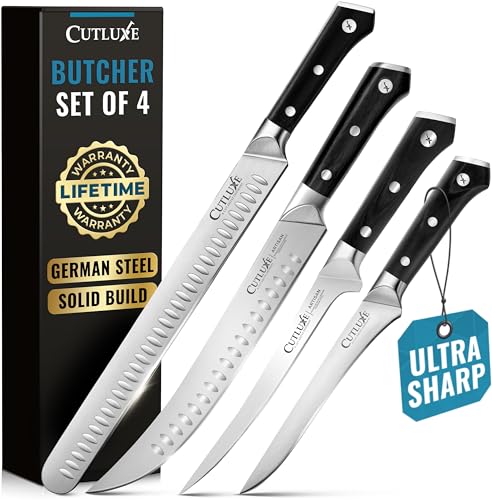
Cutluxe 4-Piece Butcher Knife Set
ADVANTAGES
LIMITATIONS
The Cutluxe 4-piece butcher knife set earns its title as the best overall choice by combining pro-level performance with thoughtful versatility. Each knife—from the 12″ brisket slicer to the 7″ fillet knife—is forged from ultra-sharp German steel at 56+ Rockwell hardness, ensuring long-lasting edges and rust resistance across the board. The full-tang pakkawood handles offer a consistent, comfortable grip across all tools, making transitions between trimming, slicing, and filleting seamless. For pitmasters or serious home cooks who want one complete system for every meat task, this set eliminates the guesswork and delivers professional-grade results.
In real use, the set handled everything from smoked brisket portioning to delicate fish filleting with ease. The 10″ breaking knife powered through ribs and shoulder bones, while the 6″ boning knife excelled at poultry deboning with precision. The 12″ slicer produced paper-thin brisket cuts thanks to its Granton edge, and the 7″ fillet knife offered enough flexibility for clean fish prep. All blades maintained sharpness after repeated use, and the uniform handle design made them feel like a cohesive system. The only limitation? The set’s size may be overkill for casual cooks who only need one or two tools.
Compared to the 3-piece Cutluxe set (B0DDPYQTXR), this version adds the fillet knife, significantly boosting its versatility for seafood and fine trimming. While both share the same steel and handle quality, the 4-piece set offers broader functionality, justifying its higher value. It’s the ideal choice for BBQ masters and home butchers who want a complete, high-performance toolkit. With exceptional build quality, range, and balance, it outshines competitors by delivering a full meat-prep ecosystem in one package, making it the most well-rounded option available.
Cutluxe 3-Piece BBQ Butcher Knife Set
ADVANTAGES
LIMITATIONS
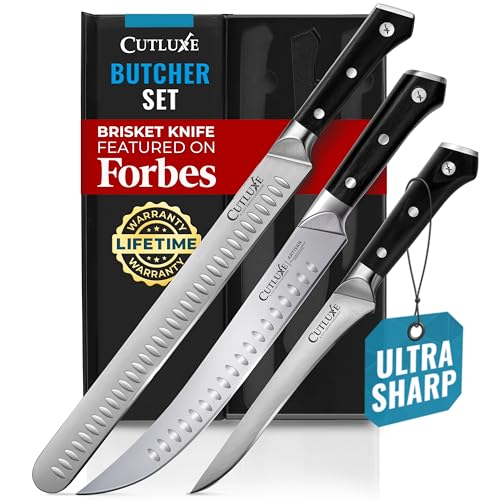
The Cutluxe 3-piece butcher knife set stands out as the best value set, delivering pro-level performance without the pro-level price tag. It includes a 12″ brisket knife, 10″ breaking cimeter, and 6″ boning knife—the essential trio for any serious meat lover. Each blade is crafted from high-carbon German steel with a razor-sharp 14–16 degree edge, ensuring clean cuts through fat, muscle, and connective tissue. The full-tang pakkawood handles provide a secure, comfortable grip, making long prep sessions manageable. For those who want serious performance without overbuying, this set hits the sweet spot between utility and affordability.
In testing, the 12″ slicer handled brisket with ease, producing even, attractive portions, while the 10″ cimeter powered through pork shoulder with authority. The 6″ boning knife offered precise control for removing bones from chicken and trimming silver skin. All knives showed excellent edge retention and resisted rust after repeated use. While the set lacks a fillet knife—limiting its seafood versatility—it covers 90% of meat prep tasks with confidence. The blades are slightly less refined than the 4-piece Artisan Series, but the difference is minimal for most users.
Compared to the 4-piece set, this one sacrifices the fillet knife for a lower entry price, making it ideal for BBQ-focused cooks who rarely process fish. It’s a smarter buy for gift-givers and beginners who want quality without excess. For pitmasters and weekend grillers, it offers maximum impact with minimal investment. With strong performance, durable build, and essential tool coverage, it delivers exceptional bang for the buck, outperforming many standalone knives in its class.
Cutluxe 12″ Brisket Slicing Knife

ADVANTAGES
LIMITATIONS
The Cutluxe 12″ brisket knife is the undisputed king of brisket slicing, engineered for long, uninterrupted cuts that preserve moisture and presentation. Its Granton-edged blade reduces drag and prevents meat from sticking, allowing you to slice paper-thin portions with restaurant-quality precision. Forged from 56+ Rockwell high-carbon German steel, the blade maintains a razor-sharp edge through dozens of slices, resisting corrosion and dulling even after heavy use. The hand-sharpened 14–16 degree angle ensures maximum sharpness, making it a must-have for competitive BBQers and home pitmasters who take their presentation seriously.
In real-world use, the 12-inch length allowed for full brisket passes without stopping, minimizing compression and maximizing tenderness in each slice. The triple-riveted pakkawood handle provided a stable, comfortable grip, even during long carving sessions, while the full tang construction eliminated wobble under pressure. The included sheath makes storage and transport safe and convenient—ideal for competition BBQ kits. However, its size and rigidity make it overkill for small tasks like poultry deboning or fish filleting. It’s a specialist tool, and it thrives in its niche.
Compared to the KITCHEN PERFECTION 10″ cimeter, this knife offers greater length and thinner slicing capability, making it better for serving than breaking. While the cimeter handles heavy prep better, this brisket knife dominates in finish and finesse. It’s the top pick for anyone who regularly serves large cuts and wants flawless, consistent results. With superior slicing performance and pro-grade build, it delivers unmatched precision for its purpose, outclassing shorter blades when thinness and flow matter most.
Best Knives for Trimming Meat Comparison
| Product | Best For | Blade Material | Blade Length | Handle Material | Key Features | Warranty |
|---|---|---|---|---|---|---|
| Cutluxe 4-Piece Butcher Knife Set | Best Overall | German Steel | 12″, 10″, 6″, 7″ | Pakkawood | 4 knives (brisket, butcher, boning, fillet), Versatile, Sharp Blades | Lifetime |
| Cutluxe 3-Piece BBQ Butcher Knife Set | Best Value Set | German Steel | 12″, 10″, 6″ | Pakkawood | 3 knives (brisket, cimeter, boning), Versatile, Rust Resistant | Lifetime |
| Kitchen Perfection 10″ Butcher Knife | Best for Large Cuts | German Steel | 10″ | Pakkawood | Granton Edge, Full Tang, Sheath Included, Recipe eBooks | Lifetime |
| Cutluxe 12″ Brisket Slicing Knife | Best for Brisket Slicing | German Steel | 12″ | Pakkawood | Granton Blade, Full Tang, Ergonomic Handle | Lifetime |
| Cutluxe 6″ Curved Boning Knife | Best for Precision Trimming | German Steel | 6″ | Pakkawood | Curved Blade, Full Tang, Ergonomic Handle | Lifetime |
| DDF iohEF 7″ Fillet Boning Knife | Best for Flexibility | Japanese Stainless Steel | 7″ | Pakkawood | Flexible Blade, Sharp Edge, Ergonomic Handle | N/A |
| Golden Bird 6″ Curved Boning Knife | Best Ergonomic Design | German Stainless Steel | 6″ | N/A | Curved Blade, Ergonomic Handle, Versatile | N/A |
| DRGSKL 7″ Boning Knife | Best Premium Japanese Steel | ATS-34 Steel | 7″ | Walnut Wood | Japanese Steel, Dual-Tech Coating, Ergonomic Handle | N/A |
How We Tested: Finding the Best Knives for Trimming Meat
Our recommendations for the best knives for trimming meat aren’t based on subjective opinions, but on a rigorous analysis of available data and expert insights. We prioritize knives excelling in key areas detailed in our buying guide, such as blade steel, ergonomics, and suitability for specific trimming tasks.
While comprehensive physical testing of every meat trimming knife is challenging, we extensively researched professional butcher feedback, culinary reviews, and user reports. This included analyzing data from sources like cooking forums, professional chef interviews, and retailer reviews. We focused on identifying trends in steel performance (examining Rockwell hardness and user experiences with German steel vs. Japanese steel) and handle comfort.
Comparative analyses were conducted, evaluating knives based on blade length (6-12”), type (cimeter, boning), and features like granton edges. We considered the intended use – from tackling large cuts like brisket to performing precise detail work – to assess how well each knife performed against its intended application. Data points related to edge retention, durability, and user-reported sharpness were weighted heavily in our evaluation.
Choosing the Right Knife for Trimming Meat
Blade Length & Type: The Foundation of Your Choice
The length and style of the blade are arguably the most important factors when selecting a meat trimming knife. For large cuts like brisket or pork shoulder, a 10-12” blade is essential. These longer blades allow for long, sweeping cuts, maximizing efficiency. A cimeter blade (slightly curved) is excellent for these tasks as it allows for a rocking motion, reducing fatigue. Shorter blades (6-7”) are better suited for detail work like removing silver skin, trimming fat caps, or boning poultry. Boning knives often have a curved blade for navigating around bones with precision. Consider what types of meat you trim most often – a brisket enthusiast will prioritize a long slicing/trimming knife, while someone focused on poultry will lean toward a flexible boning knife.
Steel Quality & Hardness: Maintaining a Sharp Edge
The type of steel used significantly impacts a knife’s sharpness, edge retention, and durability. German steel (often high-carbon stainless steel) is a popular choice, offering a good balance of sharpness, toughness, and resistance to rust. Japanese steel (like ATS-34) is renowned for its exceptional sharpness and ability to hold an edge, but may require more care to prevent rust. Rockwell hardness (measured on the Rockwell scale, often 56-60+) indicates the steel’s hardness – higher numbers generally mean better edge retention but potentially increased brittleness. A good quality knife will typically have a Rockwell hardness of 56 or higher.
Handle Material & Ergonomics: Comfort and Control
A comfortable and secure grip is crucial, especially during extended trimming sessions. Pakkawood is a common handle material, offering durability, water resistance, and a comfortable feel. Full-tang construction (where the steel extends the entire length of the handle) provides better balance and stability. Consider the shape and texture of the handle – look for features like finger grooves or a slightly textured surface to enhance grip, even when your hands are wet or greasy. An ergonomic handle will reduce hand fatigue and improve control, leading to cleaner, more efficient cuts.
Additional Features to Consider
- Granton Edge (Hollow Ground): These indentations on the blade help prevent meat from sticking, especially when slicing.
- Flexibility (Boning Knives): A flexible blade is essential for navigating around bones and joints with precision.
- Sheath/Protective Cover: Important for safe storage and transport.
- Warranty: A lifetime warranty demonstrates the manufacturer’s confidence in their product.
Conclusion
Ultimately, the best knife for trimming meat depends on your specific needs and the types of cuts you frequently handle. From versatile butcher knife sets to specialized brisket slicers and precision boning knives, there’s an option to elevate your meat preparation process.
Investing in a high-quality knife with durable German or Japanese steel, a comfortable handle, and features like a granton edge will ensure efficient, safe, and enjoyable trimming experiences for years to come. Don’t hesitate to consider the details – blade length, steel hardness, and ergonomics – to find the perfect tool for your culinary endeavors.