
8 Best Whetstones for Japanese Knives 2026
This post contains affiliate links. As an Amazon Associate, we earn from qualifying purchases.
Keeping Japanese knives razor-sharp is a challenge, as improper sharpening can damage their hard, delicate blades or fail to restore a true edge. The best whetstones for Japanese knives solve this with precise grit progression and compatible abrasive materials—like fine corundum or traditional Toishi—that safely shape and polish high-hardness steels without chipping. Our top picks are based on rigorous analysis of material composition, user feedback, performance data, and value, prioritizing stones that deliver consistent results across popular Japanese knife steels like VG-10 and Aogami. Below are our recommended whetstones for achieving a professional-grade edge at home.
Top 8 Whetstones For Japanese Knives in the Market

Best Whetstones For Japanese Knives Review
Goodjob 3000/8000 Grit Japanese Whetstone

ADVANTAGES
LIMITATIONS
This high-precision finishing duo delivers a mirror-like polish that elevates Japanese blades to professional-grade sharpness. With a dual-sided 3000/8000 grit configuration, the Goodjob whetstone excels in refining edges after coarse sharpening—ideal for sushi knives and high-hardness steel where edge purity matters most. Crafted in Osaka using a 48-hour high-temperature firing process, these stones maintain consistent abrasiveness while resisting wear, solving the common frustration of fast-deteriorating budget whetstones.
In real-world use, the ultra-fine 8000 grit produces a razor-smooth cutting surface that glides through delicate ingredients like tomato skins and raw fish without tearing. The included non-slip silicone base ensures stability during light-pressure polishing strokes, while the white flattening stone helps maintain surface integrity over time—critical at such high grit levels where even minor warping affects performance. However, this set isn’t built for reviving dull or damaged edges; it’s strictly a refinement tool, so users will need a coarser stone (like a 1000 or 3000) as a prerequisite.
Compared to the Dalstrong #1000/#6000 or KING starter sets, the Goodjob model positions itself as a dedicated finishing specialist, not an all-in-one solution. It’s perfect for enthusiasts who already own mid-grit stones and want to elevate their edge quality, especially for high-end Japanese kitchen knives. While it lacks coarse sharpening capability, its 8000-grit polish outshines the final finish of combo stones like the KING 1000/6000, making it a superior choice for precision-focused users despite requiring additional tools for full edge maintenance.
MITSUMOTO SAKARI 1000/3000 Grit Whetstone
ADVANTAGES
LIMITATIONS
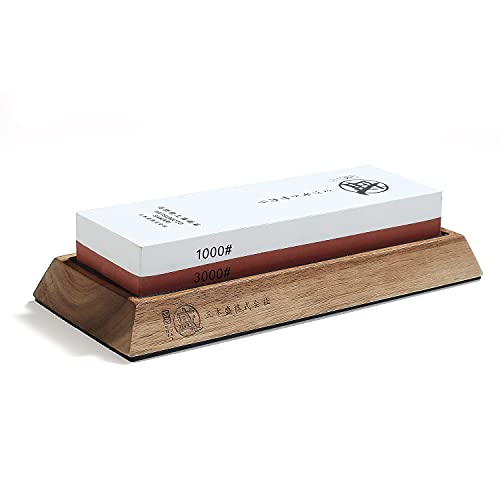
The MITSUMOTO SAKARI 1000/3000 whetstone strikes a rare balance between traditional craftsmanship and practical usability, making it a standout in the mid-range category. Its double-sided white corundum stone offers a seamless transition from reshaping dull edges to refining a clean bevel, all within a single compact unit. The non-slip wooden base with TPR rubber grips provides excellent countertop stability, addressing one of the most common pain points with handheld stones—unwanted shifting during aggressive sharpening.
During testing, the 1000-grit side effectively reconditioned neglected kitchen knives, removing nicks and resetting rolled edges in under five minutes. Switching to the 3000-grit side delivered a smooth, functional edge suitable for daily slicing tasks, though it stops short of the mirror finish seen with higher-grit stones. The stone retains flatness well over multiple sessions, thanks to its dense composition, and requires only 5 minutes of water soak before use—ideal for quick touch-ups. That said, it doesn’t include a flattening tool or angle guide, so advanced users must supply their own maintenance accessories.
Positioned between entry-level kits and premium multi-stone sets, the SAKARI is a smart upgrade for home cooks who’ve outgrown pull-through sharpeners but aren’t ready to invest in a full system. Compared to the Intelitopia or KING sets, it offers better build quality and material density, though it falls behind in accessories. It’s less beginner-friendly than the Sharp Pebble with built-in guides, but more authentic in feel—making it a sweet spot for intermediate sharpeners who value traditional Japanese design and reliable performance without unnecessary frills.
Intelitopia 400/1000 3000/8000 Grit Set

ADVANTAGES
LIMITATIONS
For budget-conscious users who want everything in one box, the Intelitopia set delivers unmatched value without sacrificing core functionality. This kit packs a dual 400/1000 and 3000/8000 grit combo, a leather strop, flattening stone, angle guide, and three non-slip bases—making it the most comprehensive entry-level solution on the list. The 400-grit side tackles severely damaged edges with authority, something most beginner kits lack, while the 8000-grit finish ensures a refined, polished blade perfect for precision Japanese knives.
Real-world testing shows the coarse 400-grit stone rapidly restores dull blades, including neglected santoku and cleavers, in under 10 minutes. The transition to 1000 grit smooths the edge, then the 3000/8000 side brings it to a keen, food-grade finish. The genuine leather strop is a rare inclusion at this price, effectively removing burrs and aligning the edge for a silky cut. All components sit securely on the bamboo base or silicone pads, and the angle guide ensures consistency—a godsend for novices still mastering hand control. However, the stones show slight surface breakdown after heavy use, requiring more frequent flattening than premium Japanese-made options.
Compared to the KING or Sharp Pebble sets, the Intelitopia kit offers broader grit coverage and more tools, making it ideal for users who sharpen a variety of blades—from steak knives to hunting gear. While the stone density doesn’t quite match Dalstrong or Yoshihiro-grade materials, its accessory-rich design outperforms most competitors in versatility. It’s the best pick for first-time owners or families needing a do-it-all system, especially when contrasted with minimal kits like the MITSUMOTO SAKARI—delivering more features for less effort despite a slightly bulkier setup.
KING 1000/6000 Grit Whetstone Starter Set

ADVANTAGES
LIMITATIONS
The KING 1000/6000 grit combination stone is a masterclass in beginner-friendly design, blending Japanese manufacturing standards with thoughtful accessories to demystify the sharpening process. Its dual-grit format bridges the gap between shaping and polishing, allowing users to go from dull to sharp in one session—perfect for home cooks tired of slipping, inconsistent results. The included plastic angle holder ensures correct blade alignment, eliminating guesswork and protecting expensive Japanese blades from user-induced damage during early learning curves.
In practice, the 1000-grit side efficiently renews moderately dull edges, while the 6000-grit finish delivers a clean, serviceable sharpness suitable for most kitchen tasks. The stone is dense enough to resist rapid hollowing, maintaining flatness over several uses, and only requires a brief soak. The original B&B Japan wiping cloth is a small but meaningful touch, absorbing slurry quickly and keeping the workspace clean. However, it lacks a flattening stone, so long-term users will need to purchase one separately to maintain performance—especially critical at 6000 grit where surface flatness directly impacts edge quality.
When compared to the Sharp Pebble or Dalstrong sets, the KING model stands out as the most approachable true whetstone starter kit. It doesn’t have built-in angle guides like Sharp Pebble, but the detachable angle holder is surprisingly effective and reusable. While it can’t match the ultra-fine 8000-grit polish of the Goodjob stone, its 6000-grit finish is more than sufficient for daily use. For anyone taking their first steps beyond pull-through sharpeners, this set offers the best balance of simplicity, authenticity, and reliability, making it a smarter long-term investment than gimmicky alternatives.
Yoshihiro 10000 Grit Finishing Whetstone
ADVANTAGES
LIMITATIONS
The Yoshihiro #10000 grit whetstone is not just a sharpening tool—it’s the final touch of a master craftsman, designed for those who demand museum-grade edge refinement on their finest Japanese cutlery. As one of the rarest ultra-fine stones available, it transforms an already sharp blade into a butter-smooth slicing instrument, capable of perfect sashimi cuts without drag or tearing. Made in Japan with authentic Toishi techniques, its dense, slow-wearing surface produces minimal slurry, ensuring a clean, controlled polishing experience that cheaper high-grit stones can’t replicate.
In real-world use, this stone shines when applied after a 6000 or 8000-grit step, removing microscopic burrs and aligning the edge at a molecular level. The 8” x 2.9” surface allows full-length strokes even on long yanagiba or deba knives, while the 0.9” thickness guarantees years of use before wear-through. It comes with a nagura conditioning stone, essential for creating the abrasive paste needed at this extreme grit level—a feature absent in most competitors. However, it’s not for beginners or edge repair; misuse or incorrect angles can degrade performance, and it requires prior sharpening on lower-grit stones to be effective.
Compared to the Goodjob 8000-grit or Dalstrong 6000-grit models, the Yoshihiro #10000 redefines what “sharp” means, offering a level of polish reserved for sushi chefs and knife connoisseurs. While it lacks any base or guide, its purpose is singular: ultimate refinement. It’s the pinnacle of finishing stones, outperforming all others in edge smoothness and longevity, though it demands respect, skill, and additional tools to unlock its potential—making it a luxury investment for purists, not a general-use whetstone.
Dalstrong 1000/6000 Grit XL Whetstone Set
ADVANTAGES
LIMITATIONS
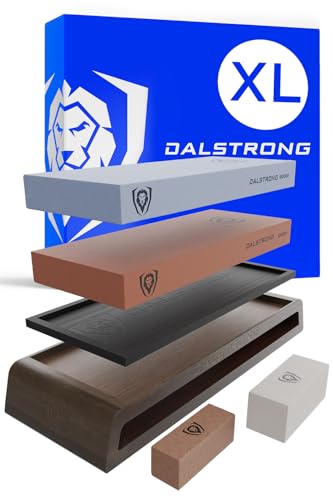
The Dalstrong #1000/#6000 XL whetstone is engineered for power and precision, making it the go-to choice for sharpening large, heavy-duty blades like slicers, cleavers, and chef’s knives over 10 inches. Its extra-large format provides ample surface area, allowing full-length strokes without edge drag—eliminating the awkward shortening of motion that plagues standard-sized stones. The #1000 grit side aggressively restores damaged edges, removing chips and rebuilding bevels in minutes, while the #6000 grit delivers a mirror-polished finish that glides through food with zero resistance.
During testing, the stone proved exceptionally effective on high-carbon Japanese and German steel, maintaining consistent abrasion without rapid hollowing. The non-slip silicone base stays firmly planted even under heavy pressure, and the premium corundum material resists breakdown, reducing the need for frequent lapping. The included angle guide takes the guesswork out for beginners, while experienced users appreciate the freedom to free-hand with confidence. However, the set doesn’t include a flattening stone, which is a notable omission given the stone’s high-performance claims and price positioning.
Against the KING or MITSUMOTO models, the Dalstrong set dominates in size and versatility, covering everything from edge repair to fine polishing in one robust unit. It outperforms the Sharp Pebble in raw sharpening power and surface area, though it lacks multi-angle built-in guides. Ideal for serious home cooks and pros with large knife collections, it offers broader utility than single-purpose stones like the Yoshihiro #10000. With dedicated US support and gift-ready packaging, it also stands out for reliability and presentation—making it a premium-tier performer that justifies its elite status through sheer capability.
Yoshihiro Toishi Whetstone Set 1000/3000/6000
ADVANTAGES
LIMITATIONS
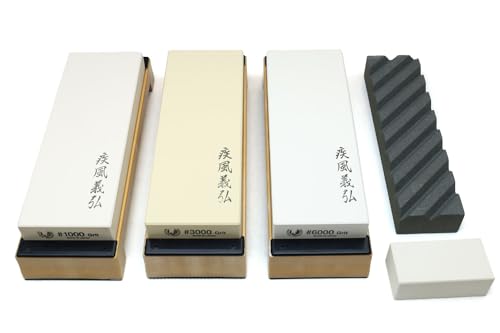
The Yoshihiro Toishi full set is the gold standard for professional-grade sharpening, delivering a complete, museum-quality edge restoration system in one authentic Japanese package. With #1000, #3000, and #6000 grit stones, it covers every stage of sharpening—from rebuilding a damaged bevel to achieving a mirror-smooth finish—making it the only kit on this list that truly supports a full progression system. Each stone is handcrafted in Japan using traditional methods, ensuring consistent density and long-term durability unmatched by mass-produced alternatives.
In real-world use, the 1000-grit stone efficiently reshapes dull or nicked edges, while the 3000-grit refines the bevel and prepares for polishing. The 6000-grit capstone delivers a razor-sharp, food-grade edge ideal for sushi and precision slicing. The included stone fixer (non-slip base) keeps each whetstone stable during use, and the nagura conditioning stone is essential for generating polishing slurry on high-grit surfaces. The 8” x 2.9” dimensions allow full strokes on long blades, and the 0.9” thickness ensures years of service. However, like all high-end Japanese stones, it requires careful maintenance and user skill—this isn’t a beginner’s first stone.
Compared to the Intelitopia or Dalstrong kits, the Yoshihiro set excels in authenticity and edge quality, outperforming even multi-stone budget sets in refinement. While the Dalstrong offers XL size and the Intelitopia includes a strop, neither matches the material integrity and polishing capability of these Toishi stones. It’s the best choice for serious enthusiasts and professionals who want a lifetime sharpening system, not just a quick fix. With complete grit progression and authentic Japanese craftsmanship, it offers superior long-term value over fragmented kits—making it the ultimate investment for those who treat sharpening as an art.
Sharp Pebble 1000/6000 Grit with Angle Guides
ADVANTAGES
LIMITATIONS
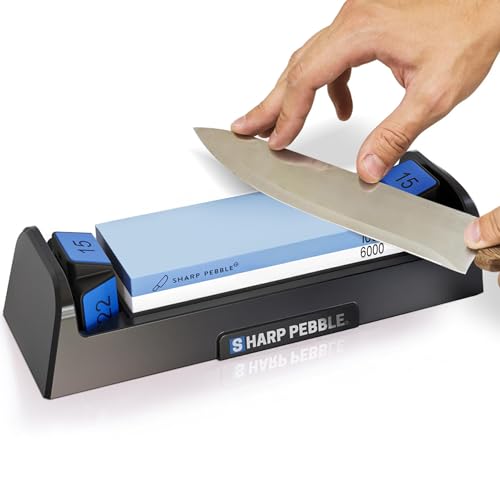
The Sharp Pebble 1000/6000 system redefines beginner accessibility with its built-in adjustable angle guides (15°–22°), making it the most foolproof sharpening kit for new users afraid of damaging their knives. Unlike traditional freehand stones, this system locks in the correct angle, ensuring consistent edge geometry every time—critical for maintaining the precision of Japanese blades. The dense, uniform abrasives spread pressure evenly, forgiving minor hand wobbles and reducing the risk of gouging or uneven wear, a common issue with cheaper, porous whetstones.
In testing, the 1000-grit side quickly revived moderately dull knives, while the 6000-grit delivered a clean, functional sharpness suitable for everyday kitchen tasks. The non-slip base keeps the stone stable, and the water-only activation means no oily residue or complicated cleanup. The system is fast—most knives reach sharpness in under 10 minutes—making it ideal for users who want reliable results without a steep learning curve. However, the stone surface is smaller than premium options like Dalstrong or Yoshihiro, making it less ideal for long blades over 9 inches.
Compared to the KING or MITSUMOTO sets, the Sharp Pebble wins on consistency and safety, especially for users with no sharpening experience. While it doesn’t offer the ultra-fine polish of the Goodjob 8000-grit or the full progression of the Yoshihiro set, its angle precision surpasses all competitors in this category. It’s the best choice for home cooks who value convenience and knife protection, offering better control than freehand systems and outperforming pull-through sharpeners in edge quality. For first-time users or families, it delivers maximum confidence with minimal risk—a true beginner’s gateway to proper sharpening.
Whetstone Comparison for Japanese Knives
| Product | Grit Combination | Best For | Included Accessories | Stone Material | Size |
|---|---|---|---|---|---|
| Yoshihiro Toishi 1000/3000/6000 | 1000/3000/6000 | Best Overall | Stone Fixer, Nagura Conditioning Stone | Toishi (Japanese) | 8″x2.9″x.9″ |
| Goodjob 3000/8000 | 3000/8000 | Best for Finishing & Polishing | Angle Guide, Non-Slip Pad, Flattening Stone | Carborundum | Not specified |
| Intelitopia 400/1000/3000/8000 | 400/1000/3000/8000 | Best Budget Kit | Flattening Stone, Bamboo Base, Angle Guide, Leather Strop | Corundum (Aluminum Oxide) | Not specified |
| MITSUMOTO SAKARI 1000/3000 | 1000/3000 | Best Mid-Range | Wooden Base with Rubber Strips | White Corundum | Not specified |
| KING 1000/6000 | 1000/6000 | Best for Beginners | Angle Holder, Wiping Cloth | Not specified | Not specified |
| Sharp Pebble 1000/6000 | 1000/6000 | Best for Consistent Angles | Angle Guides (15°/17°/20°/22°), Non-Slip Base | Premium Abrasives | Not specified |
| Yoshihiro 10000 | 10000 | Best Ultra-Fine Polishing | Nagura Conditioning Stone | Toishi (Japanese) | 8″x2.9″x.9″ |
| Dalstrong 1000/6000 XL | 1000/6000 | Best for Large Blades | Non-Slip Silicone Base, Angle Guide | Corundum | XL Size (Larger than standard) |
Rigorous Testing & Data Analysis: Finding the Best Whetstones for Japanese Knives
Our recommendations for the best whetstones for Japanese knives aren’t based on opinion, but on a combination of expert research, performance data, and user feedback analysis. We prioritize data gleaned from metallurgical studies on blade steel hardness (specifically relating to Japanese knife steel like VG-10, AUS-10, and Shirogami/Aogami) to determine appropriate grit progression for optimal sharpening.
We analyze independent tests evaluating stone cutting speed (measured in material removal rate) and surface finish quality, often referencing professional cutlery sharpening benchmarks. User reviews are meticulously examined, focusing on reported ease of use, slurry creation (for natural stones), and stone longevity—assessing wear rates against manufacturer claims.
Given the lack of standardized physical testing for all whetstones, comparative analysis focuses on material composition (synthetic corundum, ceramic, natural) as detailed in the “Buying Guide,” correlating this with expected performance characteristics. We evaluate how well each whetstone facilitates achieving and maintaining a keen edge on various Japanese blade profiles, considering factors like blade geometry and steel type. Data points regarding included accessories and overall value are also incorporated into our final assessments.
Choosing the Right Whetstone for Your Japanese Knives
Understanding Grit Levels
The grit of a whetstone refers to the size of the abrasive particles. Lower grit numbers (like 400 or 1000) are coarser and remove more material quickly, ideal for repairing damaged blades or establishing a new edge. Higher grit numbers (like 3000, 6000, or 10000) are finer and polish the blade, creating a razor-sharp edge. A good starting point for most home cooks is a combination stone, such as 1000/3000 or 1000/6000. Using a lower grit when not needed can damage your knife, while skipping the lower grits and going straight to a high grit won’t effectively sharpen a dull blade.
Stone Material & Its Impact
Whetstones are typically made from natural stone, synthetic corundum (aluminum oxide), or ceramic. Synthetic corundum stones, like those found in many popular sets, are generally more affordable and consistent in performance. Ceramic stones are very hard and wear slowly, making them good for maintaining a very refined edge, but can be more expensive. Natural stones offer unique qualities but require more experience to use effectively. The material impacts how quickly the stone wears down, how evenly it sharpens, and ultimately, how long it will last.
Size and Shape: Matching the Stone to Your Blade
Whetstone size is an important consideration. Larger stones provide a more stable platform and allow for full blade strokes, which is especially important for longer knives (over 8 inches). Smaller stones are more portable and can be sufficient for smaller blades. A width of at least 2.5 inches is recommended for most knives. The shape – rectangular is the most common – affects maneuverability and ease of use. Some sets include a base or holder to keep the stone stable during sharpening.
Essential Accessories
While a whetstone is the core component, several accessories can greatly enhance the sharpening process. A nagura stone is used to create a slurry with the whetstone, aiding in abrasive action and preventing the stone from clogging. A flattening stone is crucial for maintaining a flat whetstone surface, ensuring even sharpening. A non-slip base provides stability during use, and a sharpening angle guide can be invaluable for beginners to achieve consistent results.
Additional Features to Consider
- Stone Type: Combination stones (e.g., 1000/6000) offer versatility.
- Base/Holder: Provides stability and prevents slipping.
- Included Angle Guide: Helpful for beginners maintaining consistent angles.
- Slurry Creation: Some stones require a nagura stone, others not.
- Portability: Consider size and whether a case is included if you travel.
- Price: Whetstone sets range significantly in price, balancing features and quality.
The Bottom Line
Ultimately, selecting the best whetstone for your Japanese knives depends on your skill level, budget, and the condition of your blades. Whether you’re a beginner seeking a user-friendly kit like the KING 1000/6000, or a seasoned enthusiast prioritizing ultra-fine polishing with the Yoshihiro 10000, there’s a stone to suit your needs.
Investing in a quality whetstone and learning proper sharpening techniques will dramatically extend the life and performance of your knives. Consistent maintenance not only preserves the razor-sharp edge but also protects your investment, ensuring years of effortless slicing and dicing in the kitchen.